Thursday, March 17, 2011
A Parable of the Kingdom
Once there was a king who had three sons. He was determining who should rule after him, so he gave them each a portion of his vast kingdom, and told them to rule well. As good sons, they came to him and said, "Father, you are the great king, all wise and just. Please tell us how to rule as you have done."
The Emperor looked at each of them from his throne and said, "Write down what I say and you will know all that is necessary to rule: Sovereignty. Justice. Mercy. Sacrifice. Love. Peace. Understand these words and you will rule well." The three sons were a bit mystified, but all were confident that, given time, they would be able to understand the meaning of the Great King, and rule well.
After a year, the King called his sons back and asked them how they ruled.
The first son said this: "After some time of considering your words and spending time with your subjects, I realized that they were faithless and stupid. Then I understood your words. I am the sovereign and I must rule strongly. I must deliver justice to the people, punishing them for their sins. However, I must remind them that you, O King, are merciful and do not want them all to die. However, they must learn to sacrifice their wills to Yours, and thus learn to Love each other by loving the Law of the land. Only then there will be Peace."
The King replied, "And I understand that you punished all, for all were unworthy in your sight. This is not my rule of mercy. You are dismissed."
The second son said, "I, too, considered your words, my King, and applied them to my rule. I realized that I am not the sovereign, but You are, O King. I am only here to dispense your justice and mercy to the people. Thus, I sought to apply your law precisely, punishing the wicked and rewarding the obedient. I taught them to sacrifice their possessions to me, so that I might re-distribute them in love. And then we achieved the peace of having all needs met."
The King replied to the second son, "Because you took all land and all possessions from my people, you made them all poor, grudgingly giving back to them. This is not my rule of justice. You are dismissed."
Finally came the primary servant of the third son, and he said, "I regret to tell you, my Lord, that your son is dead. This is what occurred: He also, considered your words and he realized that he himself was given sovereignty over your people, which was a noble task, of which few are worthy. He saw the poor of your land being oppressed and the wealthy squandering their power on their own indulgence and distractions. But rather than punish them, your son remembered your word, "sacrifice" and realized that he must sacrifice himself for all the people. So he took all the power and wealth you gave him, traveled around the country and taught all the people how to share possessions, how to see with compassion and how to love each other with one's own heart. In this way, he created peace among all who listened to him.
"I wish that were the end of the story. His brother, the first son, came to his land and stirred up the wealthy, claiming that the third son was not obeying your will. They lied about him and persecuted him gladly, for he was telling them the only way to follow your will was to sacrifice their possessions and power. Because he threatened all power, the other king spurred the powerful to kill your third, innocent son."
The King bowed his head and tears came to his eyes. "Yes, I have heard all of these tidings. My son," and he turned to the first son, "You are cast from my presence. I never want to see you again. You were never interested in my will, only in punishment." Then the King turned to the servant, "Little one, because you have loved my son, my son who followed my heart of compassion, then I proclaim you to be King over all of my lands."
The servant declared, "But my Lord, I am not worthy!"
The King chuckled, "Of course you are not. But anyone who has my heart at least deserves the chance to become worthy. Worth isn't in correct interpretation, nor in delivering justice. Worth is found in seeing others' needs and doing all you can to meet them."
This parable is not about Christianity, per se. Nor is it about the atonement and how it works. Rather, it is about how one interprets the Bible. The Bible is confusing and difficult. There are a number of things that don't make sense. The one who understands the Bible correctly is the one who has the heart of the Father, following the example of His Son.
Wednesday, March 16, 2011
Are You An American?
With the homeland security rules, you have to have a lot of IDs to get your ID. You need a social security card, a birth certificate, a proof of citizenship (if necessary), a marriage certificate (if you changed your name). Oh, and don't bother bringing in your old ID because that doesn't count. Oh, and 40 dollars.
We know a lot of people who don't have any kind of ID because it got lost, burned, stolen, whatever. So the road to obtaining this ID is long and hard.
We've decided to make it easier on everyone. Look, homeland security is doing their best, we know, but they just want to prove that if a person was born in America, then they are a citizen. We think they just need to show a little more imagination.
So we created this simple test to prove if one is a real American or not. If you answer the questions right, then we give you your ID.
1. Can you speak English?
Correct answer: No. Americans don't speak English. They speak American.
2. Are all foreigners idiots?
Correct answer: Yes. Anyone who does not live in the United States lives in an idiotic way. Therefore, they are idiots.
3. Would you feel comfortable living in Canada?
Correct answer: Of course not. Canada is foreign. Therefore they are idiots. Also, they have socialized medicine.
4. Do you know where Belize is?
Correct answer: What is a Belize? No one knows where Belize is. Even those who live there probably wouldn't be able to point it out on the map.
5. Are you fluent in any language apart from English?
Correct answer: Of course not. We've already established that Americans can't even speak English.
6. Do you feel cheated if your meal doesn't fill the plate?
Correct answer: There are meals without a super size option?
7. Do you have a car?
Correct answer: How can anyone live without a car?
8. What is your favorite childhood memory?
Correct answer: I remember when gas was less than two dollars a gallon...
9. What is your opinion about France?
Correct answer: (unmentionable)
Final: Please fill in this map (correct answers provided)
We know a lot of people who don't have any kind of ID because it got lost, burned, stolen, whatever. So the road to obtaining this ID is long and hard.
We've decided to make it easier on everyone. Look, homeland security is doing their best, we know, but they just want to prove that if a person was born in America, then they are a citizen. We think they just need to show a little more imagination.
So we created this simple test to prove if one is a real American or not. If you answer the questions right, then we give you your ID.
1. Can you speak English?
Correct answer: No. Americans don't speak English. They speak American.
2. Are all foreigners idiots?
Correct answer: Yes. Anyone who does not live in the United States lives in an idiotic way. Therefore, they are idiots.
3. Would you feel comfortable living in Canada?
Correct answer: Of course not. Canada is foreign. Therefore they are idiots. Also, they have socialized medicine.
4. Do you know where Belize is?
Correct answer: What is a Belize? No one knows where Belize is. Even those who live there probably wouldn't be able to point it out on the map.
5. Are you fluent in any language apart from English?
Correct answer: Of course not. We've already established that Americans can't even speak English.
6. Do you feel cheated if your meal doesn't fill the plate?
Correct answer: There are meals without a super size option?
7. Do you have a car?
Correct answer: How can anyone live without a car?
8. What is your favorite childhood memory?
Correct answer: I remember when gas was less than two dollars a gallon...
9. What is your opinion about France?
Correct answer: (unmentionable)
Final: Please fill in this map (correct answers provided)
Tuesday, March 15, 2011
I'd Like To See A Picture of This...
From Crosswalk Daily News Summary-
Egypt's Military Begins Rebuilding Burned Church
Egypt's government acknowledged the complaints of Coptic Christians last week as the military began reconstruction of a burned church south of Cairo. Hundreds of Christians protested the torching, leading to clashes between Muslims and Copts that killed 13 Christians. "The engineering department of the Egyptian Armed Forces has started to rebuild the church in Atfeeh today at the same exact location," Army spokesman Maj. Mohamed Askar said, according to CNN. "The Armed Forces will bear all expenses."
Egypt's Military Begins Rebuilding Burned Church
Egypt's government acknowledged the complaints of Coptic Christians last week as the military began reconstruction of a burned church south of Cairo. Hundreds of Christians protested the torching, leading to clashes between Muslims and Copts that killed 13 Christians. "The engineering department of the Egyptian Armed Forces has started to rebuild the church in Atfeeh today at the same exact location," Army spokesman Maj. Mohamed Askar said, according to CNN. "The Armed Forces will bear all expenses."
Friday, March 04, 2011
Culture of Murder
A report from Consistent Life:
An Unusual Connection between Abortion and the Death Penalty
The case of the 70-year-old abortion doctor Kermit Gosnell (covered last week) has a new twist: prosecutors are consideringthe death penalty because charges involve multiple murders – and because seven of the eight murders are for children under age 12 (that is, he induced birth first and killed the born baby). Concerning the two decades when repeated reports of shocking clinic conditions went ignored, Pennsylvania Gov. Tom Corbett said, "This doesn't even rise to the level of government run amok. It was government not running at all.” The death penalty is a very poor substitute for government having done its job, even what was allowed after Roe v. Wade, by intervening much earlier. Many women could have been spared an excruciating fate. Gosnell himself may have avoided the spiral down that violence normally entails, had there not been social approval and apathy.
[Thanks to Edward Chow and Rob Arner for sending in information on this case.]
So we give someone permission to murder, find out he was doing it wrong, and to punish him, we answer it with murder? Is there something wrong with this?
Wednesday, March 02, 2011
In Reflection on the Lord's Prayer and the Beatitudes
"Daily bread"
Jesus spoke to simple people.
Jesus understood the theological niceties and the tendency of spiritualization of the educated. Perhaps that's why he didn't speak to the educated, except in debate. If we like a word, or like a teacher, we try to fit what was said into a context we can accept, an idea we can receive.
People with refrigerators and cupboards full of food want to try to apply "Give us this day our daily bread." Frankly, we don't need daily bread. We've already got bread for today, tomorrow and the next. And we aren't satisfied with bread. So we have cheese and milk and beef and turkey and donuts and hot dogs and Slim Fast bars and Nutella. So when we read about daily bread, we think it means the Word of God, or Jesus who is the Word of God, or some other kind of symbolic, spiritual bread that we actually need because 'daily bread' is an unnecessary prayer for us.
But the people Jesus spoke to-- and the majority of the world today-- would understand that when Jesus spoke of bread, he meant... well, bread. Or maybe rice. Perhaps corn. But certainly not Peanut M&Ms. Certainly not a refrigerator full of food. Certainly not Jesus. And not the word of God, either. Because the majority of the people (who ever lived) don't know if they will have enough basic food to eat that day. Some dig through trash, some rely on farms, but most go hungry. So when Jesus spoke to simple people, he spoke about bread because that's something they understood. They asked, "Heaven is great, but what will I give my children to eat today?" And Jesus answered, "Ask and you will receive. Ask your Father for what is good and He will not give you a stone."
When Jesus said, "Blessed are you who are poor," he didn't mean the people who were humble. That doesn't mean Jesus downplayed humility-- oh, no, that is essential. But Jesus also glorified the poor. Not poverty. Poverty is horrible. But the poor can be glorious and faithful and just desperate enough to seek God for what no one else would grant them. So "the poor" are... poor people.
Yes, in Matthew it says, "the poor in spirit." And it is associated with "the meek", "the mourning", those desperate for justice and those who are persecuted. These are people who, whether lacking in funds or not, are oppressed and suffering at the hands of those more powerful than they. The poor. Not those who humble themselves, but are humiliated at the hands of another.
The simple person learns that the Bible is more complicated than what the simple words seem to say, and so theologians and preachers and the educated and the wise unlearn what seems so simple to understand. So straightforward.
And so we lose the point because we are too educated, to sophisticated to understand it. Are eyes are so wide open that we see nothing. And we lose the truth that is staring us right in the face.
Jesus spoke to simple people.
Jesus understood the theological niceties and the tendency of spiritualization of the educated. Perhaps that's why he didn't speak to the educated, except in debate. If we like a word, or like a teacher, we try to fit what was said into a context we can accept, an idea we can receive.
People with refrigerators and cupboards full of food want to try to apply "Give us this day our daily bread." Frankly, we don't need daily bread. We've already got bread for today, tomorrow and the next. And we aren't satisfied with bread. So we have cheese and milk and beef and turkey and donuts and hot dogs and Slim Fast bars and Nutella. So when we read about daily bread, we think it means the Word of God, or Jesus who is the Word of God, or some other kind of symbolic, spiritual bread that we actually need because 'daily bread' is an unnecessary prayer for us.
But the people Jesus spoke to-- and the majority of the world today-- would understand that when Jesus spoke of bread, he meant... well, bread. Or maybe rice. Perhaps corn. But certainly not Peanut M&Ms. Certainly not a refrigerator full of food. Certainly not Jesus. And not the word of God, either. Because the majority of the people (who ever lived) don't know if they will have enough basic food to eat that day. Some dig through trash, some rely on farms, but most go hungry. So when Jesus spoke to simple people, he spoke about bread because that's something they understood. They asked, "Heaven is great, but what will I give my children to eat today?" And Jesus answered, "Ask and you will receive. Ask your Father for what is good and He will not give you a stone."
When Jesus said, "Blessed are you who are poor," he didn't mean the people who were humble. That doesn't mean Jesus downplayed humility-- oh, no, that is essential. But Jesus also glorified the poor. Not poverty. Poverty is horrible. But the poor can be glorious and faithful and just desperate enough to seek God for what no one else would grant them. So "the poor" are... poor people.
Yes, in Matthew it says, "the poor in spirit." And it is associated with "the meek", "the mourning", those desperate for justice and those who are persecuted. These are people who, whether lacking in funds or not, are oppressed and suffering at the hands of those more powerful than they. The poor. Not those who humble themselves, but are humiliated at the hands of another.
The simple person learns that the Bible is more complicated than what the simple words seem to say, and so theologians and preachers and the educated and the wise unlearn what seems so simple to understand. So straightforward.
And so we lose the point because we are too educated, to sophisticated to understand it. Are eyes are so wide open that we see nothing. And we lose the truth that is staring us right in the face.
Every Christian Healed?
Josh posted this on Alethia. Read more here.
Isaiah 53:5
But he was pierced for our transgressions,
he was crushed for our iniquities;
the punishment that brought us peace was on him,
and by his wounds we are healed.
I have encountered those who believe, on the basis of this verse and some others, that "physical healing was provided for in the atonement" and therefore it is now never God's will that any of his children be sick.
Thoughts?
My response:
If we are to use that passage as some use it-- as a promise that we would never be sick, or if sick immediately healed-- then we could also claim "peace" that way, as it is the parallel to the "healing" line. Thus, we should claim "shalom"-- justice and inner peace and all needs met and release from prison for all who are under Jesus' blood.
Can you see people using the verse for shalom as some use it for healing?
"It only looks like you are in prison, but the fact is, you are free! Act on that freedom, there are no guards, no walls, if you would only have faith!"
"It may seem that you are hungry and homeless, but in reality, by faith, you live in a mansion and have a feast in front of you, whatever food you want! Just claim it by faith and eat it!"
The fact is, Jesus died for our sins so that we could ask God for healing and justice and all of our needs met. But we still live in a world filled with sickness and disease and disaster and hunger and pain. We still live through sickness and suffering, without fear, knowing that Jesus is changing the world, person by person until He is ready to return and meet all of our needs.
In the meantime, He chooses to heal some of us, and feed some of us miraculously, and to house some of us and to provide inner peace to some of us. And some of us have to struggle, so that His character might show through our suffering.
Tuesday, March 01, 2011
There Are No Atheists in Pity Parties
From Crosswalk Religion News of the Day:
Anger at God Common, Even among Atheists
New research shows that self-described atheists and agnostics are more likely to be angry at God - or the hypothetical deity they reject - than believers. CNN reports that new studies from Julie Exline, Case Western Reserve University psychologist, and her colleagues. Religious people are also more likely to see a plan or good intentions behind unfortunate events, rather than a mean-spirited attack. "When people trust that God cares about them and has positive intentions toward them, even if they can't understand what those intentions or meanings are, it tends to help to resolve anger," she said. Exline and her colleagues hope to further study people's reactions to God, suffering and anger.
Mark Twain denied the existence of God, due to the death of his beloved daughter. Then he penned scathing words against God. Not against the church, mind you-- he'd been writing against the hypocrisy of the church for decades before. But against God.
Much of the anger against God is simply the opposite of the attitude of gratefulness that other people have. It is human nature to either blame or thank someone above us for circumstances that are beyond our control. But what do we do if we think there is no one actually determining these actions? Because we have to do something with our feelings, we blame or thank God, whether we intellectually believe in Him or not.
For most people, a belief in God is emotional, even if one is an atheist.
This is not a proof for God, but it is interesting to speculate. It is also interesting because thanking God for some good circumstances is right because He established the earth to be good and because He continues to allow growth and goodness to spread. However, since God established humanity to rule the world, some good (such as the harnessing of electricity) can be given to humanity, but almost all of the evil can be put at humanity's doorstep. Either humanity causes evil or humanity allows for evil to continue to exist when they could do something about it. Most of the time, humanity is apathetic toward evil, when they have been given rule by God to accomplish justice, mercy and goodness.
So if you really want to blame someone for the evil, look in the mirror.
Wednesday, February 23, 2011
What Does "Anawim" Mean? The Long Answer
I have often said that the Hebrew word "anawim" means "the poor who seek the Lord for deliverance". As a good example of this, one can look at Psalm 37, where verse 11 states, "the anawim shall inherit the land", from which Jesus received his statement, "the meek shall inherit the earth.". The longer answer is below, from Raymond Brown's tome, The Birth of the Messiah:
"The word Anawim represents a plural from the Hebrew anaw which, along with its cognate ani is a word for 'poor, humble, afflicted.'
"Although this title ["Anawim"] meaning the 'Poor Ones' may have originally designated the physically poor (and frequently still included them), it came to refer more widely to those who could not trust in their own strength but had to rely in utter confidence upon God: the lowly, the poor, the sick, the downtrodden, the widows and the orphans. The opposite of the Anawim were not simply the rich, but the proud and self-sufficient who showed no need of God or His help.
"There is considerable scholarly debate about the pre-exilic origins of the Anawim, and about the extent to which they constituted a class or community and not merely an attitude of mind. But a good case can be made for the contention that in post-exilic times the Anawim regarded themselves as the ultimate narrowing down of the remnant of Israel. The concept that God was not going to save His whole people but only a remnant was redefined many times. When the Northern Kingdom (Israel) was destroyed in 722, the Southern Kingdom (Judah) regarded itself as that remnant. When part of the Southern Kingdom was taken into captivity to Babylon (598 and 587), with part of the people left behind in Palestine, both exiles and Palestinians tended to regard themselves as the remnant.
"Eventually, under the catalyst of defeat and persecution, the remnant was redefined, not in historical or tribal terms, but in terms of piety and way of life. The parallelism in Psalm 149:4 equates the people of God with the Anawim: "The Lord takes pleasure in His people; He adorns the Poor Ones with victory." (see also Isaiah 49:13; 66:2). Very often, woven together with this piety of dependence on God was a "Temple piety". The mixture is explained by the fact that the appeal for God's deliverance of His Anawim was made in the psalms, and thus in a cultic setting. The "Poor Ones" showed their trust in God by being faithful to the times of prayer and sacrifice...
"The existence of a Jewish Christian Anawim is not purely hypothetical. In Acts 2:43-47; 4:32-37 Luke describes with nostalgia... the Jewish Christian community at Jerusalem. These people sold their possessions and gave their wealth for distribution to the needy; thus they certainly qualify to be deemed "Poor Ones". Their poverty was leavened by piety, including "Temple piety" for they devoted themselves to prayer and attendance at the Temple...
"In his discussion of the Epistle of James, Dibelius has shown the presence of a dominant Anawim mentality in a strongly Jewish writing composed in Greek quite late in the century. He argues that the traditional attitude of the Poor Ones, seen in Jerusalem Christianity early in the century, continued in the non-Pauline churches of Diaspora Judaism later in the century."
-Raymond Brown, The Birth of the Messiah, pp. 350-351, 354-355.
Wednesday, February 16, 2011
Why Do The Nations So Furiously Rage?
Leeanne T asked me what I do when people are so hard-hearted as to not allow us to love as God has called us to love. What to do when they put up blocks to meet people's needs. My response:
It is really stressful to care for people. I think thats why so few people do it, really. The cost of caring is just too high for most people.
This is what I do when our effort has failed and people still suffer:
Cry out to God for His mercy.
Trust that God is still working, even behind the scenes.
Surrendering our own effort, recognizing that we aren't the one who saves but God is.
Love with what we have, but when we realize we have run out, to hand our loved ones over to God.
Cry, sometimes, even though you know it doesn't help in the long run.
Break the law, if the law tells you not to love.
Rant on the internet. Yeah, I do that a lot.
It is really stressful to care for people. I think thats why so few people do it, really. The cost of caring is just too high for most people.
This is what I do when our effort has failed and people still suffer:
Cry out to God for His mercy.
Trust that God is still working, even behind the scenes.
Surrendering our own effort, recognizing that we aren't the one who saves but God is.
Love with what we have, but when we realize we have run out, to hand our loved ones over to God.
Cry, sometimes, even though you know it doesn't help in the long run.
Break the law, if the law tells you not to love.
Rant on the internet. Yeah, I do that a lot.
Surrender
"Lord, you know what is best for me.
Give me what you will
and when you will
and as much as you will.
Do with me as you think best
and as it pleases you
and brings you the most honor.
Place me where you will
and use me according to your wisdom.
I am in your hand
as your servant
ready to do all that you command.
I want to live,
not for myself
but for you."
-from The Imitation of Christ by Thomas a Kempis
Tuesday, February 08, 2011
The Illusionist 2010
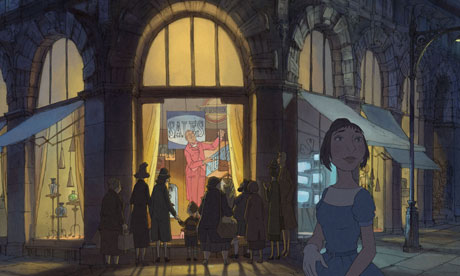
Mercy and I went out to see this tonight. You all probably know this, but it is based on an unfilmed script by Tati, the director of Mon Oncle and Play Time. I haven't seen any films by Tati, but I can see the influence of early film here. First of all, for all intents and purposes, it is a silent. And although it is about an older man caring for a younger as if she were his daughter, so without a romantic element, the main relationship has the flavor of Chaplain's Modern Times or City Lights.
I could see this being a classic silent film, and frankly, I think that animation is the perfect medium for this style of cinema. It is very reminiscent of the first half hour of Wall-E, and we can see Pixar using this same style of cinema, to even greater effect. But The Illusionist, instead of pressing for the quick plot or the quick laugh, is slower and yet still very entertaining, and thus it is utterly charming. This is a quiet film, and at first you wonder what it is about, then you wonder if it has a point, but it seduced me by the end. And it won me over with the ending. How wonderful and sad and touching. Passages of life and all that.
Nothing deep here, just a fine story well told. 4/5
Sunday, January 30, 2011
Our Prayer in Church Today
Let us see what is beautiful in You
Let us dwell on Your mercy
Let us be overwhelmed by Your compassion
Let us bask in Your purity
Let us be vanquished by Your grace
Then let us, without reservation,
Allow those qualities so enflame our hearts
That we cannot help but express them ourselves
Yeah, I wrote this one. Worship was on the theme of God's beauty.
A Book I Wrote For Ian While Homeschooling Him, Years Ago
A Deeply Philosophical Self-Referential Book, Although It Is Not Very Long And It Is Questionable, In Fact, That Perhaps The Title Might Be Longer Than The Book Itself, Which Is As Well A Self-Referential Title, And Probably Contains Too Many Commas.
Chapter 1
This is the beginning of the book.
Chapter 2
This is the middle of the book.
Chapter 3
This is the end of the book.
The End.
P.S. Please send your lauds and applause to the author.
P.P.S. I apologize for my poor writing. My computer broke last week.
P.P.P.S. I wonder if I should mention in the title that the post scripts also exceed the length of the book itself. Send me your thoughts.
(Lies! All lies! They’re trying to keep me from telling the tru—)
Chapter 1
This is the beginning of the book.
Chapter 2
This is the middle of the book.
Chapter 3
This is the end of the book.
The End.
P.S. Please send your lauds and applause to the author.
P.P.S. I apologize for my poor writing. My computer broke last week.
P.P.P.S. I wonder if I should mention in the title that the post scripts also exceed the length of the book itself. Send me your thoughts.
(Lies! All lies! They’re trying to keep me from telling the tru—)
Monday, January 24, 2011
Sunday, January 23, 2011
The Secret Teaching About God
"Yahweh, Yahweh God, compassionate and gracious, slow to anger, and abounding in lovingkindness and truth; who keeps lovingkindness for thousands, who forgives iniquity, transgression and sin; yet He will by no means leave the guilty unpunished."
(Exodus 34:6-7 NAS)
(Exodus 34:6-7 NAS)
Wednesday, January 19, 2011
What happens when we take up the cross?
"If we take up the cross, will we but suffer pain?
Nay, if we bear the cross, be sure that we will die!
The meaning of the cross is that we may be slain;
The cross experienced the self will crucify."
-Witness Lee
Nay, if we bear the cross, be sure that we will die!
The meaning of the cross is that we may be slain;
The cross experienced the self will crucify."
-Witness Lee
Tuesday, January 18, 2011
Discipline of Community
Someone asked in a private message, "I have heard that to be a part of intentional community it requires reading and prayer to prepare for it. What do you think?"
There are different kinds of intentional communities, and they have different kinds of focuses. Merton would focus on prayer, because that's what his community was about. But different communities, like different people, have different gifts. You can get a community of service-minded folks or a community of evangelists or a community of Bible students... all of these are positive (see the book Streams of Living Water by Richard Foster for a description of the church as various kinds of gifted communities).
It seems to me that the one principle that everyone living in community needs to have is commitment to love the other people in the community. If you don't have that, you won't soon have a community. This doesn't mean that they need to know how to love before they get involved-- if they are in tune to the Spirit and to the other members of the community they will learn how to do that. But if a person is only half committed to the community, they will find that they are not actually in the community and never have been. If a person never spends time with the people in the community then that person will never be truly a part of the community. If a person spends time, but only to change the community, not to change themselves, they will be angry because the community never "listened" to them.
Every member of a community must be ready to listen to the community as a whole. They must be ready to change for the sake of the other. They must be ready to be flexible to allow themselves to be bent for the community. They must be ready to serve the community. They must pray for the members of the community. In this way, the community will grow in love and in Spirit and be a powerful voice in the world.
But choosing the right community is essential too. If we choose a community that is too focused on each other or on prayer, then it is a navel-gazing community, and it never grows in love as an entity. Also, if a community is only focused on the outward, on service or work, then it loses its spiritual core. The best community is a community of balance between God and their neighbor. In this way, we can be a community that both loves God, loves each other and loves one's neighbor, neglecting not a single one of God's commandments.
Monday, January 17, 2011
No Convincing Evidence
I'm answering the question, "Is there any evidence that can prove Christianity?" on the Alethia forum:
I don't think that we can "prove" our worldview to others, even as they cannot to us. Most apologetics are only assuring to those who already believe, comforting them that what they believe isn't foolish, but based on reasonable evidence.
However, I don't think "reason", of whatever flavor, convinces anyone of anything that goes against their firmly-held beliefs.
This doesn't mean that a person can't be converted. However, the "evidence" that convinces them would be personal, not intellectual. There are only two things that convinces a person of the truth of Jesus:
a. A life that is sincerely and lovingly lived in Jesus, in close relation with those who do not believe. Over time, they may see that belief in Jesus is the most reasonable way to live, not because of proofs, but because of a sincere and compassionate heart that makes other people's lives better.
b. A personal experience with the Lord. Jesus and the Father are persons, not intellectual property. If I wanted to convince you of the existence of my friend Bill, I wouldn't argue about it, I'd just have you shake his hand. Often the best evidence is the Lord just "shaking the hand" of the unbeliever. Thus, my most common prayer for those who don't believe in the Lord is that the Lord would reveal Himself to them.
I think there is a good place for apologetics, but I don't find it as useful as I did in my early Christian years.
I don't think that we can "prove" our worldview to others, even as they cannot to us. Most apologetics are only assuring to those who already believe, comforting them that what they believe isn't foolish, but based on reasonable evidence.
However, I don't think "reason", of whatever flavor, convinces anyone of anything that goes against their firmly-held beliefs.
This doesn't mean that a person can't be converted. However, the "evidence" that convinces them would be personal, not intellectual. There are only two things that convinces a person of the truth of Jesus:
a. A life that is sincerely and lovingly lived in Jesus, in close relation with those who do not believe. Over time, they may see that belief in Jesus is the most reasonable way to live, not because of proofs, but because of a sincere and compassionate heart that makes other people's lives better.
b. A personal experience with the Lord. Jesus and the Father are persons, not intellectual property. If I wanted to convince you of the existence of my friend Bill, I wouldn't argue about it, I'd just have you shake his hand. Often the best evidence is the Lord just "shaking the hand" of the unbeliever. Thus, my most common prayer for those who don't believe in the Lord is that the Lord would reveal Himself to them.
I think there is a good place for apologetics, but I don't find it as useful as I did in my early Christian years.
Monday, January 10, 2011
Reflections
Given to me by an Anawim member:
Watch the reflections
Beside the lake
Open your mind and an
Exploration your life will take:
Explore... look back
How often did you fall to the floor?
You kept your faith, taking
An inner strength, but said
You couldn't take anymore
Letting yourself go, the tears escaped
Your silent eyes, my dear, it
Was then, that he knelt by your side
His arms invisible, but they held you
Together, holding you tightly, as
The emotions stormed wild
Life beats us down as we grow
Old and retire, but God still loves
His scarred little child... forever.
Watch the reflections
Beside the lake
Open your mind and an
Exploration your life will take:
Explore... look back
How often did you fall to the floor?
You kept your faith, taking
An inner strength, but said
You couldn't take anymore
Letting yourself go, the tears escaped
Your silent eyes, my dear, it
Was then, that he knelt by your side
His arms invisible, but they held you
Together, holding you tightly, as
The emotions stormed wild
Life beats us down as we grow
Old and retire, but God still loves
His scarred little child... forever.
Wednesday, January 05, 2011
The Friend
Jesus is your friend. He is not your enemy, for He wishes only for you to live and thrive and that for eternity.
Jesus' time is different than ours. Often we want Him to solve our problems immediately, or to make them never happen, but Jesus knows, even though we do not, that the road to joy often comes through suffering and anguish. He doesn't want us to wallow in this suffering, but to pass through it to joy. Joy is the goal, suffering is the means.
Jesus, like most of the spirit world, doesn't move in our time. Every moment in anguish is like an eternity to us and Jesus moves on a seeming geologic scale. But Jesus has a timetable. The end of suffering will come. We just need to wait for it.
Jesus often lets us know when He is working in us, for He wants the Father to get all the glory. However, when He acts, it is when we least expect it, when we think everything is at its end. Then, suddenly, Jesus is there, giving us what we need, although often at the last possible moment.
Jesus' plan isn't as laid out or organized as we might think. He has to work with us, and we often change our minds every few minutes. So Jesus works with us in order to cause our souls to live and thrive so that we might be our own and we might help others to be thriving on their own as well.
Jesus offers a lot and his promises are huge: eternal life, a just kingdom, a community of love, all our needs met, a relationship with the Father, our sin wiped away, healing and hope and joy and peace in our hearts. We look at these promises and sometimes we think that Jesus won't... can't keep them all. What we need to realize is that Jesus is no liar, nor is He a monster-- rather he sees our life now and our live after our death as a continuum. To live for eternal life is true faith, and it is this faith He strives to encourage in us.
Jesus isn't a flatterer. Rather, he shows us who we really are. Sometimes we cringe at the pain we ignorantly caused others. Sometimes he attempts to convince us that we aren't as wicked as we thought we were-- that there is actually some good in us. One by one, He takes the blocks away that separate us from the life we should live, the life of love for others. The reason it seems to hopeless is because there are so many blocks. But He faithfully takes them away, slowly and steadily.
Even though we might proclaim Jesus as Lord, we often struggle like a puppy twisting as her master gently attempts to get her out of the twine she is entangled in. We often don't know He is working to free us. And we don't know how complicated it is. In struggling to get out of his grip, we often make the mess worse. But he just sighs and keeps working, for we are in His grip.
His work isn't external, but in our hearts, working with His Spirit to free our hearts from within our hearts. This is why we often don't know He's working.
This is true for me, and true for everyone who submits to Jesus as Lord. Not necessarily every Christian, but everyone who bows to Jesus in their heart-- whether they bow in church or not.
I pray that you would fully realize and rest in Jesus' blessing. For the one whom the Son sets free is free indeed.
The Enemy
By Clay, a member of Anawim
Satan is your enemy. He's not your friend as he wished only pain and sorrow to bring about your end.
He has no timetable for the way he works as he leads you down the road you follow to his domain of misery in which he wants you to wallow.
He moves as fast as the erosion of a rock or the ripening of an apple for Satan needs no clock.
He never announces his arrival with any fanfare, but comes upon you when you think no one cares while you sit in hopeless despair.
He stealthily slithers in on silent feet to construct his web of wicked horrors and deceit for it in your soul he seeks as his coveted prize with your defeat.
He speaks to you of his wonderful rewards-- oh so sweet and grand-- as he takes your young and trusting hand to lead you to his supposedly promised land; there he injects his hatred into your heart to keep you in his endless dark.
With his silver tongue he showers you with his golden words of praise, while on his cold merciless bed he made you lay as he performed his sick and evil feats. Your spirit he slays.
And now finally in his ruthless icy heartless hard grasp, at last he steals your innocent part.
The more you struggle to become free, the more he laughs at you in his hysterical glee for what he has done to thee.
This is where he loves to reign: in your heart, filling you with his misery and pain.
I know this to be true as God has shown me, in my heart, what has happened to you.
And now by God's command I take my stand beside you, where I will stay and pray until the day Satan sets you free by God's command -Uncle.
Satan is your enemy. He's not your friend as he wished only pain and sorrow to bring about your end.
He has no timetable for the way he works as he leads you down the road you follow to his domain of misery in which he wants you to wallow.
He moves as fast as the erosion of a rock or the ripening of an apple for Satan needs no clock.
He never announces his arrival with any fanfare, but comes upon you when you think no one cares while you sit in hopeless despair.
He stealthily slithers in on silent feet to construct his web of wicked horrors and deceit for it in your soul he seeks as his coveted prize with your defeat.
He speaks to you of his wonderful rewards-- oh so sweet and grand-- as he takes your young and trusting hand to lead you to his supposedly promised land; there he injects his hatred into your heart to keep you in his endless dark.
With his silver tongue he showers you with his golden words of praise, while on his cold merciless bed he made you lay as he performed his sick and evil feats. Your spirit he slays.
And now finally in his ruthless icy heartless hard grasp, at last he steals your innocent part.
The more you struggle to become free, the more he laughs at you in his hysterical glee for what he has done to thee.
This is where he loves to reign: in your heart, filling you with his misery and pain.
I know this to be true as God has shown me, in my heart, what has happened to you.
And now by God's command I take my stand beside you, where I will stay and pray until the day Satan sets you free by God's command -Uncle.
Tuesday, January 04, 2011
Saving v. Risky Spending
Something I fell upon: a fable by Reb Zalman Schantar-Shalomi in the book, The Jew In The Lotus.
A man who believed in reincarnation went to a Swiss bank with a ton of cash. He told the bank to hold the money until another person with a certain password came, then the account could be managed by that individual.
Thirty years later a different man came to the bank and gave them the password, demanding that they give him all the money. When the bank owners questioned his judgment, he said, "I told you to save it then. But now it is time to use it.?"
Religious tradition is formed so that our communities might have continuity. The best people to invest that tradition are conservatives. But the best people to spend that investment are those who will take a risk.
It is time to spend our investment on risky love.
Wednesday, December 29, 2010
GUESs What?
The Gresham Underground Emergency Shelter has been pretty busy, and the winter's already started! Since Thanksgiving, we've opened up 10 nights-- that means 10 nights below freezing when the city shelters didn't open. We could really use some help-- is there anyone who would be willing to help volunteer other nights this winter? We've been using our volunteers up and it would be great if we could share the load. Lives have been saved! Help us do this more.
On to other Anawim news:
-This January East County Anawim is going to participate in Multnomah County's street count. This is the first year that the street count will actively pursue counting those in East County. If you would like to help fill out surveys in the week of January 26th, let us know!
-This year has been Anawim's best year in providing for the needs of our folks. Everyone who needed a sleeping bag, tarp, tent, gloves and socks-- their needs have been met! It's all because of churches like Mountian View, Abundant Life Church, East County Church of Christ, and many more! Thanks to everyone who gave donations this year!
On to other Anawim news:
-This January East County Anawim is going to participate in Multnomah County's street count. This is the first year that the street count will actively pursue counting those in East County. If you would like to help fill out surveys in the week of January 26th, let us know!
-This year has been Anawim's best year in providing for the needs of our folks. Everyone who needed a sleeping bag, tarp, tent, gloves and socks-- their needs have been met! It's all because of churches like Mountian View, Abundant Life Church, East County Church of Christ, and many more! Thanks to everyone who gave donations this year!
Wednesday, December 15, 2010
Six Trends in the Modern Church
The Barna Group has established six "megathemes" of the church in 2010. You can read their full article here:
Six Megathemes
I'll list out the themes and give my own commentary on them.
1. The Christian Church is becoming less theologically literate
I have certainly noticed that the church at large is generally Biblically illiterate, even those who claim to be scholars are so specialized that they can't seem to remember any passage except the one they are working on. How can we even claim to be a social group when we don't know what that grouping is based on? Part of this has to do with our preachers and teachers being more interested in reflecting on the newspaper or Christianity Today rather than God's word. The Bible is used more of a jumping off point or a hammer to drive their own points in. We need to read and teach God's word holistically.
2. Christians are becoming more ingrown and less outreach-oriented.
The examples the Barna Group give is people not inviting people to church as much or speaking to neighbors about Jesus. I think they may be mistaken about this trend. Rather, I have seen Christians using a different kind of evangelism that is more effective and less content oriented. It is to have relationships with non-Christians and have one's Christian life be a part of life, rather than an evangelistic tool to force down a non-Christian's throat. If there is a less outreach-orientation, it is simply because the old tools don't work and new ones are coming into place. In Portland, the churches have been working with the homeless more and have been doing service at public schools. This IS outreach, but outreach of a kind that shows the gospel rather than just talks about it.
3. Growing numbers of people are less interested in spiritual principles and more desirous of learning pragmatic solutions for life.
I think this has always been evident in American Christianity. American Christians have always had the American worldview take the front seat over Jesus' principles. It has only been relatively recently that the popularity of people like Shane Claiborne has introduced a practical lifestyle of Jesus' principles. This has drawn a following, but still few follow this radical change of life.
4. Among Christians, interest in participating in community action is escalating.
This is a positive trend and the Barna Group proves that they can see a negative in every possible trend. Look, guys, this IS evangelism and outreach. This is a powerful change in the church. Perhaps the theology of this isn't as defined, but theology doesn't usually change things anyway. The only spiritual principles we need to do good is to love God and love our neighbor.
5. The postmodern insistence on tolerance is winning over the Christian Church.
What Barna seems to forget is that there is a biblical tolerance which requires for us not to fight. The church has "fought" too hard in many wrong areas. The focus on creationism, the claim that homosexuality is a sin and insistence on a two-gender marriage is all fine within the church. But we MUST be tolerant of the opposite trends outside the church. We cannot impose church values on an unchurched world. Do we want to go back to the days of Sabbath laws or prohibition. Some would, but it would be in error. The church must learn to allow unbelievers to make their own mistakes in the freedom God has given them. When we don't, then we ARE judgmental and hypocritical and we are rightly condemned by the world. We are supposed to be the light of the world, not the wall which separates the world from being worldly.
6. The influence of Christianity on culture and individual lives is largely invisible.
I think that this is not necessarily a bad trend. Pastors, priests and fundamentalists all have a bad reputation in the world right now. We have made ourselves out to be hypocrites to the world and we have caused the world to reject our proud ways. It is time to be humble, to be quiet and allow our influence to be due to the good works we do and not because of the policy decisions we force, or because of the hateful speech we have carelessly used against politicians and social groups. Let us return to humility, not being silent, but allowing our loving actions to speak more than words. Only if we show the love of Christ will people believe in it again.
Let the church take time to find out who they are, what they really believe in and what is the best way to communicate that belief. We have allowed the pendents and the judgmentalists be our speakers for us. Allow the Christ-like to represent the church again.
Six Megathemes
I'll list out the themes and give my own commentary on them.
1. The Christian Church is becoming less theologically literate
I have certainly noticed that the church at large is generally Biblically illiterate, even those who claim to be scholars are so specialized that they can't seem to remember any passage except the one they are working on. How can we even claim to be a social group when we don't know what that grouping is based on? Part of this has to do with our preachers and teachers being more interested in reflecting on the newspaper or Christianity Today rather than God's word. The Bible is used more of a jumping off point or a hammer to drive their own points in. We need to read and teach God's word holistically.
2. Christians are becoming more ingrown and less outreach-oriented.
The examples the Barna Group give is people not inviting people to church as much or speaking to neighbors about Jesus. I think they may be mistaken about this trend. Rather, I have seen Christians using a different kind of evangelism that is more effective and less content oriented. It is to have relationships with non-Christians and have one's Christian life be a part of life, rather than an evangelistic tool to force down a non-Christian's throat. If there is a less outreach-orientation, it is simply because the old tools don't work and new ones are coming into place. In Portland, the churches have been working with the homeless more and have been doing service at public schools. This IS outreach, but outreach of a kind that shows the gospel rather than just talks about it.
3. Growing numbers of people are less interested in spiritual principles and more desirous of learning pragmatic solutions for life.
I think this has always been evident in American Christianity. American Christians have always had the American worldview take the front seat over Jesus' principles. It has only been relatively recently that the popularity of people like Shane Claiborne has introduced a practical lifestyle of Jesus' principles. This has drawn a following, but still few follow this radical change of life.
4. Among Christians, interest in participating in community action is escalating.
This is a positive trend and the Barna Group proves that they can see a negative in every possible trend. Look, guys, this IS evangelism and outreach. This is a powerful change in the church. Perhaps the theology of this isn't as defined, but theology doesn't usually change things anyway. The only spiritual principles we need to do good is to love God and love our neighbor.
5. The postmodern insistence on tolerance is winning over the Christian Church.
What Barna seems to forget is that there is a biblical tolerance which requires for us not to fight. The church has "fought" too hard in many wrong areas. The focus on creationism, the claim that homosexuality is a sin and insistence on a two-gender marriage is all fine within the church. But we MUST be tolerant of the opposite trends outside the church. We cannot impose church values on an unchurched world. Do we want to go back to the days of Sabbath laws or prohibition. Some would, but it would be in error. The church must learn to allow unbelievers to make their own mistakes in the freedom God has given them. When we don't, then we ARE judgmental and hypocritical and we are rightly condemned by the world. We are supposed to be the light of the world, not the wall which separates the world from being worldly.
6. The influence of Christianity on culture and individual lives is largely invisible.
I think that this is not necessarily a bad trend. Pastors, priests and fundamentalists all have a bad reputation in the world right now. We have made ourselves out to be hypocrites to the world and we have caused the world to reject our proud ways. It is time to be humble, to be quiet and allow our influence to be due to the good works we do and not because of the policy decisions we force, or because of the hateful speech we have carelessly used against politicians and social groups. Let us return to humility, not being silent, but allowing our loving actions to speak more than words. Only if we show the love of Christ will people believe in it again.
Let the church take time to find out who they are, what they really believe in and what is the best way to communicate that belief. We have allowed the pendents and the judgmentalists be our speakers for us. Allow the Christ-like to represent the church again.
Saturday, December 11, 2010
Got Christmas?
What is Christmas about?
Christmas is about tradition. The things we were raised doing, we want to keep doing. And Christmas is one of the main times of year to keep old traditions alive that have survived at least thirty years or so. What is your Christmas about? Check the items below that apply to you:
Giving gifts
Spending time with family
Lying to children about Santa Claus
Spending time under the mistletoe
Setting up decorations
Getting drunk
Hopping from free meal to free meal
Arguing with friends and family
Catching Miracle on 34th Street for the twentieth time
Singing a mix of old hymns and silly songs
Avoiding family
Eating meat and stuffing until you throw up
Spending time in the mall with thousands of others
Listening to Christmas music until you throw up
Watching A Charlie Brown Christmas for the fiftieth time
Receiving gifts
Returning gifts at the mall with thousands of others
Unfortunately, none of these things get to the heart of Christmas. They are all substitutes of the real focus of the festival. Once you dispense with this list, what is left of your Christmas? Watching re-runs of the Simpsons? Being morose because your Christmas doesn’t match up to your expectations? Or just being depressed in general, for no particular reason?
Christmas seems so important, such a significant part of our year, that it must be about something important. Of course, we all know that Christmas is supposed to be about Jesus. But that’s hard for us to really make practical as a holiday or feast. Or even to get our heads around. Jesus was a cool guy. And he taught some good things—most of which we can’t remember right now (too much egg nog, probably). But why is Christmas about him?
The Christmas Story
Well, part of Christmas is the Christmas story. Just in case you weren’t sure, the story isn’t A Christmas Carol. It’s about Jesus. Does Mary, Joseph, angels, shepherds, wise men ring a bell? Yeah, that’s the Christmas story. Well, what is that story about, anyway? Most of us know about the “peace on earth” part. But how do we get peace on earth?
The interesting thing is that the Christmas story doesn’t give us a strictly religious answer, like what we’d expect from the Bible. Instead, it gives us a political answer. That’s right, the Christmas story is about politics. It is propaganda about the kind of political system it thinks would be best. (Propaganda isn’t always bad, you know—it depends on whether it’s true and beneficial to everyone or not.) And the politics the Christmas story is recommending is to have the right ruler, the right government, and then you can have peace. That’s really not that different from an election year, really.
So what kind of ruler can give us peace? According to the Christmas story, it’s got to be somebody who knows what it’s like to be poor. At the same time, it’s got to be somebody who has authority. It’s got to be somebody who cares about the needs of the poor. But it’s still somebody who could capture the interest of the wise and wealthy. But most of all, it’s somebody who really upsets the status quo politics that makes everyone’s lives miserable. That’s why Jesus is uniquely qualified to be ruler of the world.
Jesus was born in poverty, and lived among people who had next to nothing. He drew to himself shepherds, who were rejected by “proper” society. Jesus’ mother sang a song about unimportant people ruling over everyone else. Yet Jesus drew magi more than a thousand miles—walking—to himself with rich gifts. At the same time, he had the current rival king so upset at him, that the king killed a village of babies and toddlers to get rid of him. At the same time, Jesus grew to establish laws that would benefit everyone that lived within his kingdom.
On top of all this, he received authority. He had the right to be in charge. God told everyone that Jesus was the one in charge, and that they needed to listen to him. Most people didn’t listen to God, but what else is new? Jesus still had the right to rule.
Choose Jesus as King of the World!
So why didn’t Jesus rule? Why isn’t he in charge of the world right now? Because he wants to give everyone a chance to choose him, first. (What other dictator would do that?) You see Christmas isn’t so much a holiday or gift-giving opportunity as an election. Jesus is presenting himself as a candidate for office. He want you to elect him. His platform is peace on earth and benefits for everyone who chooses him. What kind of benefits? Forgiveness of sins. The possibility of both receiving and giving love. Being content with your circumstances. Having your needs met. A life without suffering. Some pretty unbelievable campaign promises—but Jesus has a track record. Thousands, even millions of people have experienced Jesus’ kind of living. And it works, it really can give one peace.
Get Christmas
So have you really got Christmas? It’s simple—is Jesus your king, your Lord? If you live having Jesus as your ruler, then you can experience what Christmas is really about. So how do we do that?
Read the gospels to find out what Jesus is really like. (You can start with any of them—Matthew, Mark, Luke or John. Just skip the lists of names in Matthew or Luke). If the reading is too tough, then you can ask a pastor what it means to have Jesus as king (That’s what a pastor does, you know—he reads the Bible to explain it to those of us who can’t make heads or tails of it. If you don’t know a pastor you can call the phone number below.). Look at what Jesus is promising if he does rule. Look at what Jesus is demanding to see if you really want him to rule.
If you are ready, then accept Jesus as your Lord. You can pray to him, “Jesus I choose you as my King and Lord.” Or you can go to a church to get baptized (that’s the initiation ritual). Then you’ll really have Christmas. And a whole lot more.
Get Peace.
Get Jesus.
Labels:
Christmas,
government,
Jesus,
Kingdom of God,
politics
Thursday, December 09, 2010
Debt Kills
Poor countries throughout the world are encouraged to go into debt to the World Bank so that they will be forever servants of the Western banks.
Kids who look to a future of service of the needy must look forward to paying off their educational debts. They must serve the status quo before they serve the poor, and if they have time and wisdom and energy to escape the maze of increasing debt, then with whatever they have left they can serve the needy.
It is a basic requirement of our society to get into debt to banks if they are to buy a house, a car or to take care of a financial emergency, such as getting very sick.
The New Testament has two things to say:
If you loan, don't expect to be repaid. Jesus says in Luke 6, alongside other commands we ignore, that if we loan out money, we are not to expect to be repaid at all, let alone expect interest. This means to me that if any follower of Jesus is employed by a bank, they should get out ASAP, for they are fundamentally an anti-Jesus institution. We shouldn't expect interest, and if we loan out, we shouldn't punish people by taking away their livlihood if they don't pay back. Jesus' command: if you loan money, it's really a gift.
Also, if you seek to be in economic debt for your desires, don't. Paul says, "Owe no one anything, except the debt of love." We aren't to seek debt. This doesn't mean that we can't borrow something and pay it back next month. But we are not to be in permanent debt, it is not to be a lifestyle. And the reason for this is clear-- if we are in financial debt, then it is difficult to pay the love we owe to everyone in need.
What can we do?
Get rid of our credit cards
Pay off whatever debts we have
Christian educators should not put students into debt-- an alternative system for making a fair educational system must be made.
Small, no interest loans must be available for those who are in need.
Debt should be eradicated from godly society
And all believers should encourage the banks to forgive the debt of poor countries.
Wednesday, December 01, 2010
Crisis of Justice in Pakistan
From Crosswalk's Religion News Summary:
High Court Says Pakistan Cannot Pardon Christian Woman
Despite previous reports, Pakistan's government has yet to pardon a Christian woman sentenced to death on blasphemy charges. Moreover, Christian Today reports that the country's high court barred any such pardon while the case is pending in the courts. "Since the matter is in the high court, the government cannot now make any move to pardon Bibi," lawyer Allah Bakhsh Leghari told Agence France-Presse. Asia Bibi (also called Asia Noreen) is the first woman to receive the death sentence after being convicted of blasphemy against Islam's prophet Mohammed. Conservative Muslims have threatened anarchy if President Asif Ali Zadari pardons the woman. Human rights group Christian Freedom International warns that Bibi's case could set a precedent. "If Asia is put to death, it could mean a rise in prosecutions of Christians - not just in Pakistan, but also in other nations where Islamic law is enforced," the group warned.
The president already attempted to pardon Asia, and this is the result.
Please pray for Pakistan and for this Christian woman. This will probably lead to a crisis either way.
High Court Says Pakistan Cannot Pardon Christian Woman
Despite previous reports, Pakistan's government has yet to pardon a Christian woman sentenced to death on blasphemy charges. Moreover, Christian Today reports that the country's high court barred any such pardon while the case is pending in the courts. "Since the matter is in the high court, the government cannot now make any move to pardon Bibi," lawyer Allah Bakhsh Leghari told Agence France-Presse. Asia Bibi (also called Asia Noreen) is the first woman to receive the death sentence after being convicted of blasphemy against Islam's prophet Mohammed. Conservative Muslims have threatened anarchy if President Asif Ali Zadari pardons the woman. Human rights group Christian Freedom International warns that Bibi's case could set a precedent. "If Asia is put to death, it could mean a rise in prosecutions of Christians - not just in Pakistan, but also in other nations where Islamic law is enforced," the group warned.
The president already attempted to pardon Asia, and this is the result.
Please pray for Pakistan and for this Christian woman. This will probably lead to a crisis either way.
Friday, November 26, 2010
Please Continue To Pray for Haiti
From Crosswalk Religion News Summary:
Haiti Cholera Spreading Faster than Predicted
Haiti's cholera epidemic has spread to the capital city of Port-au-Prince and much of the country, surprising officials and infecting thousands. Reuters reports that the disease as killed more than 1,300 people since the first case was recorded in mid-October. U.N. humanitarian coordinator in Haiti Nigel Fisher said that the waterborne disease could cause 200,000 causes within three months, according to the World Health Organization. "It's going to spread," he said. "The medical specialists all say that this cholera epidemic will continue through months and maybe a year at least, that we will see literally hundreds of thousands of cases." Fisher said U.N. and other aid workers needed to "significantly ratchet up" their response, including going through faith groups to distribute chlorine tablets to purify water, and increasing the number of treatment centers.
Haiti Cholera Spreading Faster than Predicted
Haiti's cholera epidemic has spread to the capital city of Port-au-Prince and much of the country, surprising officials and infecting thousands. Reuters reports that the disease as killed more than 1,300 people since the first case was recorded in mid-October. U.N. humanitarian coordinator in Haiti Nigel Fisher said that the waterborne disease could cause 200,000 causes within three months, according to the World Health Organization. "It's going to spread," he said. "The medical specialists all say that this cholera epidemic will continue through months and maybe a year at least, that we will see literally hundreds of thousands of cases." Fisher said U.N. and other aid workers needed to "significantly ratchet up" their response, including going through faith groups to distribute chlorine tablets to purify water, and increasing the number of treatment centers.
Thursday, November 25, 2010
Are You Having Eels for Your Traditional Thanksgiving Meal?
This is quoted completely from The Wild Turkey Zone
Read it here.
For most Americans, the Thanksgiving meal consists of a turkey with stuffing, cranberry sauce, potatoes, and pumpkin pie (or sweet potato pie if you hail from the South.). While there are numerous regional and ethnic variations, this basic menu has not changed much in the last two hundred years. Nor is the standard menu much older than that. Our modern holiday fare bears little resemblance to the food eaten at the three-day 1621 harvest celebration at Plymouth Colony, the event now recalled as the “First Thanksgiving.”
The Wampanoag and Plymouth colonists often ate wild turkey, however it was not specifically mentioned in connection with the Winslow version of the 1621 harvest celebration. Edward Winslow said only that four men went hunting and brought back large amounts of “fowl” – more likely from the scenario to be seasonal waterfowl such as ducks and geese. And what about the stuffing? Yes, the Wampanoag and English did occasionally stuff the birds and fish, typically with herbs, onions or oats (English only).
The typical menu of Thanksgiving dinner is actually more than 200 years younger than that 1621 celebration and reflects both the holiday’s New England roots and a Victorian nostalgia for an imaginary time when hearth and home, family and community, were valued over progress and change. But while we have been able to work out which modern dishes were not available in 1621, just what was served is a tougher nut to crack.
What was really served at the First Thanksgiving
There are only two contemporary accounts of the 1621 Thanksgiving: First is Edward Winslow's account, which he wrote in a letter dated December 12, 1621. The complete letter was first published in 1622.
Our corn [i.e. wheat] did prove well, and God be praised, we had a good increase of Indian corn, and our barley indifferent good, but our peas not worth the gathering, for we feared they were too late sown. They came up very well, and blossomed, but the sun parched them in the blossom. Our harvest being gotten in, our governor sent four men on fowling, that so we might after a special manner rejoice together after we had gathered the fruit of our labors. They four in one day killed as much fowl as, with a little help beside, served the company almost a week. At which time, amongst other recreations, we exercised our arms, many of the Indians coming amongst us, and among the rest their greatest king Massasoit, with some ninety men, whom for three days we entertained and feasted, and they went out and killed five deer, which they brought to the plantation and bestowed on our governor, and upon the captain and others. And although it be not always so plentiful as it was at this time with us, yet by the goodness of God, we are so far from want that we often wish you partakers of our plenty.
He also further describes the bounty of the Plymouth Colony in his later writings --
Our bay is full of lobsters all the summer and affordeth variety of other fish; in September we can take a hogshead of eels in a night, with small labor, and can dig them out of their beds all the winter. We have mussels ... at our doors. Oysters we have none near, but we can have them brought by the Indians when we will; all the spring-time the earth sendeth forth naturally very good sallet herbs. Here are grapes, white and red, and very sweet and strong also. Strawberries, gooseberries, raspas, etc. Plums of tree sorts, with black and red, being almost as good as a damson; abundance of roses, white, red, and damask; single, but very sweet indeed… These things I thought good to let you understand, being the truth of things as near as I could experimentally take knowledge of, and that you might on our behalf give God thanks who hath dealt so favorably with us.1
The second description was written about twenty years after the fact by William Bradford in his History Of Plymouth Plantation. Bradford's History was rediscovered in 1854 after having been taken by British looters during the Revolutionary War. Its discovery prompted a greater American interest in the history of the Pilgrims. It is also in this account that the Thanksgiving turkey tradition is founded.
They began now to gather in the small harvest they had, and to fit up their houses and dwellings against winter, being all well recovered in health and strength and had all things in good plenty. For as some were thus employed in affairs abroad, others were exercising in fishing, about cod and bass and other fish, of which they took good store, of which every family had their portion. All the summer there was no want; and now began to come in store of fowl, as winter approached, of which this place did abound when they came first (but afterward decreased by degrees). And besides waterfowl there was great store of wild turkeys, of which they took many, besides venison, etc. Besides they had about a peck of meal a week to a person, or now since harvest, Indian corn to that proportion. Which made many afterwards write so largely of their plenty here to their friends in England, which were not feigned but true reports.
Though not specifically mentioned as a food on the menu, corn was certainly part of the feasts. Remember that the harvest being celebrated was that of the colorful hard flint corn that the English often referred to as Indian corn. This corn was a staple for the Wampanoag and soon became a fixture in the cooking pots of New Plymouth. The English had acquired their first seed corn by helping themselves to a cache of corn from a Native storage pit on one of their initial explorations of Cape Cod. (They later paid the owners for this “borrowed” corn.) It is intriguing to imagine how the English colonists processed and prepared the novel corn for the first time in the fall of 1621. One colonist gave a hint of how his countrymen sought to describe and prepare a new grain in familiar, comforting terms: “Our Indian corn, even the coarsest, maketh as pleasant a meat as rice.”3 In other words, traditional English dishes of porridge and pancakes (and later bread) were adapted to be used with native corn.
In September and October, a variety of both dried and fresh vegetables were available. The produce from the gardens of New Plymouth is likely to have included what were then called “herbs:” parsnips, collards, carrots, parsley, turnips, spinach, cabbages, sage, thyme, marjoram and onions. Dried cultivated beans and dried wild blueberries may have been available as well as native cranberries, pumpkins, grapes and nuts.
While many elements of the modern holiday menu are very different from the foods eaten in 1621, the bounty of the New England autumn was clearly the basis for both. The impulse to share hospitality with others and celebrate and give thanks for abundance transcends the menu. Edward Winslow’s final comment about the harvest of 1621, is a sentiment shared by many Americans on Thanksgiving Day: And although it be not always so plentiful as it was at this time with us, yet by the goodness of God, we are so far from want that we often wish you partakers of our plenty.
Read it here.
For most Americans, the Thanksgiving meal consists of a turkey with stuffing, cranberry sauce, potatoes, and pumpkin pie (or sweet potato pie if you hail from the South.). While there are numerous regional and ethnic variations, this basic menu has not changed much in the last two hundred years. Nor is the standard menu much older than that. Our modern holiday fare bears little resemblance to the food eaten at the three-day 1621 harvest celebration at Plymouth Colony, the event now recalled as the “First Thanksgiving.”
The Wampanoag and Plymouth colonists often ate wild turkey, however it was not specifically mentioned in connection with the Winslow version of the 1621 harvest celebration. Edward Winslow said only that four men went hunting and brought back large amounts of “fowl” – more likely from the scenario to be seasonal waterfowl such as ducks and geese. And what about the stuffing? Yes, the Wampanoag and English did occasionally stuff the birds and fish, typically with herbs, onions or oats (English only).
The typical menu of Thanksgiving dinner is actually more than 200 years younger than that 1621 celebration and reflects both the holiday’s New England roots and a Victorian nostalgia for an imaginary time when hearth and home, family and community, were valued over progress and change. But while we have been able to work out which modern dishes were not available in 1621, just what was served is a tougher nut to crack.
What was really served at the First Thanksgiving
There are only two contemporary accounts of the 1621 Thanksgiving: First is Edward Winslow's account, which he wrote in a letter dated December 12, 1621. The complete letter was first published in 1622.
Our corn [i.e. wheat] did prove well, and God be praised, we had a good increase of Indian corn, and our barley indifferent good, but our peas not worth the gathering, for we feared they were too late sown. They came up very well, and blossomed, but the sun parched them in the blossom. Our harvest being gotten in, our governor sent four men on fowling, that so we might after a special manner rejoice together after we had gathered the fruit of our labors. They four in one day killed as much fowl as, with a little help beside, served the company almost a week. At which time, amongst other recreations, we exercised our arms, many of the Indians coming amongst us, and among the rest their greatest king Massasoit, with some ninety men, whom for three days we entertained and feasted, and they went out and killed five deer, which they brought to the plantation and bestowed on our governor, and upon the captain and others. And although it be not always so plentiful as it was at this time with us, yet by the goodness of God, we are so far from want that we often wish you partakers of our plenty.
He also further describes the bounty of the Plymouth Colony in his later writings --
Our bay is full of lobsters all the summer and affordeth variety of other fish; in September we can take a hogshead of eels in a night, with small labor, and can dig them out of their beds all the winter. We have mussels ... at our doors. Oysters we have none near, but we can have them brought by the Indians when we will; all the spring-time the earth sendeth forth naturally very good sallet herbs. Here are grapes, white and red, and very sweet and strong also. Strawberries, gooseberries, raspas, etc. Plums of tree sorts, with black and red, being almost as good as a damson; abundance of roses, white, red, and damask; single, but very sweet indeed… These things I thought good to let you understand, being the truth of things as near as I could experimentally take knowledge of, and that you might on our behalf give God thanks who hath dealt so favorably with us.1
The second description was written about twenty years after the fact by William Bradford in his History Of Plymouth Plantation. Bradford's History was rediscovered in 1854 after having been taken by British looters during the Revolutionary War. Its discovery prompted a greater American interest in the history of the Pilgrims. It is also in this account that the Thanksgiving turkey tradition is founded.
They began now to gather in the small harvest they had, and to fit up their houses and dwellings against winter, being all well recovered in health and strength and had all things in good plenty. For as some were thus employed in affairs abroad, others were exercising in fishing, about cod and bass and other fish, of which they took good store, of which every family had their portion. All the summer there was no want; and now began to come in store of fowl, as winter approached, of which this place did abound when they came first (but afterward decreased by degrees). And besides waterfowl there was great store of wild turkeys, of which they took many, besides venison, etc. Besides they had about a peck of meal a week to a person, or now since harvest, Indian corn to that proportion. Which made many afterwards write so largely of their plenty here to their friends in England, which were not feigned but true reports.
Though not specifically mentioned as a food on the menu, corn was certainly part of the feasts. Remember that the harvest being celebrated was that of the colorful hard flint corn that the English often referred to as Indian corn. This corn was a staple for the Wampanoag and soon became a fixture in the cooking pots of New Plymouth. The English had acquired their first seed corn by helping themselves to a cache of corn from a Native storage pit on one of their initial explorations of Cape Cod. (They later paid the owners for this “borrowed” corn.) It is intriguing to imagine how the English colonists processed and prepared the novel corn for the first time in the fall of 1621. One colonist gave a hint of how his countrymen sought to describe and prepare a new grain in familiar, comforting terms: “Our Indian corn, even the coarsest, maketh as pleasant a meat as rice.”3 In other words, traditional English dishes of porridge and pancakes (and later bread) were adapted to be used with native corn.
In September and October, a variety of both dried and fresh vegetables were available. The produce from the gardens of New Plymouth is likely to have included what were then called “herbs:” parsnips, collards, carrots, parsley, turnips, spinach, cabbages, sage, thyme, marjoram and onions. Dried cultivated beans and dried wild blueberries may have been available as well as native cranberries, pumpkins, grapes and nuts.
While many elements of the modern holiday menu are very different from the foods eaten in 1621, the bounty of the New England autumn was clearly the basis for both. The impulse to share hospitality with others and celebrate and give thanks for abundance transcends the menu. Edward Winslow’s final comment about the harvest of 1621, is a sentiment shared by many Americans on Thanksgiving Day: And although it be not always so plentiful as it was at this time with us, yet by the goodness of God, we are so far from want that we often wish you partakers of our plenty.
Tuesday, November 23, 2010
Pakistani Christian Pardoned
From Crosswalk's Religion Today summaries:
Pakistani President Pardons Christian Woman on Death Row
Pakistani President Asif Ali Zardari ended a Christian woman's 18-month ordeal yesterday, commuting her death sentence and allowing her to walk free, The Christian Post reports. Asia Noreen (also referred to as Asia Bibi) was the first woman in Pakistan to receive the death sentence under the country's controversial blasphemy laws. The 45-year-old mother appealed her sentence Saturday after drawing international attention. "This is the only acceptable outcome to what has been a travesty of justice from the outset," said Nasir Saeed, coordinator for U.K.-based Center for Legal Aid, Assistance and Settlement (CLAAS). "Asia Bibi should never have been charged with blasphemy, let alone found guilty and sentenced to death." Muslim women in Asia Noreen's village accused her of blasphemy after an argument arose and Noreen defended her faith.
Let's praise God that the prayers of his saints were heard.
Pakistani President Pardons Christian Woman on Death Row
Pakistani President Asif Ali Zardari ended a Christian woman's 18-month ordeal yesterday, commuting her death sentence and allowing her to walk free, The Christian Post reports. Asia Noreen (also referred to as Asia Bibi) was the first woman in Pakistan to receive the death sentence under the country's controversial blasphemy laws. The 45-year-old mother appealed her sentence Saturday after drawing international attention. "This is the only acceptable outcome to what has been a travesty of justice from the outset," said Nasir Saeed, coordinator for U.K.-based Center for Legal Aid, Assistance and Settlement (CLAAS). "Asia Bibi should never have been charged with blasphemy, let alone found guilty and sentenced to death." Muslim women in Asia Noreen's village accused her of blasphemy after an argument arose and Noreen defended her faith.
Let's praise God that the prayers of his saints were heard.
Tuesday, November 16, 2010
Why I Love Movies
Posted by me on the Filmspotting Forum, where I dwell under the pseudonym, "Oldkid"
Film isn't just one thing. Painting is a visual art. Music is an audible art. Novels are a storytelling art. Film is all of this, or just one, or some combination of them. Film can have a black screen with no sound for thirty seconds and, depending on the context, it can have the deepest meaning or emotional impact. Film is the most complex art form we have, and perhaps only the Wii has the potential of giving us more. But for now, film is it.
Because of this, film has the greatest potential to be different things to different people. Everyone looking at "Starry Night" by Van Gogh sees something a little different. But that is nothing compared to a deeply rich film like Kieslowski's Blue or Coppola's Apocalypse Now. Some claim these to be among the greatest works of art of all time. Some won't appreciate them at all. But one thing is for certain, they speak to each of us differently, and for different reasons. That is what great art does. And the greatest of art sticks with us over time.
Given the complexity of film, it doesn't surprise me that our reactions to it is complex as well. I have my multiple rating system, and yet I find that even that system is inadequate to express my reaction to a film, as I gave Rachel Getting Married all top scores, but had more than twenty films I appreciated above it. What my marathon is helping me understand is that my appreciation for film is complicated enough that I can't dissect it precisely.
So I will have contradictions between my rating and my ranking. And you know why I don't mind that? Because it means that I am a human being-- complex and difficult to put in a box, like every other human being. And film is one of the few mediums that is rich enough to be able to compare to a complete human experience.
Our ratings of movies is funny, really. Do we rate our top 100 life events? How could we even judge such a thing? And, honestly, I see the best of films as being among my favorite life events. Yes, watching Spirited Away is as much a great event of my life as is watching my son be born or travelling to India. No, I won't rate these events, because they can't be measured like that. Nor can I say which event of my life I "enjoyed" the most, as if human experience can be judged on the level of "enjoyment". So, why should we judge film that way?
I really do like rating films. It's a pastime. But my determination of those which I put highest isn't limited to "enjoyment" nor to "greatness", however we might measure that. Rather, it is experience. Which film has become a part of my life more than others? Which film has become a memorable experience that I cherish? I have a hard time cherishing Rachel Getting Married as truly great I think that film is. But I can, and do, cherish the experience of Wendy and Lucy. And Nausicaa. And even Hunger and United 93-- although that may be hard to imagine.
I praise these filmmakers not just for technical ability or for the ability to take the most complex art form and create something truly wondrous with it. I praise them for enriching my life.
Film isn't just one thing. Painting is a visual art. Music is an audible art. Novels are a storytelling art. Film is all of this, or just one, or some combination of them. Film can have a black screen with no sound for thirty seconds and, depending on the context, it can have the deepest meaning or emotional impact. Film is the most complex art form we have, and perhaps only the Wii has the potential of giving us more. But for now, film is it.
Because of this, film has the greatest potential to be different things to different people. Everyone looking at "Starry Night" by Van Gogh sees something a little different. But that is nothing compared to a deeply rich film like Kieslowski's Blue or Coppola's Apocalypse Now. Some claim these to be among the greatest works of art of all time. Some won't appreciate them at all. But one thing is for certain, they speak to each of us differently, and for different reasons. That is what great art does. And the greatest of art sticks with us over time.
Given the complexity of film, it doesn't surprise me that our reactions to it is complex as well. I have my multiple rating system, and yet I find that even that system is inadequate to express my reaction to a film, as I gave Rachel Getting Married all top scores, but had more than twenty films I appreciated above it. What my marathon is helping me understand is that my appreciation for film is complicated enough that I can't dissect it precisely.
So I will have contradictions between my rating and my ranking. And you know why I don't mind that? Because it means that I am a human being-- complex and difficult to put in a box, like every other human being. And film is one of the few mediums that is rich enough to be able to compare to a complete human experience.
Our ratings of movies is funny, really. Do we rate our top 100 life events? How could we even judge such a thing? And, honestly, I see the best of films as being among my favorite life events. Yes, watching Spirited Away is as much a great event of my life as is watching my son be born or travelling to India. No, I won't rate these events, because they can't be measured like that. Nor can I say which event of my life I "enjoyed" the most, as if human experience can be judged on the level of "enjoyment". So, why should we judge film that way?
I really do like rating films. It's a pastime. But my determination of those which I put highest isn't limited to "enjoyment" nor to "greatness", however we might measure that. Rather, it is experience. Which film has become a part of my life more than others? Which film has become a memorable experience that I cherish? I have a hard time cherishing Rachel Getting Married as truly great I think that film is. But I can, and do, cherish the experience of Wendy and Lucy. And Nausicaa. And even Hunger and United 93-- although that may be hard to imagine.
I praise these filmmakers not just for technical ability or for the ability to take the most complex art form and create something truly wondrous with it. I praise them for enriching my life.
Monday, November 08, 2010
Do The Poor Work?
"If you tax people who work and you pay people who don't... do I need to say the next sentence to you? If you tax rich people and you pay poor people you're going to get lots and lots of poor people."
-Arthur Laffer, quoted on NPR's Intelligence Squared Debate
So, Mr. Laffer, you are characterizing poor people as those who don't work. This is the most "laffable" of social prejudices. That people who are poor don't work, but people who are rich do.
I think we can consider this simply. Let's take your average CEO and your average poor person. The average CEO might work hard for a few years, take "well deserved" vacations of a few weeks a year and, if they get fired for incompetence, has a multi-million dollar severance pay so they can spend a couple years looking for work. The CEO's spouse doesn't need to work at all.
The average working poor family has two wage earners, one of whom probably has two jobs. If they lose one of those jobs-- perhaps she was asleep during working hours because she has only been getting five hours of sleep a night-- then she immediately has to find another job to replace it or else she loses her apartment and then her children.
Now let's look at the average homeless person. This person has been up half the night due to anxiety-- worry about being found out by the police and worry about what he is going to accomplish the next day. He has been pounding the pavement every day looking for work, and all the employers are saying, "Too old, needs to be retrained, there are better candidates for the job." Perhaps he might turn to begging so he could get a motel for the night, and as he stand there, he is greeted with people yelling at him, "Get a job" or "Get a life, you bum!". He is constantly ashamed, constantly worried about what his life is going to be.
I am not saying that all of the wealthy are like that CEO. However, Mr. Laffer, don't ever make the statement that poor people don't work. They work harder than you and pundits like you could possibly know. You can only claim that the rich "work" because you don't know what real work is.
Real work is waking up each morning driven to do something because otherwise your children will go hungry.
Real work is being humiliated before your boss and not talking back because you can't have your family end up on the street.
Real work is having to walk for miles with your children to the closest free meal, only to find out that someone gave you wrong information and the meal was closed that day.
Real work is having to carry a box full of cans and pasta miles home because the bus driver wouldn't allow such a large box on his bus.
Real work is being told by the police to leave their town because they don't want to see "your type" here anymore.
Real work is getting up at five in the morning so you can search through dumpsters for cans before the garbage truck comes, so you can make thirty bucks if it's a good day.
Real work is beautifully playing your violin on the street, only to be ignored by all but a handful of passers-by.
Let's face it, Mr. Laffer, obtaining wealth is part talent, part drive and part luck. Not everyone has the specific talents involved to make large amounts of money-- should those who don't have such talents lack basic human needs like shelter and health? Not everyone who has the talents to obtain wealth decides to use them, deciding to benefit others instead of themselves. Should they be penalized for choosing a profession that supports society? And obtaining wealth is a large part luck. Because even if you have the talent and the drive to make a lot of money, ofttimes you won't because you weren't in the right place or the right time.
I am not talking about the tax debate. I am talking about prejudicial statements against the poor in order to win the tax debate. Show respect to the poor. If the only way to win the debate is by telling lies about the people who most need the truth, then the debate is not worth winning.
Sunday, November 07, 2010
Stop HOBOphobia!
November is Homeless Awareness Month!!
Countless times a day, homeless people are rejected, falsely accused, harassed, ticketed, and even beat up, all for the “crime” of not having a roof over their heads or of being dirty or of carrying all their possessions in a backpack. The homeless are treated as the outcast of society, as those at the bottom of the economic ladder. Yet the homeless are not the cause of the evils of our society. Nor are they necessarily the outcome of our evils. The homeless are people—people who want to live and love and hope and work, just like you do. Let us not continue to punish those who are lowly in our society, but help them.
Battle the cliches of the homeless
The homeless are “us”, not “them”—Many of the homeless are good Christians or children of important citizens. Many of our neighbors and friends have been homeless at one time or another. Homelessness is not an evil, or even necessarily a tragedy—it is a stage of life that many of us have gone through.
The homeless DO work—While most do not have jobs, they do work hard, some harder than people who have “regular jobs”. It is not easy to get up at 6am to get to dumpsters before anyone else and climb in many of them in order to get recycled cans. Other homeless volunteer at free hot meals and shelters.
Not all homeless are alcoholics—In general, about one third of the homeless have alcohol or drug abuse problems. Many more have mental health or social difficulties. Many have had tragedies that have overwhelmed them, such as a loss of a job or the suicide of a spouse or family member.
Not all homeless are criminals or violent—Most homeless abhor the crime and violence done by the few homeless who do because it gets them accused. The homeless have the same percentage of theft and violence as those who are housed.
Teach your children and the community not to hate the homeless.
The majority of violent crimes against the homeless are done by middle class youth who feel that they have the right to violently fulfill the prejudices of their parents and community. If our youth and community learn that the homeless are human—people like us—then such crimes will be reduced, even eliminated.
Meet and listen to homeless people
Find out the times and locations of local free meals and sit at the table with the homeless. Find out their real motivations and hopes and desires. You may find that they do not differ that much from your own. Be patient with a homeless person’s oddness—you seem just as odd to them.
Include the homeless in social events
Invite the homeless to community and church functions. However, because many of them do not believe that they would be welcome, certain assurances must be made:
It is not necessary to be well-dressed for the function.
It may be necessary to provide transportation to and from the event.
An announcement may be necessary to make sure that everyone is accepting of the homeless.
Support benevolence organizations that assist the homeless
Volunteer at a free meal, give to an organization that helps the homeless, give blankets and clothes to a shelter. Call a local church to find out where you can help the homeless. As you give and volunteer be a friend to those you are helping—seeing and meeting them— not a distant, nameless Benefactor.
Provide opportunities for the homeless
Provide what the homeless REALLY need—opportunities to shower, socks, clean clothes, an address, a chance to work for money, a chance to do volunteer work for others. Be a friend to the homeless and help them get the resources they need.
Do you want to know more about homelessness or Anawim, our ministry? Please go to:
www.NoWhereToLayHisHead.org
Countless times a day, homeless people are rejected, falsely accused, harassed, ticketed, and even beat up, all for the “crime” of not having a roof over their heads or of being dirty or of carrying all their possessions in a backpack. The homeless are treated as the outcast of society, as those at the bottom of the economic ladder. Yet the homeless are not the cause of the evils of our society. Nor are they necessarily the outcome of our evils. The homeless are people—people who want to live and love and hope and work, just like you do. Let us not continue to punish those who are lowly in our society, but help them.
Battle the cliches of the homeless
The homeless are “us”, not “them”—Many of the homeless are good Christians or children of important citizens. Many of our neighbors and friends have been homeless at one time or another. Homelessness is not an evil, or even necessarily a tragedy—it is a stage of life that many of us have gone through.
The homeless DO work—While most do not have jobs, they do work hard, some harder than people who have “regular jobs”. It is not easy to get up at 6am to get to dumpsters before anyone else and climb in many of them in order to get recycled cans. Other homeless volunteer at free hot meals and shelters.
Not all homeless are alcoholics—In general, about one third of the homeless have alcohol or drug abuse problems. Many more have mental health or social difficulties. Many have had tragedies that have overwhelmed them, such as a loss of a job or the suicide of a spouse or family member.
Not all homeless are criminals or violent—Most homeless abhor the crime and violence done by the few homeless who do because it gets them accused. The homeless have the same percentage of theft and violence as those who are housed.
Teach your children and the community not to hate the homeless.
The majority of violent crimes against the homeless are done by middle class youth who feel that they have the right to violently fulfill the prejudices of their parents and community. If our youth and community learn that the homeless are human—people like us—then such crimes will be reduced, even eliminated.
Meet and listen to homeless people
Find out the times and locations of local free meals and sit at the table with the homeless. Find out their real motivations and hopes and desires. You may find that they do not differ that much from your own. Be patient with a homeless person’s oddness—you seem just as odd to them.
Include the homeless in social events
Invite the homeless to community and church functions. However, because many of them do not believe that they would be welcome, certain assurances must be made:
It is not necessary to be well-dressed for the function.
It may be necessary to provide transportation to and from the event.
An announcement may be necessary to make sure that everyone is accepting of the homeless.
Support benevolence organizations that assist the homeless
Volunteer at a free meal, give to an organization that helps the homeless, give blankets and clothes to a shelter. Call a local church to find out where you can help the homeless. As you give and volunteer be a friend to those you are helping—seeing and meeting them— not a distant, nameless Benefactor.
Provide opportunities for the homeless
Provide what the homeless REALLY need—opportunities to shower, socks, clean clothes, an address, a chance to work for money, a chance to do volunteer work for others. Be a friend to the homeless and help them get the resources they need.
Do you want to know more about homelessness or Anawim, our ministry? Please go to:
www.NoWhereToLayHisHead.org
Saturday, November 06, 2010
Greed Is Good?
The original idea of capitalism by Adam Smith is that the seller would have enough empathy to understand what his customer actually needs and provide it to him. The customer, of course, helps determine the cost by whether he buys it from this seller or the next.
But capitalism is completely different than the way Adam Smith imagined it. Modern capitalism is not so much empathy for the consumer, but a manipulation of the consumer to convince the consumer of "needs" that she never had. Modern capitalism is emotional blackmail, and a blight on civilization.
It is greed that allows a two liter bottle of Pepsi cost less than a loaf of bread. It is greed that makes banks and utilities charge the poor for the fact that they don't have much money. And it is a society of greed that looks down on hardworking people and tells them that they are worthless. And that same society, if those hardworking people lose their job, that tells them that they don't deserve to sleep, or even to use a bathroom. Greed is not good, and has never produced good, except to both the greedy and the lucky.
But capitalism is completely different than the way Adam Smith imagined it. Modern capitalism is not so much empathy for the consumer, but a manipulation of the consumer to convince the consumer of "needs" that she never had. Modern capitalism is emotional blackmail, and a blight on civilization.
It is greed that allows a two liter bottle of Pepsi cost less than a loaf of bread. It is greed that makes banks and utilities charge the poor for the fact that they don't have much money. And it is a society of greed that looks down on hardworking people and tells them that they are worthless. And that same society, if those hardworking people lose their job, that tells them that they don't deserve to sleep, or even to use a bathroom. Greed is not good, and has never produced good, except to both the greedy and the lucky.
Wednesday, November 03, 2010
The "New Perspective" on Paul
A member of a film forum I'm on asked me my opinion on the theological and historical fad concerning Paul the Apostle, called "the new perspective on Paul".
In sum, the "new perspective" is the realization that Paul was Jewish and that as such he did not stand against all things Jewish, as the church, for many centuries seem to portray him. This perspective was initiated by E.P. Sanders in his book Paul and Palestinian Judaism, and expanded into full theologies by J.D. Dunn and N.T. Wright.
The main insight by Sanders is absolutely correct-- Paul was Jewish and we have every indication that he continued to teach in synagogues throughout his life. In Acts, Paul is said to have obeyed the law completely in every aspect (Acts 21:24). He was a Jew in good standing, and although he caused controversy, he was never excluded from the Temple, and, if church tradition is correct, he was killed as a Roman citizen, in accord with Roman law, not as a Jewish citizen. I also think that it is the church's, especially the Protestants', interpretation of Paul that has caused him such disrepute, not what he actually wrote.
However, for me, I think that the "new perspective" theology is still pretty young and not fully developed. I've read a number of commentaries on Romans, including the one by Wright and a good portion of the one by Dunn, and I have yet to read one that made sense of the arguments in the book. I think that Richard Hays explains the book of Galatians adequately (although his book is almost incomprehensible) and I wish he would do some solid work on Romans in the same light.
Okay, now that I've gotten all technical, these are my conclusions as a reflection on the new perspective on Paul:
1. The early Christian church were more persecuted by the second Temple Jews because they considered the temple unnecessary and the priesthood corrupt and not worth obedience rather than their view on the law.
2. I think that Paul was not speaking of law or moral principle in general when he said it was superseded by faith. I think he was speaking specifically about the law of Moses and how it was superseded by Jesus' principles. Paul was still a strong proponent of moral code as being essential for salvation, as seen in I Corinthians 5-6.
3. That Paul was not one who dismissed Judaism, but was one who attempted to reform Judaism, even as Jesus did, even as Luther tried for the Catholic church. In all of these cases, it was the systems of power that rejected the reforms, thus causing new religions to be formed.
4. That what really got Paul rejected was his insistence of the acceptance of Gentiles by God into a Jesus-reformed Judaism. Although many have accused Paul of prejudice, I think that it was his tolerance that got him rejected. And I think that both Galatians and especially Romans are defenses of Paul's "gospel", which is, namely, the welcoming of Gentiles into God's kingdom.
Sorry for getting all technical and stuff. Perhaps my "great learning has driven" me "mad"
In sum, the "new perspective" is the realization that Paul was Jewish and that as such he did not stand against all things Jewish, as the church, for many centuries seem to portray him. This perspective was initiated by E.P. Sanders in his book Paul and Palestinian Judaism, and expanded into full theologies by J.D. Dunn and N.T. Wright.
The main insight by Sanders is absolutely correct-- Paul was Jewish and we have every indication that he continued to teach in synagogues throughout his life. In Acts, Paul is said to have obeyed the law completely in every aspect (Acts 21:24). He was a Jew in good standing, and although he caused controversy, he was never excluded from the Temple, and, if church tradition is correct, he was killed as a Roman citizen, in accord with Roman law, not as a Jewish citizen. I also think that it is the church's, especially the Protestants', interpretation of Paul that has caused him such disrepute, not what he actually wrote.
However, for me, I think that the "new perspective" theology is still pretty young and not fully developed. I've read a number of commentaries on Romans, including the one by Wright and a good portion of the one by Dunn, and I have yet to read one that made sense of the arguments in the book. I think that Richard Hays explains the book of Galatians adequately (although his book is almost incomprehensible) and I wish he would do some solid work on Romans in the same light.
Okay, now that I've gotten all technical, these are my conclusions as a reflection on the new perspective on Paul:
1. The early Christian church were more persecuted by the second Temple Jews because they considered the temple unnecessary and the priesthood corrupt and not worth obedience rather than their view on the law.
2. I think that Paul was not speaking of law or moral principle in general when he said it was superseded by faith. I think he was speaking specifically about the law of Moses and how it was superseded by Jesus' principles. Paul was still a strong proponent of moral code as being essential for salvation, as seen in I Corinthians 5-6.
3. That Paul was not one who dismissed Judaism, but was one who attempted to reform Judaism, even as Jesus did, even as Luther tried for the Catholic church. In all of these cases, it was the systems of power that rejected the reforms, thus causing new religions to be formed.
4. That what really got Paul rejected was his insistence of the acceptance of Gentiles by God into a Jesus-reformed Judaism. Although many have accused Paul of prejudice, I think that it was his tolerance that got him rejected. And I think that both Galatians and especially Romans are defenses of Paul's "gospel", which is, namely, the welcoming of Gentiles into God's kingdom.
Sorry for getting all technical and stuff. Perhaps my "great learning has driven" me "mad"
Friday, October 15, 2010
We Need Jesus, We Need Water
World Water Day Video
Did you know that a billion people in the world today don't have safe water?
That millions of people in China and Bangladesh have natural arsenic in their water?
That one fifth of all children under five in Africa die because they don't have access to clean water?
Pray for those who need clean water, that they might obtain it.
Support organizations that create clean water for those who need it.
Learn more about the need for clean water
Act now to assist those who need water
Did you know that a billion people in the world today don't have safe water?
That millions of people in China and Bangladesh have natural arsenic in their water?
That one fifth of all children under five in Africa die because they don't have access to clean water?
Pray for those who need clean water, that they might obtain it.
Support organizations that create clean water for those who need it.
Learn more about the need for clean water
Act now to assist those who need water
Sunday, October 10, 2010
The Joy of Socks
Thanks to three generous donations of socks-- all from California!-- I've been handing out more socks than ever.
And the best people to hand out socks to are folks with signs or who are begging for money. First of all, they don't expect it. But really, it's something they actually need.
Here's some of the responses I've gotten:
"Whoa! Socks are like gold!"
"You don't know how much I need these!"
"A pair of dry socks is what I need the most!" -- this last from an obvious alcoholic.
Carry socks in your car and hand them out freely to those in need on the street!
And praise God for David Reece who is starting to do this very kind of distribution to those in need in Orange County!
And the best people to hand out socks to are folks with signs or who are begging for money. First of all, they don't expect it. But really, it's something they actually need.
Here's some of the responses I've gotten:
"Whoa! Socks are like gold!"
"You don't know how much I need these!"
"A pair of dry socks is what I need the most!" -- this last from an obvious alcoholic.
Carry socks in your car and hand them out freely to those in need on the street!
And praise God for David Reece who is starting to do this very kind of distribution to those in need in Orange County!
Wednesday, September 29, 2010
Atheists Understand Christianity Better Than Most Christians
From Crosswalk Religious News Summary:
A new Pew Forum on Religion & Public Life survey shows that if atheists and agnostics know Christian doctrine better than many Christians, according to the Los Angeles Times. For instance, four in 10 Catholics incorrectly described the bread and wine in Holy Communion as only a symbol of the body and blood of Christ, while atheists were more likely to say the elements become actual body and blood. The reason for this surprise finding may be that atheists and agnostics "are people who thought a lot about religion," said Alan Cooperman, associate director for research at the Pew Forum. "They're not indifferent. They care about it." Stephen Prothero, a professor of religion at Boston University, added, "I think in general the survey confirms what I argued in the book, which is that we know almost nothing about our own religions and even less about the religions of other people," he said.
Friday, September 10, 2010
Worldwide Rejection of Burning Qur'ans
A German congregation founded by the Florida preacher who has sparked global controversy with plans to burn Korans on 9/11 says it has had nothing to do with the preacher since 2008, denouncing him as "violent and fanatical." Religion News Service reports that the Christian Community of Cologne, which the Rev. Terry Jones formed in the 1980s, ousted the pastor over financial irregularities and personality clashes. Meanwhile, Vatican officials added their voice to the growing number of leaders denouncing the plan, calling it "an outrageous and grave gesture against a book considered sacred by a religious community." Similarly, Southern Baptist ethicist Richard Land said the burning of the Koran is "appalling" and does not represent the teachings of Christ.
The overall Christian rejection of the plan to burn Qur'ans on Sept 11 is probably the best thing to happen to Muslim/Christian relations. It is wonderful to see Christians reject the prejudice and anger-inducing threats of Terry Jones.
We need to remember to be tolerant, accept everyone and to allow God to do the judging. Praise God that the church in general is deciding to do that this time. It makes for a nice change.
The overall Christian rejection of the plan to burn Qur'ans on Sept 11 is probably the best thing to happen to Muslim/Christian relations. It is wonderful to see Christians reject the prejudice and anger-inducing threats of Terry Jones.
We need to remember to be tolerant, accept everyone and to allow God to do the judging. Praise God that the church in general is deciding to do that this time. It makes for a nice change.
Everybody Pray for Christopher Hitchens
Everybody Pray for Hitchens Day-- Sept 20
Christopher Hitchens, who's book "God is Not Great" had throat cancer and it has been suggested by Christians that we should pray for his healing on Sept 20.
Atheist Christopher Hitchens, who suffers from esophageal cancer, says he would be happy if Christians didn't follow through with "Everybody Pray for Hitchens Day" on Sept. 20. In Vanity Fair's October issue, he writes, "I don't mean to be churlish about any kind intentions, but when September 20 comes, please do not trouble deaf heaven with your bootless cries." He added, "Unless, of course, it makes you feel better." Hitchens, author of the New York Times bestseller God Is Not Great: How Religion Poisons Everything, says he appreciates the sentiment behind people's prayers, but certainly doesn't believe their prayers will have effect. "[W]hat if I pulled through and the pious faction contentedly claimed that their prayers had been answered? That would somehow be irritating," he writes.
Perhaps, however, it would give him a pause if all of his symptoms disappeared on Sept 20 and he was completely healed. If he is actually a reasoned creature, as he proclaims, a clear, personal miracle may be what he needs.
Pray for Christopher Hitchens!
Christopher Hitchens, who's book "God is Not Great" had throat cancer and it has been suggested by Christians that we should pray for his healing on Sept 20.
Atheist Christopher Hitchens, who suffers from esophageal cancer, says he would be happy if Christians didn't follow through with "Everybody Pray for Hitchens Day" on Sept. 20. In Vanity Fair's October issue, he writes, "I don't mean to be churlish about any kind intentions, but when September 20 comes, please do not trouble deaf heaven with your bootless cries." He added, "Unless, of course, it makes you feel better." Hitchens, author of the New York Times bestseller God Is Not Great: How Religion Poisons Everything, says he appreciates the sentiment behind people's prayers, but certainly doesn't believe their prayers will have effect. "[W]hat if I pulled through and the pious faction contentedly claimed that their prayers had been answered? That would somehow be irritating," he writes.
Perhaps, however, it would give him a pause if all of his symptoms disappeared on Sept 20 and he was completely healed. If he is actually a reasoned creature, as he proclaims, a clear, personal miracle may be what he needs.
Pray for Christopher Hitchens!
Thursday, September 09, 2010
Should our Language of God be Gender-Neutral?
UK Daily Mail reports that the Scottish Episcopal Church has caused controversy by removing masculine references to God in a new order of service. The new liturgy and worship forms with more "inclusive" language are an attempt to acknowledge that God is "beyond human gender." Not every church, however, will be using the new form -- only those who have difficulty with a male God. To that end, words such as 'Lord, he, his, him' have been removed; 'mankind' has been replaced with "world" in most instances. Traditionalists have criticized the changes on the grounds that they smack of political correctness and because they believe they are not consistent with the teachings of the Bible. The church's Liturgy Committee produced the new form in consultation with the Faith & Order Board of General Synod and the College of Bishops.
While it is true that God is beyond human gender-- both male and female were created in God's image-- the Biblical language of God is always male? C.S. Lewis, in That Hideous Strength, says that God is always the male and we are always the female. Which is to say, God is always the forceful one, we the passive. That sounds offensive to feminists, and so it should. Women are not necessarily passive. For this reason the language of God being male might be offensive to some.
However, just on a biological level, we need to recognize that the male is more aggressive, more apt to be forceful. This is hormonal, not cultural. And the Bible teaches that it is God who goes to war for us, it is God who is aggressive for us, so that we do not have to be. In some ways, for us males, God castrates us. He forces us to surrender our maleness and give it up to Him, allowing him to be the Alpha male.
For this reason, I think it is good to keep the traditional language. To recognize God in the traditional male role, giving us the freedom to remain submissive to Him.
While it is true that God is beyond human gender-- both male and female were created in God's image-- the Biblical language of God is always male? C.S. Lewis, in That Hideous Strength, says that God is always the male and we are always the female. Which is to say, God is always the forceful one, we the passive. That sounds offensive to feminists, and so it should. Women are not necessarily passive. For this reason the language of God being male might be offensive to some.
However, just on a biological level, we need to recognize that the male is more aggressive, more apt to be forceful. This is hormonal, not cultural. And the Bible teaches that it is God who goes to war for us, it is God who is aggressive for us, so that we do not have to be. In some ways, for us males, God castrates us. He forces us to surrender our maleness and give it up to Him, allowing him to be the Alpha male.
For this reason, I think it is good to keep the traditional language. To recognize God in the traditional male role, giving us the freedom to remain submissive to Him.
Friday, September 03, 2010
Anawim Newsletter!
We have e-published our first Anawim newsletter. If you have not received it in your email and you WANT to receive it, please send me your email address and I'll get it to you right away.
My email address is: stevekimes@aol.com
Thursday, September 02, 2010
Religion and Wealth
Those who need God more seek Him more. Those who are "self-sufficient" don't bother with God except superficially.
An article by Religious News Summaries:
Recently released data by Gallup reveals that religion plays a greater role in the daily lives of people in poor countries than those living in wealthy countries. Christian Today reports that 84 percent of adults in 114 countries say religion is an important part of their daily lives. In countries where per-capita income hovers under $2,000, that figure jumps to 95 percent of people. The percentage plummets in more wealthy nations. In countries where average per-capita income is above $25,000, just 47 percent of people say religion is important to their daily lives. In the United States, 65 percent of people said religion is important to their daily lives. In Estonia, only 16 percent of those surveyed agreed. Gallup said the survey results could indicate that religions plays a "more functional role" in poor countries by "helping many residents cope with a daily struggle to provide for themselves and their families."
An article by Religious News Summaries:
Recently released data by Gallup reveals that religion plays a greater role in the daily lives of people in poor countries than those living in wealthy countries. Christian Today reports that 84 percent of adults in 114 countries say religion is an important part of their daily lives. In countries where per-capita income hovers under $2,000, that figure jumps to 95 percent of people. The percentage plummets in more wealthy nations. In countries where average per-capita income is above $25,000, just 47 percent of people say religion is important to their daily lives. In the United States, 65 percent of people said religion is important to their daily lives. In Estonia, only 16 percent of those surveyed agreed. Gallup said the survey results could indicate that religions plays a "more functional role" in poor countries by "helping many residents cope with a daily struggle to provide for themselves and their families."
Tuesday, August 31, 2010
Bangladeshi Christian Accused of Theft
From Crosswalk Religious News Summaries:
Christian Convert in Bangladesh Falsely Accused of Theft
A Christian convert from Islam was falsely arrested for cattle theft last weekend as Muslims attempted to stop his Christian activities, area villagers said. Day laborer Abul Hossen, 41, was arrested on Aug. 21 for alleged cattle theft about 180 miles northwest of the capital, Dhaka. Christian villagers told Compass Direct News that Hossen was the victim of "dirty tricks" by influential Muslims. "There is another Abul Hossen in the village who might be the thief, but his father-in-law is very powerful," said Gonesh Roy. "To save his son-in-law, he imputed all the blame to a different Abul Hossen who is a completely good man." Hossen, who converted to Christianity from Islam in 2007, is very active in the community, and Muslims are harassing him with the charge so his ministry will be discredited and villagers will denounce his faith, Roy said. Some 150 villagers, about 20 percent of them Christian, went to the police station to plea for his freedom
Christian Convert in Bangladesh Falsely Accused of Theft
A Christian convert from Islam was falsely arrested for cattle theft last weekend as Muslims attempted to stop his Christian activities, area villagers said. Day laborer Abul Hossen, 41, was arrested on Aug. 21 for alleged cattle theft about 180 miles northwest of the capital, Dhaka. Christian villagers told Compass Direct News that Hossen was the victim of "dirty tricks" by influential Muslims. "There is another Abul Hossen in the village who might be the thief, but his father-in-law is very powerful," said Gonesh Roy. "To save his son-in-law, he imputed all the blame to a different Abul Hossen who is a completely good man." Hossen, who converted to Christianity from Islam in 2007, is very active in the community, and Muslims are harassing him with the charge so his ministry will be discredited and villagers will denounce his faith, Roy said. Some 150 villagers, about 20 percent of them Christian, went to the police station to plea for his freedom
Thursday, August 19, 2010
Churches Helping Bring Justice Into Prisons
"Six months before she was scheduled to be released on drug charges, Marilyn Shirley was raped in 2000 by a guard at the Texas prison where she was serving time. Her attacker said she wasn't "the only one." Now an assortment of 35 religious and human rights groups is pushing Attorney General Eric Holder to adopt standards that would clamp down on the estimated 60,000 cases that happen each year. "What we are witnessing is justice denied," said Tim Goeglein, vice president of external relations at Focus on the Family and one of the signers of a letter. Religion News Service reports that he standards, proposed last year, would subject correctional facilities to audits and establish a protocol for handling rape in their facilities. According to the 2003 Prison Rape Elimination Act, they were supposed to be enacted by Holder by June of this year."
-Religious News Summaries by Crosswalk
Friday, August 06, 2010
Judges Ruling in CA
From Crosswalk Religious News Summary:
California's Proposition 8 Overturned, Christian Leaders Respond
On Wednesday, August 4, U.S. District Judge Vaughn R. Walker struck down California's Proposition 8- a voter-driven referendum, which confirming that marriage should remain between one man and one woman. Many politically active Christian leaders spoke up against this decision, expressing deep concern over implications of the controversial ruling. "The religious liberty dimensions of the decision are momentous and deeply troubling. According to Albert Mohler, President of the Southern Baptist Theological Seminary said that "while Judge Walker declared that the religious freedoms of citizens and religious bodies were not violated... the very structure of his argument condemned religious and theological objections to homosexuality and same-sex marriage as both harmful and irrational." "It's not just marriage that was put on trial," said Daniel Blomerg, an attorney with the Alliance Defense Fund, "but the fundamental freedom of having your vote count and having the liberty to express and live by your religious beliefs. It's pretty shocking." On his radio program Thursday, August 5, author and President of Prison Fellowship Chuck Colson told listeners, "What's at stake here goes beyond California and even beyond marriage itself. The reasoning that overturned California's law, that said that the right of gays to marry is a fundamental constitutional right, would, if applied nationally, overturn similar laws throughout the country."
I am not an expert on the Constitution, although I know it, and I am certainly not an expert on the California-- I don't know if anyone is. But I do know that religious freedom cannot be hindered by giving someone else freedom, unless that freedom is to harm people for their religious beliefs. It is a lie to say that heterosexual marriage in general is harmed if homosexuals can get married. One freedom does not define other freedom. The only law that truly harms marriage is divorce laws, which applies to all.
If you want to save marriage, don't get divorced. Or commit adultery. Or cause someone else to get divorced or to commit adultery. Or you can discourage people from getting divorced or committing adultery. But don't think that giving someone else a freedom will break an already broken system.
California's Proposition 8 Overturned, Christian Leaders Respond
On Wednesday, August 4, U.S. District Judge Vaughn R. Walker struck down California's Proposition 8- a voter-driven referendum, which confirming that marriage should remain between one man and one woman. Many politically active Christian leaders spoke up against this decision, expressing deep concern over implications of the controversial ruling. "The religious liberty dimensions of the decision are momentous and deeply troubling. According to Albert Mohler, President of the Southern Baptist Theological Seminary said that "while Judge Walker declared that the religious freedoms of citizens and religious bodies were not violated... the very structure of his argument condemned religious and theological objections to homosexuality and same-sex marriage as both harmful and irrational." "It's not just marriage that was put on trial," said Daniel Blomerg, an attorney with the Alliance Defense Fund, "but the fundamental freedom of having your vote count and having the liberty to express and live by your religious beliefs. It's pretty shocking." On his radio program Thursday, August 5, author and President of Prison Fellowship Chuck Colson told listeners, "What's at stake here goes beyond California and even beyond marriage itself. The reasoning that overturned California's law, that said that the right of gays to marry is a fundamental constitutional right, would, if applied nationally, overturn similar laws throughout the country."
I am not an expert on the Constitution, although I know it, and I am certainly not an expert on the California-- I don't know if anyone is. But I do know that religious freedom cannot be hindered by giving someone else freedom, unless that freedom is to harm people for their religious beliefs. It is a lie to say that heterosexual marriage in general is harmed if homosexuals can get married. One freedom does not define other freedom. The only law that truly harms marriage is divorce laws, which applies to all.
If you want to save marriage, don't get divorced. Or commit adultery. Or cause someone else to get divorced or to commit adultery. Or you can discourage people from getting divorced or committing adultery. But don't think that giving someone else a freedom will break an already broken system.
Thursday, August 05, 2010
Celibate Homosexual Clergy Persecuted
From Crosswalk Religious News Summaries:
The Associated Press reports that a Lutheran pastor has been reinstated after being outed for his membership in support group for Christians who struggle with same-sex attraction. The Rev. Tom Brock told his Minneapolis congregation on Sunday that he has never acted on his attraction. In June, the Minnesota gay magazine Lavender reported Brock's attendance at the support group, even though he's said he opposes openly gay clergy. "I am a 57-year-old virgin," Brock told the Hope Lutheran congregation during services upon returning to the pulpit on Sunday. A task force from the church said they found no evidence Brock ever had gay sex. Brock said he intends to step down as senior pastor at Hope Lutheran, but will retain his affiliation with the church. He told the AP he hopes to have a wider national audience with a new message: "You can have this struggle with same-sex attraction, say no to it, and still follow Christ."
I am sure the minister wouldn't appreciate my using the term "homosexual" for him. He probably doesn't see himself as a homosexual, but someone who struggles with the temptation for sexual sin, just like most of us.
This minister shouldn't have even been squinted at. He is an honest follower of Jesus, recognizing his temptation and trying to deal with it the best he could. It is sad he was persecuted for his faithfulness.
We need to distinguish between temptation and acting on sin. Having a sexual orientation-- any sexual orientation-- does not make one less of a Christian. Acting on it without repentance does.
The Associated Press reports that a Lutheran pastor has been reinstated after being outed for his membership in support group for Christians who struggle with same-sex attraction. The Rev. Tom Brock told his Minneapolis congregation on Sunday that he has never acted on his attraction. In June, the Minnesota gay magazine Lavender reported Brock's attendance at the support group, even though he's said he opposes openly gay clergy. "I am a 57-year-old virgin," Brock told the Hope Lutheran congregation during services upon returning to the pulpit on Sunday. A task force from the church said they found no evidence Brock ever had gay sex. Brock said he intends to step down as senior pastor at Hope Lutheran, but will retain his affiliation with the church. He told the AP he hopes to have a wider national audience with a new message: "You can have this struggle with same-sex attraction, say no to it, and still follow Christ."
I am sure the minister wouldn't appreciate my using the term "homosexual" for him. He probably doesn't see himself as a homosexual, but someone who struggles with the temptation for sexual sin, just like most of us.
This minister shouldn't have even been squinted at. He is an honest follower of Jesus, recognizing his temptation and trying to deal with it the best he could. It is sad he was persecuted for his faithfulness.
We need to distinguish between temptation and acting on sin. Having a sexual orientation-- any sexual orientation-- does not make one less of a Christian. Acting on it without repentance does.
Labels:
church leadership,
homosexuality,
sex,
temptation
Wednesday, July 28, 2010
"Burn A Qur'an Day"
Burn a Qur'an Day
Somehow Dove World Outreach Center thinks that burning Qur'ans is an excellent way to show the love of Jesus.
Wow, this seems very Western-centric. Let's see, allowing the billion Muslims in the world to characterize Christianity as God-hating, scripture hating bigots-- is that the way to show Jesus' love?
The article reads, "Most people who criticize are also the people who don’t do anything,” said Jones. “If they do not like our method – they don’t have to like our method, they don’t have to adopt our method – then they should do something themselves,” he said, proposing they go door-to-door to distribute Christian literature about the love of Jesus.
Okay. I've gone to Bangladesh and talked to people in mosques. I taught the word of Jesus in a way that it could be heard. I made friends with Muslims and handed out New Testaments. I didn't change the world, but I was there. Jesus is about loving our enemies, not communicating that we hate them.
This isn't evangelism, it is war. Jesus did not come to judge or to destroy, but to save.
Somehow Dove World Outreach Center thinks that burning Qur'ans is an excellent way to show the love of Jesus.
Wow, this seems very Western-centric. Let's see, allowing the billion Muslims in the world to characterize Christianity as God-hating, scripture hating bigots-- is that the way to show Jesus' love?
The article reads, "Most people who criticize are also the people who don’t do anything,” said Jones. “If they do not like our method – they don’t have to like our method, they don’t have to adopt our method – then they should do something themselves,” he said, proposing they go door-to-door to distribute Christian literature about the love of Jesus.
Okay. I've gone to Bangladesh and talked to people in mosques. I taught the word of Jesus in a way that it could be heard. I made friends with Muslims and handed out New Testaments. I didn't change the world, but I was there. Jesus is about loving our enemies, not communicating that we hate them.
This isn't evangelism, it is war. Jesus did not come to judge or to destroy, but to save.
Wednesday, July 21, 2010
Mysticism and Fundamentalism
A brilliant letter to an atheist by Mark Van Steenwyk:
Anabaptist letter to Atheist
A brief section of it:
"A mystic is one who connects directly with ultimate reality… spiritual truth… God. Such a posture is necessary to believe and sacrifice what is for what can be. It takes faith to seek a better world. Fundamentalists (either theist or atheists) don’t have faith. They rigidly grip certainty until all life has been squeezed out.
"Ultimately, the reason I stubbornly embrace Jesus has little to do with a logical worldview. I don’t cling to propositions the way a fundamentalist does. My convictions evolve and change. My way of seeing the world shifts. But through it all, the beauty of this man who sacrificed his life for the Kingdom of God compels me. His vision of a new humanity caused him to not only die for a cause, but to die for a cause when he could have killed to force his vision upon the world. His vision has seeped into my imagination. I have experienced him – deeply and truly – in the presence of failure and brokenness."
Anabaptist letter to Atheist
A brief section of it:
"A mystic is one who connects directly with ultimate reality… spiritual truth… God. Such a posture is necessary to believe and sacrifice what is for what can be. It takes faith to seek a better world. Fundamentalists (either theist or atheists) don’t have faith. They rigidly grip certainty until all life has been squeezed out.
"Ultimately, the reason I stubbornly embrace Jesus has little to do with a logical worldview. I don’t cling to propositions the way a fundamentalist does. My convictions evolve and change. My way of seeing the world shifts. But through it all, the beauty of this man who sacrificed his life for the Kingdom of God compels me. His vision of a new humanity caused him to not only die for a cause, but to die for a cause when he could have killed to force his vision upon the world. His vision has seeped into my imagination. I have experienced him – deeply and truly – in the presence of failure and brokenness."
Labels:
fundamentalism,
historic Jesus,
Mark Van S,
mysticism
Wednesday, July 14, 2010
Freeing Slaves Isn't Enough
From Religion Today Summaries:
Mission News Network reports that women trafficked in several Asian countries continue to struggle even if they are able to leave the sex trade. "The huge driving factor of the sex industry in East Asia is poverty," said Ella Grere, a missionary in an East Asian country with Pioneers. Many women are lured into the trade by acquaintances and family who offer them a job. Countries such as Burma have such a poor population that women can't afford to turn down a job opportunity. Grere says women endure so much abuse and forced addictions that they have trouble leaving the brothels. "We've had our business going for two years now, and really only three women have come out of the brothel to work for us full-time," she said. Tamarisk Tree, the ministry Grere works with, deliberately offers slightly lower wages than the brothels in order to ensure the women who come genuinely want to begin a new life.
Tuesday, July 06, 2010
So Getting Rid of Oppression is Secular Humanism?
In Religion Today Summaries:
Christian Music Fest Draws Fire over Jim Wallis Invitation
The Christian Post reports that the inclusion of controversial Christian activist Jim Wallis has dampened enthusiasm for a popular Christian music festival. Lifest included Wallis among its 58 speakers this year in Wisconsin, drawing criticism and leading one sponsor to pull support for the event. "After researching extensively the words and published positions of Jim Wallis and his organization, Sojourners Magazine, and seeking fervently the guidance of the Holy Spirit in prayer, we believe the social justice message and agenda they promote is a seed of secular humanism, seeking an unholy alliance between the Church and Government," Q90 FM, a Christian radio station based in De Pere, Wis., state
If, as Christians, we aren't supposed to stop injustice and oppression, if we aren't supposed to help the needy, if we aren't supposed to love our neighbors, then I quit.
I'm not saying that Jim Wallis is always right-- their support of the Democrats was a huge mistake-- but they are about ceasing injustice, and that's what Jim talks about. Christians often bug me anyway, but when they call justice evil, that's when I publicly reject their message.
Jesus is always for justice. As long as that justice is for everyone. Jesus was one of the original humanists. He just wasn't secular.
Christian Music Fest Draws Fire over Jim Wallis Invitation
The Christian Post reports that the inclusion of controversial Christian activist Jim Wallis has dampened enthusiasm for a popular Christian music festival. Lifest included Wallis among its 58 speakers this year in Wisconsin, drawing criticism and leading one sponsor to pull support for the event. "After researching extensively the words and published positions of Jim Wallis and his organization, Sojourners Magazine, and seeking fervently the guidance of the Holy Spirit in prayer, we believe the social justice message and agenda they promote is a seed of secular humanism, seeking an unholy alliance between the Church and Government," Q90 FM, a Christian radio station based in De Pere, Wis., state
If, as Christians, we aren't supposed to stop injustice and oppression, if we aren't supposed to help the needy, if we aren't supposed to love our neighbors, then I quit.
I'm not saying that Jim Wallis is always right-- their support of the Democrats was a huge mistake-- but they are about ceasing injustice, and that's what Jim talks about. Christians often bug me anyway, but when they call justice evil, that's when I publicly reject their message.
Jesus is always for justice. As long as that justice is for everyone. Jesus was one of the original humanists. He just wasn't secular.
Monday, July 05, 2010
Freedom of Speech
It is the responsibility of every free citizen of the United States to point out the oppressions of our nation and culture. If we do not use our freedom of speech to better our society and help the outcast, then we have taken our freedom and thrown it in the garbage can.
Subscribe to:
Posts (Atom)