 Gordon asks:Does GOD send people to hell?? are we obligated to GOD?? A tree is just a tree. It didn't ask to be a tree, it just is.
God appointed all humanity to rule over the earth. We have chosen to live in the ways of Satan's judgment and to be hateful and apathetic to the needy. So we deserve what we get.
The repentant in Jesus, the merciful and suffering will be with the Lord for all eternity, living their second chance at life.
The hypocritical, the destroyer of the innocent, and the "lawless" will spend eternity in hell. They deserve to be there, not because they are sinners, but because they are taking other people down with them.
What about other people? Those who tried their best, but they continued to sin? What about those who sinned their whole lives but thought it was good? What about people who lived decent lives but didn't believe in God? We don't know. The Bible doesn't say. There is a hint in Matt 25 that says that the merciful to the poor who don't know God might get in anyway. There is also a possibility that some would just no longer exist. But in the end, we don't know.
As far as what you were saying "God made us and we can't be blamed for how we are made." I think you misunderstood how God made us. He made us all to be powerful, almost god-like in our powers of decision making and control over our environment. God is sovereign, and in His power He has made US sovereign.
This doesn't mean that we aren't weak. God knows we are desperately weak. We often do things that we shouldn't have done, and do things that we deeply regret. And what God asks most of us is to regret what our weakness has made us do, and to do all we can to repent of it. God doesn't ask us to change overnight, although that would be great. God doesn't ask us to change our nature.God does ask us to do a few things in our weakness, however:
1. He asks us to regret. To weep and mourn over our sin.
2. He asks us to reduce and eliminate harm to others. He will not excuse us if we hurt an innocent.
3. He asks us to work on changing our lives so we don't sin. We may fail, but there is credit in the attempt.
4. He asks us not to judge others, because we are sinners just as they are.
In the end, we have to trust that God is just and loving and will give us not what we deserve, but what we and the universe needs.
Thursday, April 26, 2012
Who Goes To Hell?


Wednesday, April 11, 2012
Religion and Love

The mother of the two young children baptized the kids without the father's consent, where it is assumed that she knew he would find the action unacceptable. (She supports early baptism, while he affirms the anabaptist ideal of waiting until the children has full knowledge of what they are committing to). So he takes her to court, and she will possibly be put in jail for this action because she violated the courts order that the religious upbringing of the children must be made with the knowledge (if not necessarily approval) of the father.
Legally, it makes some sense. Under Jesus' law, this is insane. Having a secular court arbitrate in religious decisions is crazy. Heck, having a court arbitrate in personal matters is insane.
But the legal system has nothing to do with Jesus' standards of love. Is it loving to put the mother of your children in jail because she disagrees with you about baptism? Absolutely not. Does it display love for the children to have their mother put in jail because of something they did? What does that communicate to the children? That they have driven their parents apart again.
This is why Jesus said in Matthew 12 that our laws and religious beliefs need to be subjected to mercy. Every time we make a judgment, it should be put to the test of love: is it loving to force David and his men to go hungry because they weren't supposed to eat that bread? Is it loving for the disciples to be judged for plucking grain in the field on the Sabbath?
Is it loving? Does it show mercy? If our religion can't abide by this principle, then throw the religion out, it's worthless.
Wednesday, April 04, 2012
The Red Tent: A Review

But there are some issues that are problematic with the Bible. Not only those who claim more for the texts than the texts themselves allow, but also a matter of perspective. There are only three stories that are told from a woman's point of view-- a spare book named Ruth, the story of Samuel's birth and a thinly told story of Jesus' resurrection. All the rest of the Bible is told from a male point of view. Yes, at times women are included, but more often than not, women are treated as possessions of men, with not even their names passed on. There are certain heroes who are women: Sarah, Esther, Deborah, Abigail, Mary Magdalene, Mary the mother of Jesus, Tabitha. But these stories are told from the wrong side of the ancient sexual veil, and their hearts aren't revealed, only actions.
Anita Diamant has written a book which breaks down that veil. One of the most ugly, deeply disturbing stories of the Bible is found in Genesis, about Dinah, the daughter of Jacob, taken by a local prince who was taken vengeance upon by her brothers Levi and Simeon. But what was her perspective? And what about the four wives of Jacob, how do they see their co-marriage, their children, their husband's sometimes strange actions? Daimant does a marvelous job of taking the Bible text and reading between the lines to understand the woman's perspective. She not only understands the ancient women, but also their pagan perspective, so their stories are not given through the Yahwist's perspective. The novel is raw, emotional and strangely joyful for all the ugliness of the original stories.
Even if you aren't a fan of the Bible, if you like historical fiction in any form, this is a keeper. It is powerful and dramatic. In a sense, it might be better without knowledge of the stories of Genesis, because they can impact you better. 5/5
Tuesday, March 13, 2012
Statistics Always Tell The Truth

If you are a pastor, then, you have a more than 1 in 2 chance of being a porn addict.
Therefore, if you are a pastor, you need to stop being a hypocrite!
A Modern Version of the Ten Commandments?

Some have complained about not needing a "modern" version of the ten commandments. Some have called it "taking away from God's word" and others have said that it is unnecessary to have a new version of the ten commandments as the old one works fine.
While I agree that a new ten commandments is unnecessary, I would disagree as to the purpose of this new ten commandments. The fact is, we create "modern" versions of Scriptures all the time. They are called translations. Every translation is a slightly different interpretation of the Scriptures, and we have been doing this for thousands of years. Why switch from Latin to English? And the Greek Orthodox would wonder why we switched from Greek in the first place-- Latin is just too "modern" for them.
The fact is, re-translating and reinterpreting Scripture is a practice we find in Scripture itself. Ezra interprets the Scripture when he told the told the Judeans to divorce their foreign wives. The earlier Scriptures say not to marry Canaanites but it doesn't say what to do once you have married a Canaanite, and Ezra seems to ignore the fact that Tamar (wife of Judah) and Ruth were both foreign wives-- ancestors of the very people he was commanding. Ezra was facing a crisis and he re-interpreted the Scripture to fit that crisis.
This practice, of course, continues on in the New Testament. Jesus re-interprets Moses' law in Matthew 5 to fit the law as interpreted by "Love your neighbor as yourself". Paul, in Galatians 3, re-interprets the story of Sarah and Hagar to speak to the law and grace.

And even if he did call this a new translation, and we strongly disagreed with it, then what should we do? We should speak to his translation. As a translation, I would certainly disagree with "Affair proof your relationship", because that changes the meaning and intent of the original. However, I could find nothing wrong with the translation "Don't screw around on your spouse" because it accurately reflects the original meaning of the text.
As an application of the seventh commandment, however, I don't really have an objection to "affair proof your relationship", and it isn't much different than Rabbi Shmuley Boteach's book Kosher Adultery: Seduce and Sin with Your Spouse. It's clever and a way to think about the command in a different way. Nothing wrong with that. We shouldn't limit new interpretations, but they should initiate discussion as to whether they reflect the original intent or not.
As for the individual who said that he quotes the ten commandments all the time and hasn't had to update them, does he really quote all four verses of the Sabbath commandment? And does he quote that we shouldn't be coveting another's male and female slaves? If you leave it out, then you are guilty of "modernizing" Scripture.
This is based on an article by The Christian Post
Tuesday, March 06, 2012
Capitalism
When Adam Smith wrote the Wealth of Nations, he first wrote the Theory of Moral Sentiments, about how society works by empathy. Economics is supposed to be based on compassion, on concern for one's fellow man. If economics is based on greed, then even the greedy find that they have starved to death.

It is time to revolt against greed, wherever it is found. Beginning in our own hearts.
It is time to revolt against greed, wherever it is found. Beginning in our own hearts.
Wednesday, February 15, 2012
A Lenten Meditation
Christine Sine has called for Lenten meditations on the theme, "What do we hunger or thirst for?" Here is my reflection:

 My God, how do you remain silent? How does heaven remain barred, allowing the
foolishly satisfied to claim that all is right in the world? I am starving from your silence. The god-speakers (but not do-gooders) insist
that there is peace, peace, yet they do not step outside of their golden
palaces long enough to see the sickness, poverty and death. How long will you allow them to speak of your
kingdom already come when destruction, despair and disdain reign? How long will you allow them to speak of the
miracle of democracy and capitalism, when billions of souls are the cost upon
which the society is built? How dare you remain silent! Damn their blasphemies!
Entwine their pseudo-god-speak with a millstone and cast them into the deepest
lake of fire!
My God, how do you remain silent? How does heaven remain barred, allowing the
foolishly satisfied to claim that all is right in the world? I am starving from your silence. The god-speakers (but not do-gooders) insist
that there is peace, peace, yet they do not step outside of their golden
palaces long enough to see the sickness, poverty and death. How long will you allow them to speak of your
kingdom already come when destruction, despair and disdain reign? How long will you allow them to speak of the
miracle of democracy and capitalism, when billions of souls are the cost upon
which the society is built? How dare you remain silent! Damn their blasphemies!
Entwine their pseudo-god-speak with a millstone and cast them into the deepest
lake of fire!
 But I… my feet come close to stumbling. How easy it is to
see a world entombed, and to fail to see the coming consummation. Yours is the power. Yours is the glory. Yours is the kingdom. If only I could enter into your patience. It is so hard to welcome long suffering when
children shiver in the cold and are beaten into becoming the next generation of
evil-doers. It is difficult to
wait.
But I… my feet come close to stumbling. How easy it is to
see a world entombed, and to fail to see the coming consummation. Yours is the power. Yours is the glory. Yours is the kingdom. If only I could enter into your patience. It is so hard to welcome long suffering when
children shiver in the cold and are beaten into becoming the next generation of
evil-doers. It is difficult to
wait.
O God, I am parched.
I am barely able to move, my need is so deep. Yes, I move in
the world, I eat, I drink, I converse.
But my body is hollow; my soul is mourning its loss. My God, why have you forsaken us? I already
know there is no hope on earth for us.
Why are the needy forsaken?
Why do children pick through garbage for food? Why do the simple have no one to support
them? Babies hanging on empty breasts;
wraith souls brutally violated; men wandering: hearthless, hopeless, frenzied,
friendless. They cry to you, and pour
their hearts to you and they are silenced by death, even while living. Why are the weak only granted more
weakness? Why are the mourning gifted
ever more sorrow?
And the powerful obtain more power. “Look at my sorrow, observe my need,” say
those who horde the resources of this world as a toddler who insists that the
whole of the world is his own plaything. They offer a drop of water to the desperate
and keep an ocean to themselves, never declaring “enough.” Why do the sightless insist that compassion
is fruitless? Why do the powerful harden
their hearts to the helpless?
My God, how do you remain silent? How does heaven remain barred, allowing the
foolishly satisfied to claim that all is right in the world? I am starving from your silence. The god-speakers (but not do-gooders) insist
that there is peace, peace, yet they do not step outside of their golden
palaces long enough to see the sickness, poverty and death. How long will you allow them to speak of your
kingdom already come when destruction, despair and disdain reign? How long will you allow them to speak of the
miracle of democracy and capitalism, when billions of souls are the cost upon
which the society is built? How dare you remain silent! Damn their blasphemies!
Entwine their pseudo-god-speak with a millstone and cast them into the deepest
lake of fire!
How dare you? How
dare you allow these dealers of synthetic theology speak while you remain
silent? How dare you allow generation
after generation fall while the fat and sassy build themselves up, using your
name so casually, so faithlessly? Have
you no pride?
 But I… my feet come close to stumbling. How easy it is to
see a world entombed, and to fail to see the coming consummation. Yours is the power. Yours is the glory. Yours is the kingdom. If only I could enter into your patience. It is so hard to welcome long suffering when
children shiver in the cold and are beaten into becoming the next generation of
evil-doers. It is difficult to
wait.
But I… my feet come close to stumbling. How easy it is to
see a world entombed, and to fail to see the coming consummation. Yours is the power. Yours is the glory. Yours is the kingdom. If only I could enter into your patience. It is so hard to welcome long suffering when
children shiver in the cold and are beaten into becoming the next generation of
evil-doers. It is difficult to
wait.
I know, Lord. I know
you have given me everything good. I
know that your heart is with the needy.
You understand that when your sorrows overwhelm you it is hard to be
grateful. You have experienced all of our temptations. I am not thankless, my
Father. But we are in need of
restoration and resurrection. No
economic system, no governmental ideal will grant it to us. Only your love.
We are so parched, my Lord.
Satisfy us with your love. Let
mercy flood this world, until we drown in it. Allow your compassion to cover our heads,
until we cease struggling in its watery depths.
Let us finally rest.
Wednesday, January 25, 2012
If Jesus Was Involved in American Politics...
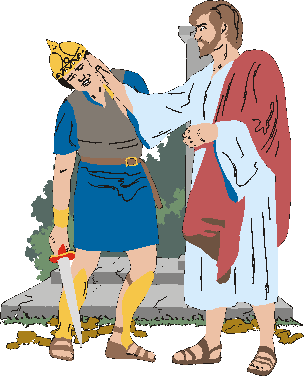
My sources tell me that this is a picture of Jesus healing a centurion's ear. But it looks like Jesus got fed up of "turning the other cheek" and decided to give some back.
Certainly that's how most of the American church reacts when they are exposed to anything they find offensive. Like the fact a Democrat is in the White House.
Jesus Heals Today

If the gospels are true and Jesus arose from the dead, he also said that we could do greater works than he did when he was here. Some of the works are great works of compassion-- feeding and healing millions more than He did through feeding programs, hospitals and through great effort and compassionate wisdom.
But Jesus hasn't stopped working. He can, and does, heal today.
This doesn't mean that to see a doctor is a lack of faith. Jesus is happy to have us help each other and use what knowledge and resources we have to help the needy. But like the woman who saw many doctors and then came to Jesus, we will not be denied by Jesus.
Many who are ill, who have not obtained help by any-- go to Jesus. He can and will heal. He won't heal everyone, it is true. Some of us need to continue in our weakness. But others will be healed.
I had a terrible gallstone at one point, in which I would be in pain for hours, unable to get out of bed. I couldn't pay for a doctor. A group of healers prayed for me, and I was healed, the pain never returned.
A couple years later, I had another terrible pain. I was told by a doctor friend to go immediately to the hospital. They ended up taking out my appendix, which was on the verge of bursting. Then they paid for all the bills because I was poor.
Then I had a severe hormone imbalance, causing diabetes and muscle atrophy and the inability to deal with stress. I have prayed against it. I have sought doctor's help. I have struggled with many symptoms and severe depression because of it. But it didn't go away. Thanks to medication, it is reduced, but until I am healed from it (which may never happen in this life), I still deal with bad days.
Jesus worked in all these circumstances. In the first he healed me, just as he did in days of old. In the second, he used compassionate people to get me to the hospital and heal me and to have mercy on my inability to pay. In the third, I was told, as Paul, "My strength is made perfect through weakness" and I had to live with the consequences. But I receive daily grace to deal with it and to do Jesus' work despite it.
Jesus works in all circumstances, but we must ask and we must rely on Him, no matter what.
Wednesday, January 18, 2012
Outline of a Christian Existence

Wow. What a question. Gordon never goes for the little ones, like the meaning of dispensationalism. Anyway, here is my answer:
First of all, we have to know what you mean by a "Christian life". Do you mean a life in a church, do you mean a social Christian or do you mean a follower of Jesus? All of these have different requirements.
Because you are asking me, and not a priest or an average religious religious person, I'm going to give you the follower of Jesus answer.
The "follower" of Jesus is one who acknowledges that Jesus is their King, even if he is King of no one else they know (even if others call themselves Christians). To have someone as a king, means that we give that person the respect of a king (worship), we obey that person when they give us laws or commands, and we rely on that person when we are in need of help. So, in general, the Christian life looks like this: Honoring Jesus, Obeying Jesus and Relying on Jesus.
Honoring is pretty much about giving the proper praise of the king. This can be done individually, in families or in community. It can be done through chanting, singing, praise, prayer or and number of other things. The Christian church has been wonderful about providing a variety of ways of honoring their Lord.
Relying on Jesus means we turn to Him when we are in trouble or in need of wisdom. This means we pray, we seek God, we rely on His provision and are grateful for His provision when it comes. Prayer and thanks.
The longest one is obedience, and this is the one that many Christians disagree about. Well, I guess they disagree about everything, but on the other two, the basics are agreed upon. Some Christians think that obedience doesn't come into it at all. They will tell you that you can ignore what Jesus said. Others will tell you that you need to listen to this teacher or this church authority. However, if Jesus and Jesus alone is our king, it is best to listen to him directly, if you have that opportunity.
So what is obedience to Jesus? Loving, of course. In fact, Jesus said, that if anyone tells you to not love in the name of the law, you have every right to disobey that law and to act out in love instead.
We also need to be pure. This means not doing things that offend God, like sexual immorality or hate speech, or faithlessness.
We also need to be humble. This doesn't mean having a lowly frame of mind, but allowing ourselves to be humiliated by others or by taking on humiliating tasks, especially if they assist other people. It does not mean surrendering your possessions, but making sure you surrender them in a way that shows love for someone else. It doesn't mean punishing yourself, but allowing yourself to be punished if an authority insists upon it.
In the end, obedience is following the principles of Jesus, which is following the same principles Jesus lived out himself.

Tuesday, December 13, 2011
Experience and Tradition
I was asked to respond to the following:

Although it can be tough at times, I prefer experiential knowledge. Pioneering. Everytime we copy something it dilutes its originality. In regards to religion as well, yes it's important to pass it on, but the more experiential knowledge you have the more potent you are. To seek things out for yourself instead of repeating what you heard or were told. Look at the value of an original painting, being authentic and genuine has weight. Searching for your own truth in the things that interest you is well worth it. You will not have an empty knowledge but a robust understanding in which can inspire or help others or simply satisfy you inside. For reference please use the book Siddhartha by Herman Hesse and the verse Matthew 16:17.
Here is my response:
Without the knowledge of those who have passed on, then knowledge can never be built. Without the knowledge of the ancients until 1969, no one could have put a man on the moon. It wasn't NASA that put a man on the moon, but all of humanity up until that time. Even so, if we want a deeper relationship with God, we need not depend on our own. Why should repeat the mistakes of Abraham and David? They made the mistakes so that we do not need to. Why should we be stuck with the spirituality of ancient pagans? We have learned so much more.
Finally, you referenced tradition in order to buck tradition-- Siddhartha and Matthew. Make up your mind-- are you about 100 percent experience? Then why reference tradition? Instead, admit that all we are is part tradition and part experience-- our everyday life and our spirituality. The important part is that we are personally choosing how to interpret our experience and the traditions we received. That is what makes it our own.
Although it can be tough at times, I prefer experiential knowledge. Pioneering. Everytime we copy something it dilutes its originality. In regards to religion as well, yes it's important to pass it on, but the more experiential knowledge you have the more potent you are. To seek things out for yourself instead of repeating what you heard or were told. Look at the value of an original painting, being authentic and genuine has weight. Searching for your own truth in the things that interest you is well worth it. You will not have an empty knowledge but a robust understanding in which can inspire or help others or simply satisfy you inside. For reference please use the book Siddhartha by Herman Hesse and the verse Matthew 16:17.
Here is my response:
Without the knowledge of those who have passed on, then knowledge can never be built. Without the knowledge of the ancients until 1969, no one could have put a man on the moon. It wasn't NASA that put a man on the moon, but all of humanity up until that time. Even so, if we want a deeper relationship with God, we need not depend on our own. Why should repeat the mistakes of Abraham and David? They made the mistakes so that we do not need to. Why should we be stuck with the spirituality of ancient pagans? We have learned so much more.
Finally, you referenced tradition in order to buck tradition-- Siddhartha and Matthew. Make up your mind-- are you about 100 percent experience? Then why reference tradition? Instead, admit that all we are is part tradition and part experience-- our everyday life and our spirituality. The important part is that we are personally choosing how to interpret our experience and the traditions we received. That is what makes it our own.
Monday, November 28, 2011
What's the Problem?

Obama is not the problem.
Corporations are not the problem.
Government is not the problem.
The Republicans are not the problem.
The Occupy movement isn't the problem.
The Tea Party isn't the problem.
Homosexuals aren't the problem.
Fundamentalists aren't the problem.
Muslims aren't the problem.
Politicians aren't the problem.
Us caring more about ourselves than those in need is the problem.
Us expecting anyone other than ourselves to sacrifice is the problem.
Our greed and materialism, hatred and anger is the problem.
Jesus' love is the solution.
Wednesday, November 23, 2011
Why I Am Not A Part of Occupy Anything

When I first heard about Occupy Wall Street, I thought it was pretty cool. It was encouraging public awareness of a great discrepency. The numbers weren't totally right, but 5 percent of all Americans own about 2/3 of all the wealth in the U.S., so the principle was correct. "I am the 99%" is a catchy slogan. And it talked about real people's real lacks and how the system ultimately wasn't working. I am for all that. Creating awareness is great.
But as it went on, I became more uncomfortable with the movement. It wasn't the internationallity of it. That was fine. It wasn't the protest nature of it-- I personally don't like participating in such protests, but I don't have problems of others protesting. And massive protests can do some good.
Ultimately, my discomfort was the fact that it was just a huge blame game. The purpose seemed to say that the 1 percent (which is really five percent) are bad people and "something should be done". That "something" seemed to be blocking city streets and generally making a nuisance of oneself. Again, I don't have a problem with protests or inconveniencing a few in order to benefit many more. But the movement seemed to emphasize the negative, while not really unifying behind a positive action.
In the end, the protesters were excellent at attacking. Of course, there's a lot of people we could blame. The banks, corporations in general, CEOs in particular, the government-- whichever branch you like, consumerism society, political parties, and on and on. Lets face it, our society is broken. The Occupy folks, just like the Tea Partiers before them, makes that clear.
But at least the Tea Partiers had a positive message-- "let's vote in the right people with the right values" seemed to be their main message. That had a positive impact. Perhaps many people don't like who was voted in, and perhaps the values didn't always make practical sense, but the movement did have an impact, an action.
The Occupy folks just seemed like a lot of whiners, really. It seemed to boil down to rich people are bad and the government is bad for supporting the rich people and the cities are bad for trying to stop the Occupy people from possession public parks and streets. In the end, everyone is bad. It's all bad.
But if you want to make change, you don't tell people how bad they are, even if they are bad. Instead, you show how they could do something more positive than they currently are. I would have joined the protests if they would have recommended to the 1% (who is the 5%) that they create more jobs. With health insurance. For the people who really need jobs now. These guys have the wealth to create jobs, they just aren't working on it. Why aren't they? But more than that, why aren't the protesters speaking something positive into the arena?
I am not opposed to the Occupy folks. In my heart of hearts, I agree with them. But I hope that this movement can actively do something positive with their energy. They lived on the street-- can they help the people who are stuck there permanently? They caught the world's attention-- can they use that media outlet to bring positive change? I hope and pray that they will.
Wednesday, November 09, 2011
"Persecution" in Nigeria

In the last decade, there have been more than ten thousand deaths related to riots and slayings of a religious nature. Many of these have been Muslims killing Christians, as we have seen in many articles posted in the West. The headlines are clear: "500 Christans killed by Muslims in Nigeria" or today's headline: "Muslim Radicals Kill 150 in Nigeria, Goal Sharia"
What these headlines completely neglect is that Christians are also killing Muslims in Nigeria. This isn't a one-sided attack from one religious group to another. This is what we call war.
To label this as "persecution of Christians" is misguided. Yes, innocents are being killed, as they do in all wars. And this is a crime against all humanity. But innocents of both Muslim and Christian beliefs are being killed by both Muslims and Christians. And it is both the Muslims who are trying to control the law and Christians, in opposition to their religious and political enemies.
This isn't persecution, it is prejudice. It is two sides refusing to listen to each other.
And worst, this is a large population, calling themselves "Christian" yet being very un-Christlike. We need to pray for these Christians. Not that they escape persecution, but that they learn to love their enemies.
Sources:
Schleitheim, "Christians Killing Muslims"
Religious News Summary, Crosswalk, Nov. 9, 2011
Wednesday, November 02, 2011
What To Do With False Prophets?

From Religion Today Summaries:
Family Radio Stations, Inc., founder and chairman Harold Camping said he was wrong to predict Christ's return and confessed that, after decades of misleading his followers, he regrets his misdeeds, the Christian Post reports. Camping, 90, who falsely predicted the world would end Sept. 6, 1994, then May 21, 2011, then finally on Oct. 21, 2011, also said he was wrong to say that God had stopped saving people after May 21. Since 1992, Camping has claimed that he had discovered a special numerical system in the Bible that allowed him to calculate the exact dates of biblical events such as the flood, the crucifixion and the day of Jesus' return to earth. When Camping's final doomsday prediction failed to happen, Family Radio removed its teachings regarding both the purported May 21 and Oct. 21 rapture dates. According to a member of Camping's staff, he is no longer able to lead Family Radio or his ministry.
In an analysis of the NT, it spends a lot of time talking about false teachers. What they act like, what their false teachings are and how they approach "ministry". Some main passages include Matthew 7, Matthew 23, II Peter 2 and Revelation 2.
But what the NT doesn't say, with any of the detail we would appreciate, is how to deal with false prophets. The Hebrew Scriptures are clear: stone them or curse them (Deuteronomy and Jeremiah). Clear cut answers to a serious problem.
But in the NT, the issue isn't so clear. If you've got a false prophet, you discern the truth and you don't let them teach, sure. But what else do you do? Do you kick them out of the church? Publicly rebuke them? The NT doesn't say.
In fact, the only thing that is clear is that Jesus will be judging the false prophet Himself (see the letter to Thyratia in Revelation 2 and the end of Matthew 7). And this judgment is extremely harsh. But shouldn't the church get more involved, more than just not letting the person teach?
Not necessarily. And this is because Jesus is just as concerned about the false prophet as He is about the rest of His followers. He doesn't want to lose even a person who taught lies in His name. Jesus has not come to judge the world, but that through Him the world might be saved. This doesn't mean that He doesn't judge... but the church should always be ready to catch a fallen disciple.
We need to be clear about what is true and what is false. But let's always be there to accept the fallen, to forgive them, to love them, even when they hurt the church.
Sunday, October 16, 2011
Dawning of the Age of the Heterdox
A post on the Inter-Faith/denomination Forum on Facebook by John Brandkamp:
An interesting issue that keeps coming up here is the concept of what is "orthodoxy" and who gets to define that. In certain respects I'm quite "orthodox" (within the Evangelical Protestant tradition) and yet in other areas I'm quite off the beaten path. It seems to be a movable feast to say the least. And it seems to be as true in other traditions as well. Are we left with a cacophony of theological noise and nothing else?
My (lengthened) response:
Conveniently, there's a term called "heterodox": those of us who are generally orthodox or at least accepted by the church but have some points of view that disagrees with generally accepted theology. I wonder if this age of the Christian church is the "heterodox" age.

While there is not the multiplications of denominations, as there was in the Reformation era (circa 1530), but there are certainly the multiplications of beliefs. Just within the evangelical movement, one of the more conceptually restrictive movements, there are a variety of political ideas and belief systems. Both Jim Wallis and Pat Robertson can call themselves "evangelical", but they certainly agree on very little.
This is more so in other denominations and religious groups. For the most part, we have all had to learn how to get along with people we strongly disagree with, people who hold radically different beliefs than ourselves. What is "orthodox" is being shrunk to some very basic beliefs, that seem to matter less in our everyday lives.
On the one hand, this is good. We need to learn to rub elbows with, and not judge, those who see life differently. This is why God established marriage as He did. We become one with a person who cannot think "right". Yet we need to learn to live with that person, to care for that person, to support even some of their "wrong" decisions. To have the church at large do this can be constructive.
On the other hand, it could undermine the whole idea of orthodoxy and lead us to a concept of relative truth. We need to determine what is really, basically true, and stick with that. For me, there is one basic truth-- Jesus is Lord. There are some basics that come from that one belief, but there's also a lot that I hold dear that can be disagreed with by good followers of Jesus.
The key to heterodoxy is to have that balance of accepting diversity and defending basic truths.
An interesting issue that keeps coming up here is the concept of what is "orthodoxy" and who gets to define that. In certain respects I'm quite "orthodox" (within the Evangelical Protestant tradition) and yet in other areas I'm quite off the beaten path. It seems to be a movable feast to say the least. And it seems to be as true in other traditions as well. Are we left with a cacophony of theological noise and nothing else?
My (lengthened) response:
Conveniently, there's a term called "heterodox": those of us who are generally orthodox or at least accepted by the church but have some points of view that disagrees with generally accepted theology. I wonder if this age of the Christian church is the "heterodox" age.
While there is not the multiplications of denominations, as there was in the Reformation era (circa 1530), but there are certainly the multiplications of beliefs. Just within the evangelical movement, one of the more conceptually restrictive movements, there are a variety of political ideas and belief systems. Both Jim Wallis and Pat Robertson can call themselves "evangelical", but they certainly agree on very little.
This is more so in other denominations and religious groups. For the most part, we have all had to learn how to get along with people we strongly disagree with, people who hold radically different beliefs than ourselves. What is "orthodox" is being shrunk to some very basic beliefs, that seem to matter less in our everyday lives.
On the one hand, this is good. We need to learn to rub elbows with, and not judge, those who see life differently. This is why God established marriage as He did. We become one with a person who cannot think "right". Yet we need to learn to live with that person, to care for that person, to support even some of their "wrong" decisions. To have the church at large do this can be constructive.
On the other hand, it could undermine the whole idea of orthodoxy and lead us to a concept of relative truth. We need to determine what is really, basically true, and stick with that. For me, there is one basic truth-- Jesus is Lord. There are some basics that come from that one belief, but there's also a lot that I hold dear that can be disagreed with by good followers of Jesus.
The key to heterodoxy is to have that balance of accepting diversity and defending basic truths.
Wednesday, October 12, 2011
Prayer Against Temptation

and expel all darkness from my heart
Fight strongly for me
and drive away the temptations
that rage like wild beasts within me.
Then my conscience will be at peace,
and the praise of your name
will sound within the temple of my soul.
Command the winds and storms of pride to be still
and the sea of covetousness to be at rest.
Subdue the north wind of the devil's temptation
Then there will be a great calm within me.
-Thomas a Kempis
Cotton Patch Version

Clarence Jordan wrote a version of the New Testament called
The Cotton Patch Translation. It truly
was a translation, he had studied the Greek and made out the meaning as best as
he could, and then he translated this understanding to apply to the language
and geography of his mid-20th century Southern United States. What comes out is spiritual and humorous and
deeply compassionate.
Here are a couple examples:

“So then, with what shall I compare the people of this day,
and what are they like? I know, they are
like children playing in the streets, and shouting to each other, ‘We put on
some jazz, but you wouldn’t dance ; so we put on funeral music, but you wouldn’t
go into mourning.’ For John the Baptizer
offered you a harsh, rugged life and you say, ‘This guy is nuts.’ I, the son of man, offer you laughter and joy
and you say, ‘Look at that man, a gadfly and a jitterbug, a friend of Yankees
and a nigger-lover.’ So if intelligence can be judged by all that it produces, well—! “

“The officers did a lot of other remarkable and wonderful
things among the people. They were
meeting together at Grant Park, and while nobody was brave enough to join them,
folks did speak mighty highly of them.
But increasingly quite a group of both men and woman put their faith in
the Lord and were enrolled. Besides, the
sick were carried into the streets and put on cots and stretchers so that even Rock’s
shadow might fall on them as he passed.
Also, crowds from towns all around Atlanta flocked in, bringing those
sick in body and mind and they were all healed
“But the mayor and the city council, who were members of the
Conservative Party, blew their top. They arrested the apostles and put them in
the city jail. But that night an angel
of the Lord opened the jailhouse doors, led them outside and said, ‘Go, stand
on the courthouse steps and explain to the people all the matters concerning
this kind of life.’ They listened
carefully and at the crack of day they went to the courthouse steps and started
teaching. Now the mayor and his
assistants called a meeting of the Council and all the prominent white citizens
and sent to fetch the apostles. But when
the fuzzes got to the clink, they didn’t find the apostles in it. They went back and reported: ‘We found the
jailhouse locked according to regulations and the guards were on duty, but when
we opened up and went inside we didn’t find a soul.’ When the police chief and the Council heard
this, they tried to figure out what the hell had happened. About that time somebody came bursting in and
shouted, ‘Hey, those joes you put in the jug are standing on the courthouse
steps preaching to the people.’ Then the
chief and his fuzzes went out and got them without using brutality, because
they were scared the crowd might throw bottles at them. They led them in and stood them before the
Council. The mayor tore into them and
said, ‘We warned you in no uncertain terms not to spread the ideas of that
fellow. And now look, you’ve agitated
all of Atlanta with your ideas and are trying to pin that guy’s lynching on us!’
“Rock and the other officers replied, ‘It’s our duty to obey
God rather than humans. Our ancestors’
God raised Jesus whom you mobbed and strung up on a tree. God promoted him to be his number on Leader
and Deliverer, to bring to white folks a change of heart and a way out of their
sins. And all ofus are evidence of this statement, as indeed the Holy Spirit
which God give to those who are controlled by him.’
“At this the city fathers blew a gasket and wanted to kill
them on the spot. But a Baptist by the
name of Gamaliel, a Sunday school teacher with a good reputation in the
community, got up in the Council and ordered the apostles to be put outside for
a little while. Then he said, ‘My fellow
citizens, be extremely careful in your actions against these men… I’d advise
you to keep your hands off of them and let them be. If this plan or program of theirs is a purely
human scheme it will blow itself out. But if it’s God’s thing, you can’t put a stop
to it without declaring yourself at war against God.’ That made sense to them, so they called in
the apostles, beat them up, warned them not to talk about Jesus anymore, and
turned them loose. The apostles then
left the Council meeting, happy that they were counted worthy to be disgraced
for the Name. Every day, both on the
courthouse steps and from door to door, they never quit teaching and preaching
that Jesus is Lord. “
Thursday, September 29, 2011
High on God

A quote I read on the Alethia forum found here: (I don't know who it is by, sorry)
Ever since I first became a believer, I have had a constant addiction to the presence of God. I do not know of any other way to live the Christian life, apart from a loving compulsion to continuously be near this God of gladness. One of the primary things the Lord showed us years ago was that intoxication on Him is the very essence of “first love.” God is not interested in your dispassionate praise or disinterested service. He is going for the depths of your heart strings. The thing that intoxicates you to the core is the very thing you worship. There is a deep, inner craving that draws us outside ourselves and into the realms of divine ecstasy. This is our inheritance as children and lovers of God. The only kind of love that will lay down its life is a love that has transcended life itself.
Heaven should be the prevailing norm. Ecstatic trances may seem strange or unusual to the natural mind, but they are the ordinary effect of Heaven’s joy poured out on the average believer. Wherever the church has failed to set the standard in this regard, the enemy is ready to offer a cheap counterfeit.
Everyone is created for love’s delirium, and this is why drug addiction is such a major draw not only for our youth, but in every sector of society today. Mind-altering drugs, like many occultist religious practices, do induce trance-like states. But these are illegal means of channeling spiritual activity, and they open adherents up to demonic influence. Pharmaceutical means to altered states of consciousness are direct counterfeits to the ordinary state of bliss humankind should experience in Christ. Adam was created to walk in bliss with God in Eden. Humanity was not created for depression, toil and the curse of a fallen world. People unknowingly pursue drugs and alcohol to recapture this lost sense of the presence of God that man remembers from the garden. As we know, these addictions only provide a fleeting, momentary sensation that is followed by devastation to health and homes, ending in broken families, poverty, suicide and destruction for future generations.
Even the temporary pleasure offered by drugs is shallow and utterly incomparable to the surpassing ecstasies of the Living God! Only believers have access to the purest stash of open Heaven delights. Though they do not realize it, drug addicts are trying to find this pleasure for which they were created. But most believers are also clueless to the infinite kilos of ecstasy available in their own bellies!
My response is below:
I have never felt that "spiritual high" and I don't really want it. I'm not refusing it, I'm just not seeking it, as it is not a need of mine.
The human experience is varied, and what different people want or need to be "complete" is different. Some need a "high" to feel joy or think that joy is defined by a "high". But I think that the "joy in the presence of the Lord" is the same as taking joy in any other person. It is a pleasure to be with them and you seek their company because they make you feel good. This isn't a "high", but a practical joy. If I can be content with my life, that is sufficient, given the promise of suffering that Jesus said we would have. Highs and lows just make me dizzy. Rather, I seek peace and contentment with whatever comes my way, in the presence of God or in the shame of incrimination. And so I was made for a life of service and creating peace within drama. That's just how I roll.
I think a "high" is a good part of life and I have no qualms with it. To display such a high in the Lord shows the world that we can party in a different way and experience the highs and lows of life. Some must have that experience. But it is necessary that not everyone pursue such experiences. We need people to build, to administrate, to think sensibly, to maintain a vision for years (even decades), all of which are difficult to do while seeking the next "God-fix".
This is why God gave us different gifts and experiencing the "high" of God is simply a gift. It is one I don't need. If God decides otherwise, that's fine. But I remember the experience of Mother Teresa, who experiences the presence of God fully when she was young. But once she began her life work in Calcutta she never felt it again (until now, I am certain). She needed to be focusing on others, administrating and building, instead of seeking her high.
There is a season for everything. And the great thing is that this life is just one season. We have plenty of time to experience that which we haven't in eternity.
You can read more:http://aletheia.proboards.com/index.cgi?action=display&board=mystical&thread=3483&page=1#ixzz1ZM7XFETA
Thursday, September 15, 2011
Note To Fanatics (like me)

I'm visiting family in Pennsylvania and I remember some of the things I said and did my first visit here and I decided I was a jerk. Oh, I was a jerk for all the "right" reasons. Heck, I had almost all the same values I have now. But I had no experience in actually being a radical Christian.
Red letter Christians have just as much possibility to be a jerk as other people, especially in the fanatical variety. Whenever one is a fanatic of any type (whether Christian or atheist, liberal or conservative, for peace or for war) the greatest danger is the refusal to allow others to live as they are going to live. Fanatics just can't see why anyone would have a different point of view. "If you hold to these presuppositions, then you must come to this conclusion." And so you expect that if anyone else belongs to your general group (Christian or Republican or peacemonger or skeptic or whatever) then everyone in that group should be the same type of ideology you are because that is simply logical.
We need to realize, fanatics are the way we are because we hold to a rare or unique point of view. Others won't hold to our point of view. We have the right to hold our point of view, but we cannot insist that others must convert to our logic. There are plenty of people who come to different conclusions and just because we hold one point of view, it doesn't mean anyone else must. We all are given the freedom of choice, and we must accept others' freedom to make different choices. Maybe right, maybe wrong, but we are all responsible to ourselves and our gods to follow consistently our own ideology.
Also, just because we have followed a certain line of logic, it doesn't mean that it is better than other people's point of view. I can show that a Christian shouldn't support war. But if I insist on this point of view for all Christians, I am missing the fact that there are a lot of different kinds of Christians and, in the whole realm of Christendom, I am in the minority in my presuppositions as to what makes the best kind of Christianity. Thus, others can be perfectly good Christians and hold to a different point of view.
I didn't see this when I was twenty seven. I hope that I'm more accepting to different points of view, or at least more ready to allow God do the judging and not me.
Subscribe to:
Posts (Atom)