Tuesday, June 28, 2011

The Lies We Tell


Christianity always does itself a disservice when they tell each other lies about how life "should" be.  "You should be joyful" "Believe that you are at peace and you will be" "You should be forgiving" "Just have faith that you are well and you will be well" .  Our emotions are God-given and they teach us things about ourselves.  God is not there to teach us about how we should be but to help us recognize our weaknesses, sorrows and poverty and to offer real salvation from them.  


Let's not invent our salvation in our own minds.

Government v. Private Sector


There are some things a national government does better than a private source and some that they do worse.  Which are which?  That is the debate.

My List:
Government does better at:

                    Basic welfare
                    Health care
                    Security issues (necessary violence)
                    Creating bureaucracy
                    Making enormous budgets
                    Spending lots of money
                 
The Private Sector does better at: 

                        Innovation
                        
Cool looking things that don't mean anything
                        Making the rich richer
                        Complaining about the government
                        Spending lots of money


First posted on the Filmspotting Forum, Politics thread

Jesus v. Christianity


Here's what I see are some differences between Jesus' teaching/example and a good portion of the Christian church. Jesus was a revivalist, in a sense, trying to get monotheists back to a basic core, and Christianity still has the need of Jesus calling them back to the basics:

-Instead of promoting war, we should be promoting peacemaking

-Instead of judging, we should be compassionate to sinners

-Instead of punishing sin, we should be seeking forgiveness

-We should never establish a ritual, law or policy that harms others or limits the needy from meeting their needs

-We should be freely giving to the poor, not making increasing demands of them

-We should never promote any kind of prejudice

-Our churches should be full of the outcast, rejected and hated, especially due to sin and suffering

-Instead of displays of wealth, we should use our wealth for the needy

-Instead of our leaders having grand titles and signs of respect, they should be serving all, including doing dishes and cleaning toilets


Father, I pray that we can all learn to be more like Jesus and less like the world.  Let us be full of grace instead of rejection.


First posted on the Facebook group, Inter-Faith/Denomination Discussion.

Friday, June 24, 2011

What Is Salvation?


So often in Christian circles salvation is seen as deliverance from the wrath of God, from hell.  Or it is deliverance from the world, an escape route to heaven.

Jesus said "The kingdom is near." The kingdom IS salvation-- we are not to be saved from something but to something. Salvation is a world that is changed into God's order.  Jesus' kingdom is a world that is without oppression, a world without death, a word without fear. It is also a world that ends poverty, that gives justice to everyone and all know and receive all they need from the one God.  It is a world that is lead by a community of the poor who know how to practice merciful and compassion to all.  It is a world in which we see each other as one family under one Father, God.


We will not see this complete salvation until Jesus returns.  But we need to practice.  We need to figure out how to accomplish this in our churches, now.  Salvation isn't something to wait for, it is something that we create through the Holy Spirit and the word and power of Jesus. 

Wednesday, June 01, 2011

Position on Abortion


I believe that human life is precious and should be protected. And if there is a conflict between two lives, the best should be done for both lives, not just one.

The question in abortion is is the fetus truly a human life? This question is not specifically answered by the Bible. Thus people must make a philosophic and idealist choice as to whether to treat the fetus as equal or less than her mother.

I have made the philosophic decision that the fetus is an individual human at conception and thus must be protected from that point. That fetus is a human life and to kill it is murder. I will not harm others for the sake of this human, nor should anyone else. However, the fetus is precious, as is the mother.

It has been discovered that most abortions do not occur if the mother is not in poverty. Thus, whether abortion is legal or not, if we reduce poverty and support mothers in their time of need, then there will not be as many abortions. If everyone on all sides would agree to work on reducing poverty and to support pregnant women, then the abortion rate would go down on its own.

Saturday, May 28, 2011

War of the Peace-Lovers


Guest blogger today! This is an essay my daughter Nikki wrote for her Modern World History class. She's 15.

“My religion is better!”
“No, MINE is!”
A fight that happens ALL THE FREAKING TIME!! And I’m getting tired of it! People fight because they WANT to, NOT need to for their religion. It’s silly! I sometime feel like one of the few people who know what peacemaking is! And I’m at my sister’s throat very often. So, I will tell you the reasons of why there should be peace between religions.

First off, the basics of the three most common religions are the same. A lot of the change comes with “do you believe in Jesus, and if so, what is he to you”. Heck! It gets so bad, at least in Christianity, that different TYPES of the same religion fight! Most of us supposedly love peace, are good pacifists, and don’t sin(at least not very much) but their constantly at war, they sin left and right without repenting and are at each other’s… no everyone’s necks. Not very good at what’s supposed to be done.

Next,if and when the world comes to an end, what would we do if there was no gods or higher powers that created us and witches just had overactive imaginations(nothing against my friend)? What if the evolutionary and big bang theories were correct? Would there have been any point to arguing? I know I don’t enjoy getting angry over nothing. I know I personally believe in God, who created everything as is. But others don’t… and I get curious: what would happen if I were wrong? Would all of us, the Christians, die? I hate to think of it that way, but it’s possible. Anyone can be wrong when it comes to religion. Heck, maybe all gods are real… and they will treat their followers well in their own way. Then again I could decide to sound like an atheist and say all religious figures are fake and we’re all idiots, but I won’t because I believe in one. Actually, I think that it’s possible that many exist.

Even if you have completely different religions you can just avoid talking about it. I don’t even ask religion very often. It’s that I just don’t care, a person is who they are; religion doesn’t change that… that and I forget to ask. If you’re like me as far as you know your boyfriend/girlfriend/best friend could be in an opposing religion, and then you’d start “hating” them or ignore them like they don’t exist.

This probably won’t affect anyone but, I’m a Christian and my friend she’s a witch… no, she does NOT make potions with newt’s eye or fly using a broom! She speaks with spirits, which is why it opposes to Christianity. So… I act like I don’t know what her religion is. I act ignorant. It’s not like I want to be ignorant. If she starts speaking to spirits in front of me though… I’m not gonna stick around, I’m at least in the other room, and she won’t come to any church, I don’t think either of mind though, I certainly don’t. We ignore and avoid it. Just like I suggested.

I just feel that too many friendships are at risk because of religious arguments. And we should all shut up about it before more people die. Being caught up in the middle of a battle that I have no intention to fight, that’s what I am. If adults don’t feel the pain they’re causing, and very few children do, how are we supposed to stop the war of the “peace lovers”?

Saturday, May 14, 2011

Too Much, Too Soon


Stacy just found the blogs and writes in:

I wanted to know your thoughts, if you have time, about being fearfully and wonderfully made and having disabilities and/or handicaps. This is something I'm not understanding and have not been able to find an answer I have peace with in my spirit. I've grown up as an army brat when it comes to churches going from conservative to charasmatic to really charasmatic and now attend a great Four Square which is both conservative and has quiet veins of charasmatic running through it which is a perfect fit for me. My issue though is that the school of thought I run into is that something like a handicap or addiction or whatnot is because it's something we allowed into our life, like an open window for the enemy to come in, or our parents sinned and let that spirit /problem in, or generational curses and the like. I've also heard that our handicaps or disability is a gift that is to be used for the glory of God and then others say it can be used by God but that we should always pray to be healed since God wants to heal us.

If we are fearfully and wonderfully made then were do handicaps/disabilities come in? How can one be fearfully and wonderfully made while being say crippled? Or mentally challenged etc. ? I don't see how those flaws fit in with the fearfully and wonderfully made part? I mean noone looks at a crippled person and says "That's great! I want to be that way too!". We all know it's an issue and noone would want that problem. And yet we're told we're fearfully and wonderfully made and God knitted us in our mother's womb. I mean did He knit that crippling/physical or mental problem in too?


My response:

I love my charismatic brothers and sisters, but they have taken their proper emphasis on healing and turned it into an "overrealized eschatology." This means that they take things that are promised to us in the final kingdom of God and expect that we should be living it all now.

In the kingdom, we will all be healed, there will be perfect justice, and we will all be unified. Right now, although there is some unity in the church, there is a lot of division and hatred as well, because we are still working on our maturity in love. Right now, although there is some justice through the church, it is only partially realized because we don't live under the Perfect King. Right now, although there is some healing, not everyone is healed. And some struggle with addictions and sins with no easy out.

We can see this in Scripture. There's the passage you quoted in John 9-- Jesus answered, "It was neither that this man sinned, nor his parents; but it was so that the works of God might be displayed in him." (Joh 9:3 NAU) Also we have the evangelist Epaphrophitus who was "sick even to death" but God had mercy on him to spare him and Paul. This means that he was sick, and he could have died. Eventually he was healed, but it wasn't an instant healing, and he could have died from it. Paul had no expectation that his co-worker should have just had more faith to be healed. Rather, it was the will of God that was the main issue. (Phil. 2:25-27).

Some say that we are promised healing in the atonement of Jesus (Isaiah 53:5). But in that passage we are also promised shalom, the peace and justice of God. However shalom is not yet fully realized, and so we cannot take that passage and say that everyone in all cases should be healed right now. Eventually we will be, but for now, we must struggle.

We can see this with Paul in II Corinthians 12. A "messenger of Satan" attacked Paul continuously. We don't know what this is. It could be a sickness or disability. It could be a sin he struggled with continuously. All we know is that it limited Paul's salvation and that it came from Satan. And Paul prayed about it, but it was not taken away. Instead, God told him, "My strength will be made perfect through weakness." God told Paul to accept his weakness-- to accept a messenger of Satan!-- as part of his life, because God's work was being done through it. Even so, our weaknesses: sickness, addiction, disability-- some of these will be healed. Others, however, we will have to live with because God is at work in us.

God makes it clear that our character will only become mature through suffering.

3 And not only this, but we also exult in our tribulations, knowing that tribulation brings about perseverance;
4 and perseverance, proven character; and proven character, hope;
(Rom 5:3-4 NAU)

Consider it all joy, my brethren, when you encounter various trials,
3 knowing that the testing of your faith produces endurance.
4 And let endurance have its perfect result, so that you may be perfect and complete, lacking in nothing.
(Jam 1:2-4 NAU)

These "trials" or "tribulations" are actually best translated "tests" and they can take the form of suffering or persecution or personal weakness or temptations. This is how our maturity happens. Only in this way can we find perfect joy.

Hope that helps.

God bless you and keep the faith in love!

Wednesday, May 04, 2011

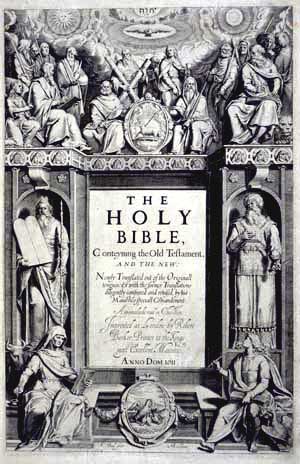
In Praise of 400 Years of the KJV

The King James Bible is a touchstone of English literature. It is not the first English translation of the Bible, nor is it necessarily the best. However, it is the first universally accepted scholarly translation of the Bible, and it is the very rare balance between art and accuracy.

The language of the KJV is so gorgeous that writers such as Herman Melville, John Steinbeck, T.S. Eliot, and many others have been influenced by it. It is THE classic work of English literature.

At the same time, the translation is powerful. The methods of translation are so solid that any Bible who calls itself "standard" uses the same methods of literal translation. The KJV was called "authorized" because it was approved to be read in all the congregations of the Church of England, and later in the Episcopal church. And rightly so. The scholars had to balance the 17th century battle between the formal Anglicans and the Calvinist Puritans. Other translations of the Bible were rebelliously Protestant or Puritan. But the KJV scholars had no axe to grind. Instead, they were interested in simple objectivity and beauty.

I rarely use the KJV myself because the language is antiquated, and sometimes misunderstood. Some of the difficult passages are famously misused, such as "Abstain from every appearance of evil." This has been used to restrict people from seeming evil, which Jesus himself could not avoid. The original translation meant, "stay away from doing evil", not seeming like doing evil as our modern understanding of "appearance" means.

Although the KJV's usefulness is limited compared to its original use, it is still a powerful and effective two edged sword. We still read its version of the Lord's Prayer, the classic text of Psalm 23 and the beautiful version of I Corinthians 13. Their translations of the Psalms have never been matched in power and language (it is rumored that Shakespeare helped with the translation of Psalms).

We should take time to read the KJV again, or at least portions of it, to remind us of this most influential English text.

My God, my God, why hast thou forsaken me? why art thou so far from helping me, and from the words of my roaring?
O my God, I cry in the daytime, but thou hearest not; and in the night season, and am not silent.
But thou art holy, O thou that inhabitest the praises of Israel.
Our fathers trusted in thee: they trusted, and thou didst deliver them.
They cried unto thee, and were delivered: they trusted in thee, and were not confounded.
But I am a worm, and no man; a reproach of men, and despised of the people.
All they that see me laugh me to scorn: they shoot out the lip, they shake the head, saying,
He trusted on the LORD that he would deliver him: let him deliver him, seeing he delighted in him.
But thou art he that took me out of the womb: thou didst make me hope when I was upon my mother's breasts.
I was cast upon thee from the womb: thou art my God from my mother's belly.
Be not far from me; for trouble is near; for there is none to help.

(Psa 22:1-11 KJV)

Friday, April 22, 2011

What Is Evil?

Evil, biblically, means one who does harm to people. An “evil” spirit is not one that is in opposition to God, except to do harm to humans.

Why does evil exist? First, because God placed humans in charge over the earth. God gave a sliver of his sovereignty to humanity, and humanity chose to use that sovereignty for selfish, destructive motives.

However, most evil is simply ignorance– not thinking about what harm we cause others–, judgment–punishing others for harms we think they have done– or systemic– participating in a system which benefits some by harming others. Satan, as an evil force, is the head of a system of judgment.

We do evil to God by separating ourselves from Him by disobeying His will or by doing actions of hatred toward Him. We cannot truly harm God, but we can harm our relationship with Him and we can harm those who are made in His image. If we harm our relationship with God, that leads us to more evil, for all good things come from God.

Thursday, April 21, 2011

Living in Oregon

Some one liners by Jeff Foxworthy. If I have a comment, it's in parentheses.

If someone in a Home Depot store offers you assistance and they don't work there, you live in Oregon.

If you've worn shorts, sandals and a parka at the same time, you live in Oregon.

If you've had a lengthy telephone conversation with someone who dialed the wrong number, you live in Oregon.

If you measure distance in hours, you live in Oregon.

If you have switched from 'heat' to 'A/C' and back again in the same day, you live in Oregon.
(Even more so if you need to do this in the same hour...)

If you feel guilty throwing aluminum cans or paper in the trash, you live in Oregon.


If you know more than 10 ways to order coffee, you live in Oregon. (Or Washington)


If you stand on a deserted corner in the rain waiting for the "Walk" signal, you live in Oregon.
(If you walk out against the signal and against traffic, you live in Portland)

If you consider that if it has no snow or has not recently erupted, it is not a real mountain, you live in Oregon.

If you can taste the difference between Starbucks, Seattle's Best, and Dutch Bros, you live in Oregon.

If you know the difference between Chinook, Coho and Sockeye salmon, you live in Oregon.

If you know how to pronounce Sequim, Puyallup, Clatskanie, Issaquah, Oregon, Umpqua, Yakima and Willamette, you live in Oregon.
(If you know how to pronounce Glisan with a long "e", Couch with a "oo", then you live in Portland)

If you consider swimming an indoor sport, you live in Oregon.
(Especially Styxx, who's room floods out a lot)


If you know that Boring is a city and not just a feeling, you live in Oregon.
(Jokes about Boring are just that)


If you can tell the difference between Japanese, Chinese and Thai food, you live in Oregon.

If you think people who use umbrellas are either wimps or tourists, you live in Oregon.
(Or they are just foolish. TriMet reports umbrella losses in the thousands annually)

If you actually understand these jokes you live or have lived in Oregon

Wednesday, April 13, 2011

Some More Funnies About Blogging

So that the pics don't take over my sidebar. (I should really use tinypic)


How You Should Blog (Even If I Don't)


I just read "5 Commandments for Blogging" and I really disagreed with most of it. So I'm giving my own, according to what I like to read. I may not follow all of these rules, but I'd like to. That counts, doesn't it?

1. Don't write for the masses
If you are only writing because you want to see a higher count or because you want to get known, just don't bother. Be yourself and write about what is important to you, even if it's not important to anyone else. Don't change your public persona to be popular. This doesn't mean don't think about your audience. It means keep a balance between who you really are and what people want to hear.

2. Be passionate
Go ahead and post your most extreme ideas. It is passion that really makes an interesting article. This is not the same as emotional or insulting or troll-ish. Passion is what stirs your soul, not what others react in you. Write on what you love, not on what you hate.

3. Quote
Most bloggers don't quote other works or they keep quotations brief. But if you read something amazing, especially if it is little-known or out of print or simply unpublished, please take the time to share it with the rest of us. Just remember to say where you got it from, who wrote the quote and keep the length under copyright limits. Ask permission if possible.

4. Use pics
Text is dull by itself. Use a pic that reflects the mood and subject of the post. It's an eye catcher and makes us more likely to read what you have to say.

5. Not too long
I have a blog that is only a sentence or two each post. And another that is only pics. And I have writings that are more than a thousand words long. Frankly, I know for a fact that no one will read the thousand word posts. They are just too long. This is the internet, not a novel. No one is going to take an hour to read a blog post. It's just a fact of life. However, if you have an idea that takes a long time to explain, you can do it in multiple posts.

6. Not too personal
If we are writing about what happened with our neighbor the other day without any relevance to anyone else, why put it on the internet? A blog, like Facebook, is a public journal, not a private one. I don't want to know about your sex life, the things you hate about your spouse, or the tiny details that make up your life. That doesn't mean I don't want personal info. Tell me what movies you really like or really hate; tell me briefly about your top ten pet peeves-- that's fine, especially if it's funny. But let's not get into exclusively private territory.

7. Be entertaining
We can't be entertaining all the time. Not every post will be earth-shattering. But something in each post should be dramatic or funny or informative or thought-provoking. Not necessarily the whole post, but something. The title is a good place to start.

Wednesday, March 30, 2011

The Great Sellaway


Can you talk about the verse that says its easier for a camel to go through the eye of a needle than it is for a rich man to enter heaven? Why is it so hard to let go of "things" ? Mark and I have been discussing that lately as our circumstances change. We aren't snobs and know that people come first, so why is it hard to lose material things? They won't last. I always wondered that, and why when Jesus told the man to sell his things, he couldn't. When we KNOW these things are not lasting, why is it still difficult? Is it because we once had them and now won't? -Mark and Leeanne

Okay, this is going to take a minute.

In the passage Jesus is talking about "selling your possessions and giving to the poor." His is a subject he spoke pretty frequently about. He told it to the rich young ruler and to Zaccheus in Luke 19. He also talked about it to all of his disciples in Luke 12:33 and Luke 14:33. He referred to it in his parables of the pearl of great price and the parable of the treasure in the field. And he applied it in his story of the rich man and Lazarus as well as his teaching about wealth in Matthew 6 and Luke 12. So this is a big deal to Jesus.

And it's really hard for us Americans to do. Not just because we are attached to our possessions, but that we have so many of them and it's a constant process of getting rid of them, because we always get more. Not more money, mind you, just stuff. So it's a lot of hard work.

But what you are referring to is the emotional attachment we have to our stuff. Because we get stuff and it becomes a part of us, a part of our essence. As Jesus says, "Where your treasure is, there your heart will be also." Or, wherever you store your stuff, your core is right in the midst of it.

So why get rid of our stuff? First off all, because those who are poor need it more than we do. John the Baptist got at the basics when he said, "If you have two coats and someone you know doesn't have any, give one to him." It's basic fair distribution. If our stuff is more needed by our brother, then we should pass it on.

Secondly, we get rid of our stuff because it causes us to be more attached to this world instead of God. The more stuff we have, the more effort and love we put into our stuff, and the less time and love we have for God or for the poor around us.

Third, we get rid of our stuff, because it builds up our stuff in heaven. Jesus says that whatever we give to the poor, God puts that stuff in our savings account in heaven, for our retirement. Thus, the more we give away to the needy, the greater the interest accumulates in our bank account in the Kingdom. Thus, we don't want to think of the poor as greedy-- rather, they are the bankers who keep our possessions (or the wealth from our possessions) secure for us for when we really need it-- after this life is over.

Finally, how do we give?
In scripture there are three ways to get rid of our possessions.

a. We sell our possessions and then take the proceeds to the poor. That could be to a charity or directly to the poor. It doesn't matter what they do with it, it is the act of giving out of love that gains our benefit.

b. We drop our possessions like a hot potato. The disciples, noting that they didn't give their possessions to the poor, wondered if just leaving their nets and boats on the shoreline was acceptable. Jesus told them it was fine as long as they were doing it for God's kingdom. Getting rid of everything to do kingdom work is just as much a benefit as giving to the poor. Thus, having a garage sale and the proceeds go to ministry or leaving everything on the side of the road so you could be a missionary is great in Jesus' eyes.

c. We are freely open to use our possessions with those who are in need. This is the Philemon principle. He was a friend of Paul's who used his house to have the church meet in it and whenever anyone came to town he opened up his house for them to stay with him, as long as they needed it. Even so, if we have a car, but use it to transport the poor, have a house but use it to house the needy or have music that we share (in a legal manner) with those who don't, then it is all good, all building up toward our heavenly account.

The hardest thing about that last kind of giving is that if we loan something out or allow people to have use of our possessions, they may not be as careful with our possessions as we are. Thus, we may get back something that is unusable. This is why this last kind of giving is just as much surrendering as the other kind of giving. Because when people use your stuff, pretty soon that stuff can't be used anymore.

So how can we make it easier to get rid of our stuff? Well, I don't know that we can. Giving away our stuff is a lot like going on a diet. We can recognize our fat, but it's hard to make the commitment. But after the fat is gone, we feel relieved. But there isn't much relief until it's gone. Until then, it's just hard work.

I would recommend that we all commit all of our stuff to the Lord. Not in the spiritual sense, "Oh, it's all yours, Lord" but in a real sense of, "Jesus, this stuff right here I'm getting rid of for you. Jesus, this stuff right here isn't mine, but I'm going to allow others to use it whenever they need to. Jesus, I'm making this available to You for it to benefit others." In this way, the Lord will help you in your commitment to Him. His Spirit will flow down upon you, and fill you with the love for Him and for others and the love of possessions will just fade away.

Thursday, March 17, 2011

A Parable of the Kingdom


Once there was a king who had three sons. He was determining who should rule after him, so he gave them each a portion of his vast kingdom, and told them to rule well. As good sons, they came to him and said, "Father, you are the great king, all wise and just. Please tell us how to rule as you have done."

The Emperor looked at each of them from his throne and said, "Write down what I say and you will know all that is necessary to rule: Sovereignty. Justice. Mercy. Sacrifice. Love. Peace. Understand these words and you will rule well." The three sons were a bit mystified, but all were confident that, given time, they would be able to understand the meaning of the Great King, and rule well.

After a year, the King called his sons back and asked them how they ruled.

The first son said this: "After some time of considering your words and spending time with your subjects, I realized that they were faithless and stupid. Then I understood your words. I am the sovereign and I must rule strongly. I must deliver justice to the people, punishing them for their sins. However, I must remind them that you, O King, are merciful and do not want them all to die. However, they must learn to sacrifice their wills to Yours, and thus learn to Love each other by loving the Law of the land. Only then there will be Peace."

The King replied, "And I understand that you punished all, for all were unworthy in your sight. This is not my rule of mercy. You are dismissed."

The second son said, "I, too, considered your words, my King, and applied them to my rule. I realized that I am not the sovereign, but You are, O King. I am only here to dispense your justice and mercy to the people. Thus, I sought to apply your law precisely, punishing the wicked and rewarding the obedient. I taught them to sacrifice their possessions to me, so that I might re-distribute them in love. And then we achieved the peace of having all needs met."

The King replied to the second son, "Because you took all land and all possessions from my people, you made them all poor, grudgingly giving back to them. This is not my rule of justice. You are dismissed."

Finally came the primary servant of the third son, and he said, "I regret to tell you, my Lord, that your son is dead. This is what occurred: He also, considered your words and he realized that he himself was given sovereignty over your people, which was a noble task, of which few are worthy. He saw the poor of your land being oppressed and the wealthy squandering their power on their own indulgence and distractions. But rather than punish them, your son remembered your word, "sacrifice" and realized that he must sacrifice himself for all the people. So he took all the power and wealth you gave him, traveled around the country and taught all the people how to share possessions, how to see with compassion and how to love each other with one's own heart. In this way, he created peace among all who listened to him.

"I wish that were the end of the story. His brother, the first son, came to his land and stirred up the wealthy, claiming that the third son was not obeying your will. They lied about him and persecuted him gladly, for he was telling them the only way to follow your will was to sacrifice their possessions and power. Because he threatened all power, the other king spurred the powerful to kill your third, innocent son."

The King bowed his head and tears came to his eyes. "Yes, I have heard all of these tidings. My son," and he turned to the first son, "You are cast from my presence. I never want to see you again. You were never interested in my will, only in punishment." Then the King turned to the servant, "Little one, because you have loved my son, my son who followed my heart of compassion, then I proclaim you to be King over all of my lands."

The servant declared, "But my Lord, I am not worthy!"

The King chuckled, "Of course you are not. But anyone who has my heart at least deserves the chance to become worthy. Worth isn't in correct interpretation, nor in delivering justice. Worth is found in seeing others' needs and doing all you can to meet them."

This parable is not about Christianity, per se. Nor is it about the atonement and how it works. Rather, it is about how one interprets the Bible. The Bible is confusing and difficult. There are a number of things that don't make sense. The one who understands the Bible correctly is the one who has the heart of the Father, following the example of His Son.

Wednesday, March 16, 2011

Are You An American?

With the homeland security rules, you have to have a lot of IDs to get your ID. You need a social security card, a birth certificate, a proof of citizenship (if necessary), a marriage certificate (if you changed your name). Oh, and don't bother bringing in your old ID because that doesn't count. Oh, and 40 dollars.

We know a lot of people who don't have any kind of ID because it got lost, burned, stolen, whatever. So the road to obtaining this ID is long and hard.

We've decided to make it easier on everyone. Look, homeland security is doing their best, we know, but they just want to prove that if a person was born in America, then they are a citizen. We think they just need to show a little more imagination.

So we created this simple test to prove if one is a real American or not. If you answer the questions right, then we give you your ID.

1. Can you speak English?
Correct answer: No. Americans don't speak English. They speak American.

2. Are all foreigners idiots?
Correct answer: Yes. Anyone who does not live in the United States lives in an idiotic way. Therefore, they are idiots.

3. Would you feel comfortable living in Canada?
Correct answer: Of course not. Canada is foreign. Therefore they are idiots. Also, they have socialized medicine.

4. Do you know where Belize is?
Correct answer: What is a Belize? No one knows where Belize is. Even those who live there probably wouldn't be able to point it out on the map.

5. Are you fluent in any language apart from English?
Correct answer: Of course not. We've already established that Americans can't even speak English.

6. Do you feel cheated if your meal doesn't fill the plate?
Correct answer: There are meals without a super size option?

7. Do you have a car?
Correct answer: How can anyone live without a car?

8. What is your favorite childhood memory?
Correct answer: I remember when gas was less than two dollars a gallon...

9. What is your opinion about France?
Correct answer: (unmentionable)

Final: Please fill in this map (correct answers provided)

Tuesday, March 15, 2011

I'd Like To See A Picture of This...

From Crosswalk Daily News Summary-

Egypt's Military Begins Rebuilding Burned Church

Egypt's government acknowledged the complaints of Coptic Christians last week as the military began reconstruction of a burned church south of Cairo. Hundreds of Christians protested the torching, leading to clashes between Muslims and Copts that killed 13 Christians. "The engineering department of the Egyptian Armed Forces has started to rebuild the church in Atfeeh today at the same exact location," Army spokesman Maj. Mohamed Askar said, according to CNN. "The Armed Forces will bear all expenses."

Friday, March 04, 2011

Culture of Murder


A report from Consistent Life:

An Unusual Connection between Abortion and the Death Penalty

The case of the 70-year-old abortion doctor Kermit Gosnell (covered last week) has a new twist: prosecutors are consideringthe death penalty because charges involve multiple murders – and because seven of the eight murders are for children under age 12 (that is, he induced birth first and killed the born baby). Concerning the two decades when repeated reports of shocking clinic conditions went ignored, Pennsylvania Gov. Tom Corbett said, "This doesn't even rise to the level of government run amok. It was government not running at all.” The death penalty is a very poor substitute for government having done its job, even what was allowed after Roe v. Wade, by intervening much earlier. Many women could have been spared an excruciating fate. Gosnell himself may have avoided the spiral down that violence normally entails, had there not been social approval and apathy.

[Thanks to Edward Chow and Rob Arner for sending in information on this case.]


So we give someone permission to murder, find out he was doing it wrong, and to punish him, we answer it with murder? Is there something wrong with this?

Wednesday, March 02, 2011

In Reflection on the Lord's Prayer and the Beatitudes

"Daily bread"

Jesus spoke to simple people.

Jesus understood the theological niceties and the tendency of spiritualization of the educated. Perhaps that's why he didn't speak to the educated, except in debate. If we like a word, or like a teacher, we try to fit what was said into a context we can accept, an idea we can receive.

People with refrigerators and cupboards full of food want to try to apply "Give us this day our daily bread." Frankly, we don't need daily bread. We've already got bread for today, tomorrow and the next. And we aren't satisfied with bread. So we have cheese and milk and beef and turkey and donuts and hot dogs and Slim Fast bars and Nutella. So when we read about daily bread, we think it means the Word of God, or Jesus who is the Word of God, or some other kind of symbolic, spiritual bread that we actually need because 'daily bread' is an unnecessary prayer for us.

But the people Jesus spoke to-- and the majority of the world today-- would understand that when Jesus spoke of bread, he meant... well, bread. Or maybe rice. Perhaps corn. But certainly not Peanut M&Ms. Certainly not a refrigerator full of food. Certainly not Jesus. And not the word of God, either. Because the majority of the people (who ever lived) don't know if they will have enough basic food to eat that day. Some dig through trash, some rely on farms, but most go hungry. So when Jesus spoke to simple people, he spoke about bread because that's something they understood. They asked, "Heaven is great, but what will I give my children to eat today?" And Jesus answered, "Ask and you will receive. Ask your Father for what is good and He will not give you a stone."

When Jesus said, "Blessed are you who are poor," he didn't mean the people who were humble. That doesn't mean Jesus downplayed humility-- oh, no, that is essential. But Jesus also glorified the poor. Not poverty. Poverty is horrible. But the poor can be glorious and faithful and just desperate enough to seek God for what no one else would grant them. So "the poor" are... poor people.

Yes, in Matthew it says, "the poor in spirit." And it is associated with "the meek", "the mourning", those desperate for justice and those who are persecuted. These are people who, whether lacking in funds or not, are oppressed and suffering at the hands of those more powerful than they. The poor. Not those who humble themselves, but are humiliated at the hands of another.

The simple person learns that the Bible is more complicated than what the simple words seem to say, and so theologians and preachers and the educated and the wise unlearn what seems so simple to understand. So straightforward.

And so we lose the point because we are too educated, to sophisticated to understand it. Are eyes are so wide open that we see nothing. And we lose the truth that is staring us right in the face.

Every Christian Healed?


Josh posted this on Alethia. Read more here.

Isaiah 53:5

But he was pierced for our transgressions,
he was crushed for our iniquities;
the punishment that brought us peace was on him,
and by his wounds we are healed.

I have encountered those who believe, on the basis of this verse and some others, that "physical healing was provided for in the atonement" and therefore it is now never God's will that any of his children be sick.

Thoughts?


My response:

If we are to use that passage as some use it-- as a promise that we would never be sick, or if sick immediately healed-- then we could also claim "peace" that way, as it is the parallel to the "healing" line. Thus, we should claim "shalom"-- justice and inner peace and all needs met and release from prison for all who are under Jesus' blood.

Can you see people using the verse for shalom as some use it for healing?

"It only looks like you are in prison, but the fact is, you are free! Act on that freedom, there are no guards, no walls, if you would only have faith!"

"It may seem that you are hungry and homeless, but in reality, by faith, you live in a mansion and have a feast in front of you, whatever food you want! Just claim it by faith and eat it!"

The fact is, Jesus died for our sins so that we could ask God for healing and justice and all of our needs met. But we still live in a world filled with sickness and disease and disaster and hunger and pain. We still live through sickness and suffering, without fear, knowing that Jesus is changing the world, person by person until He is ready to return and meet all of our needs.

In the meantime, He chooses to heal some of us, and feed some of us miraculously, and to house some of us and to provide inner peace to some of us. And some of us have to struggle, so that His character might show through our suffering.

Tuesday, March 01, 2011

There Are No Atheists in Pity Parties


From Crosswalk Religion News of the Day:

Anger at God Common, Even among Atheists

New research shows that self-described atheists and agnostics are more likely to be angry at God - or the hypothetical deity they reject - than believers. CNN reports that new studies from Julie Exline, Case Western Reserve University psychologist, and her colleagues. Religious people are also more likely to see a plan or good intentions behind unfortunate events, rather than a mean-spirited attack. "When people trust that God cares about them and has positive intentions toward them, even if they can't understand what those intentions or meanings are, it tends to help to resolve anger," she said. Exline and her colleagues hope to further study people's reactions to God, suffering and anger.


Mark Twain denied the existence of God, due to the death of his beloved daughter. Then he penned scathing words against God. Not against the church, mind you-- he'd been writing against the hypocrisy of the church for decades before. But against God.

Much of the anger against God is simply the opposite of the attitude of gratefulness that other people have. It is human nature to either blame or thank someone above us for circumstances that are beyond our control. But what do we do if we think there is no one actually determining these actions? Because we have to do something with our feelings, we blame or thank God, whether we intellectually believe in Him or not.

For most people, a belief in God is emotional, even if one is an atheist.

This is not a proof for God, but it is interesting to speculate. It is also interesting because thanking God for some good circumstances is right because He established the earth to be good and because He continues to allow growth and goodness to spread. However, since God established humanity to rule the world, some good (such as the harnessing of electricity) can be given to humanity, but almost all of the evil can be put at humanity's doorstep. Either humanity causes evil or humanity allows for evil to continue to exist when they could do something about it. Most of the time, humanity is apathetic toward evil, when they have been given rule by God to accomplish justice, mercy and goodness.

So if you really want to blame someone for the evil, look in the mirror.