Showing posts with label Jesus. Show all posts
Monday, February 25, 2013
Thursday, March 17, 2011
A Parable of the Kingdom
Once there was a king who had three sons. He was determining who should rule after him, so he gave them each a portion of his vast kingdom, and told them to rule well. As good sons, they came to him and said, "Father, you are the great king, all wise and just. Please tell us how to rule as you have done."
The Emperor looked at each of them from his throne and said, "Write down what I say and you will know all that is necessary to rule: Sovereignty. Justice. Mercy. Sacrifice. Love. Peace. Understand these words and you will rule well." The three sons were a bit mystified, but all were confident that, given time, they would be able to understand the meaning of the Great King, and rule well.
After a year, the King called his sons back and asked them how they ruled.
The first son said this: "After some time of considering your words and spending time with your subjects, I realized that they were faithless and stupid. Then I understood your words. I am the sovereign and I must rule strongly. I must deliver justice to the people, punishing them for their sins. However, I must remind them that you, O King, are merciful and do not want them all to die. However, they must learn to sacrifice their wills to Yours, and thus learn to Love each other by loving the Law of the land. Only then there will be Peace."
The King replied, "And I understand that you punished all, for all were unworthy in your sight. This is not my rule of mercy. You are dismissed."
The second son said, "I, too, considered your words, my King, and applied them to my rule. I realized that I am not the sovereign, but You are, O King. I am only here to dispense your justice and mercy to the people. Thus, I sought to apply your law precisely, punishing the wicked and rewarding the obedient. I taught them to sacrifice their possessions to me, so that I might re-distribute them in love. And then we achieved the peace of having all needs met."
The King replied to the second son, "Because you took all land and all possessions from my people, you made them all poor, grudgingly giving back to them. This is not my rule of justice. You are dismissed."
Finally came the primary servant of the third son, and he said, "I regret to tell you, my Lord, that your son is dead. This is what occurred: He also, considered your words and he realized that he himself was given sovereignty over your people, which was a noble task, of which few are worthy. He saw the poor of your land being oppressed and the wealthy squandering their power on their own indulgence and distractions. But rather than punish them, your son remembered your word, "sacrifice" and realized that he must sacrifice himself for all the people. So he took all the power and wealth you gave him, traveled around the country and taught all the people how to share possessions, how to see with compassion and how to love each other with one's own heart. In this way, he created peace among all who listened to him.
"I wish that were the end of the story. His brother, the first son, came to his land and stirred up the wealthy, claiming that the third son was not obeying your will. They lied about him and persecuted him gladly, for he was telling them the only way to follow your will was to sacrifice their possessions and power. Because he threatened all power, the other king spurred the powerful to kill your third, innocent son."
The King bowed his head and tears came to his eyes. "Yes, I have heard all of these tidings. My son," and he turned to the first son, "You are cast from my presence. I never want to see you again. You were never interested in my will, only in punishment." Then the King turned to the servant, "Little one, because you have loved my son, my son who followed my heart of compassion, then I proclaim you to be King over all of my lands."
The servant declared, "But my Lord, I am not worthy!"
The King chuckled, "Of course you are not. But anyone who has my heart at least deserves the chance to become worthy. Worth isn't in correct interpretation, nor in delivering justice. Worth is found in seeing others' needs and doing all you can to meet them."
This parable is not about Christianity, per se. Nor is it about the atonement and how it works. Rather, it is about how one interprets the Bible. The Bible is confusing and difficult. There are a number of things that don't make sense. The one who understands the Bible correctly is the one who has the heart of the Father, following the example of His Son.
Monday, January 24, 2011
Wednesday, January 05, 2011
The Friend
Jesus is your friend. He is not your enemy, for He wishes only for you to live and thrive and that for eternity.
Jesus' time is different than ours. Often we want Him to solve our problems immediately, or to make them never happen, but Jesus knows, even though we do not, that the road to joy often comes through suffering and anguish. He doesn't want us to wallow in this suffering, but to pass through it to joy. Joy is the goal, suffering is the means.
Jesus, like most of the spirit world, doesn't move in our time. Every moment in anguish is like an eternity to us and Jesus moves on a seeming geologic scale. But Jesus has a timetable. The end of suffering will come. We just need to wait for it.
Jesus often lets us know when He is working in us, for He wants the Father to get all the glory. However, when He acts, it is when we least expect it, when we think everything is at its end. Then, suddenly, Jesus is there, giving us what we need, although often at the last possible moment.
Jesus' plan isn't as laid out or organized as we might think. He has to work with us, and we often change our minds every few minutes. So Jesus works with us in order to cause our souls to live and thrive so that we might be our own and we might help others to be thriving on their own as well.
Jesus offers a lot and his promises are huge: eternal life, a just kingdom, a community of love, all our needs met, a relationship with the Father, our sin wiped away, healing and hope and joy and peace in our hearts. We look at these promises and sometimes we think that Jesus won't... can't keep them all. What we need to realize is that Jesus is no liar, nor is He a monster-- rather he sees our life now and our live after our death as a continuum. To live for eternal life is true faith, and it is this faith He strives to encourage in us.
Jesus isn't a flatterer. Rather, he shows us who we really are. Sometimes we cringe at the pain we ignorantly caused others. Sometimes he attempts to convince us that we aren't as wicked as we thought we were-- that there is actually some good in us. One by one, He takes the blocks away that separate us from the life we should live, the life of love for others. The reason it seems to hopeless is because there are so many blocks. But He faithfully takes them away, slowly and steadily.
Even though we might proclaim Jesus as Lord, we often struggle like a puppy twisting as her master gently attempts to get her out of the twine she is entangled in. We often don't know He is working to free us. And we don't know how complicated it is. In struggling to get out of his grip, we often make the mess worse. But he just sighs and keeps working, for we are in His grip.
His work isn't external, but in our hearts, working with His Spirit to free our hearts from within our hearts. This is why we often don't know He's working.
This is true for me, and true for everyone who submits to Jesus as Lord. Not necessarily every Christian, but everyone who bows to Jesus in their heart-- whether they bow in church or not.
I pray that you would fully realize and rest in Jesus' blessing. For the one whom the Son sets free is free indeed.
Saturday, December 11, 2010
Got Christmas?
What is Christmas about?
Christmas is about tradition. The things we were raised doing, we want to keep doing. And Christmas is one of the main times of year to keep old traditions alive that have survived at least thirty years or so. What is your Christmas about? Check the items below that apply to you:
Giving gifts
Spending time with family
Lying to children about Santa Claus
Spending time under the mistletoe
Setting up decorations
Getting drunk
Hopping from free meal to free meal
Arguing with friends and family
Catching Miracle on 34th Street for the twentieth time
Singing a mix of old hymns and silly songs
Avoiding family
Eating meat and stuffing until you throw up
Spending time in the mall with thousands of others
Listening to Christmas music until you throw up
Watching A Charlie Brown Christmas for the fiftieth time
Receiving gifts
Returning gifts at the mall with thousands of others
Unfortunately, none of these things get to the heart of Christmas. They are all substitutes of the real focus of the festival. Once you dispense with this list, what is left of your Christmas? Watching re-runs of the Simpsons? Being morose because your Christmas doesn’t match up to your expectations? Or just being depressed in general, for no particular reason?
Christmas seems so important, such a significant part of our year, that it must be about something important. Of course, we all know that Christmas is supposed to be about Jesus. But that’s hard for us to really make practical as a holiday or feast. Or even to get our heads around. Jesus was a cool guy. And he taught some good things—most of which we can’t remember right now (too much egg nog, probably). But why is Christmas about him?
The Christmas Story
Well, part of Christmas is the Christmas story. Just in case you weren’t sure, the story isn’t A Christmas Carol. It’s about Jesus. Does Mary, Joseph, angels, shepherds, wise men ring a bell? Yeah, that’s the Christmas story. Well, what is that story about, anyway? Most of us know about the “peace on earth” part. But how do we get peace on earth?
The interesting thing is that the Christmas story doesn’t give us a strictly religious answer, like what we’d expect from the Bible. Instead, it gives us a political answer. That’s right, the Christmas story is about politics. It is propaganda about the kind of political system it thinks would be best. (Propaganda isn’t always bad, you know—it depends on whether it’s true and beneficial to everyone or not.) And the politics the Christmas story is recommending is to have the right ruler, the right government, and then you can have peace. That’s really not that different from an election year, really.
So what kind of ruler can give us peace? According to the Christmas story, it’s got to be somebody who knows what it’s like to be poor. At the same time, it’s got to be somebody who has authority. It’s got to be somebody who cares about the needs of the poor. But it’s still somebody who could capture the interest of the wise and wealthy. But most of all, it’s somebody who really upsets the status quo politics that makes everyone’s lives miserable. That’s why Jesus is uniquely qualified to be ruler of the world.
Jesus was born in poverty, and lived among people who had next to nothing. He drew to himself shepherds, who were rejected by “proper” society. Jesus’ mother sang a song about unimportant people ruling over everyone else. Yet Jesus drew magi more than a thousand miles—walking—to himself with rich gifts. At the same time, he had the current rival king so upset at him, that the king killed a village of babies and toddlers to get rid of him. At the same time, Jesus grew to establish laws that would benefit everyone that lived within his kingdom.
On top of all this, he received authority. He had the right to be in charge. God told everyone that Jesus was the one in charge, and that they needed to listen to him. Most people didn’t listen to God, but what else is new? Jesus still had the right to rule.
Choose Jesus as King of the World!
So why didn’t Jesus rule? Why isn’t he in charge of the world right now? Because he wants to give everyone a chance to choose him, first. (What other dictator would do that?) You see Christmas isn’t so much a holiday or gift-giving opportunity as an election. Jesus is presenting himself as a candidate for office. He want you to elect him. His platform is peace on earth and benefits for everyone who chooses him. What kind of benefits? Forgiveness of sins. The possibility of both receiving and giving love. Being content with your circumstances. Having your needs met. A life without suffering. Some pretty unbelievable campaign promises—but Jesus has a track record. Thousands, even millions of people have experienced Jesus’ kind of living. And it works, it really can give one peace.
Get Christmas
So have you really got Christmas? It’s simple—is Jesus your king, your Lord? If you live having Jesus as your ruler, then you can experience what Christmas is really about. So how do we do that?
Read the gospels to find out what Jesus is really like. (You can start with any of them—Matthew, Mark, Luke or John. Just skip the lists of names in Matthew or Luke). If the reading is too tough, then you can ask a pastor what it means to have Jesus as king (That’s what a pastor does, you know—he reads the Bible to explain it to those of us who can’t make heads or tails of it. If you don’t know a pastor you can call the phone number below.). Look at what Jesus is promising if he does rule. Look at what Jesus is demanding to see if you really want him to rule.
If you are ready, then accept Jesus as your Lord. You can pray to him, “Jesus I choose you as my King and Lord.” Or you can go to a church to get baptized (that’s the initiation ritual). Then you’ll really have Christmas. And a whole lot more.
Get Peace.
Get Jesus.
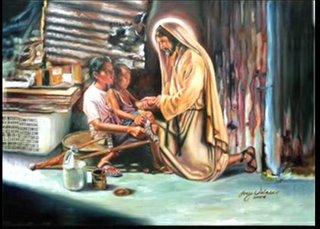
Labels:
Christmas,
government,
Jesus,
Kingdom of God,
politics
Wednesday, July 01, 2009
The OT and the NT
Top Ten Acts of Oppression as quoted in Young Anabaptist Radicals:
All references are from the ancient Hebrew prophets:
1. Refusing to defend the needy- Isaiah 1:17, 23; Jeremiah 5:28
2. Stealing from the poor- Isaiah 3:14-15
3. Unjust judgments against the poor- Isaiah 10:1-2
4. Not assisting the needy- Ezekiel 16:49
5. Taking interest for loans- Ezekiel 18:15-17
6. Enslaving a people- Amos 1:6
7. Excessive violence in war, especially against innocents- Amos 1:13
8. Excessive rent against the poor- Amos 5:11
9. Accepting bribes- Amos 5:12
10. Turning away those who need shelter for a night- Amos 5:12
Daylight replies:
You are absolutely right in your scriptural basis against acts of oppression. I wonder though. If I posted a list of Old Testament scriptures to build a case against homosexuality, abortion, or to support such things as the death penalty and war, you might reject my list under the notion that we are New Testament people now. Why do liberal Christians have one list of favorite Bible causes and conservative Christians have different list? Both lists have a common source. Just asking.
My response:
I have to admit, that while I am deeply interested in the Hebrew Scriptures, I don’t often use it as a source of moral truth, except when it explains what Jesus was saying. Jesus (and especially his brother James) spoke against the oppression of the poor. However, the definition of this, he depended on the Hebrew Scriptures, just as he depended on the Hebrew Scriptures for the defninition of “porneia” or sexual immorality. So this list is in the way of a definition.
Also, although I know that there are “liberal” and “conservative” Christians, I don’t find that divide to be helpful. There are people who use the Scriptures for their own ideologies. I have no interest in them. I think that kind of interpretation of the Scripture is not only wrong-headed, but boring. I find truth in Jesus, and so Jesus is the way to interpret the rest of the canon. We understand him first, and then the rest of Scripture makes sense.
All references are from the ancient Hebrew prophets:
1. Refusing to defend the needy- Isaiah 1:17, 23; Jeremiah 5:28
2. Stealing from the poor- Isaiah 3:14-15
3. Unjust judgments against the poor- Isaiah 10:1-2
4. Not assisting the needy- Ezekiel 16:49
5. Taking interest for loans- Ezekiel 18:15-17
6. Enslaving a people- Amos 1:6
7. Excessive violence in war, especially against innocents- Amos 1:13
8. Excessive rent against the poor- Amos 5:11
9. Accepting bribes- Amos 5:12
10. Turning away those who need shelter for a night- Amos 5:12
Daylight replies:
You are absolutely right in your scriptural basis against acts of oppression. I wonder though. If I posted a list of Old Testament scriptures to build a case against homosexuality, abortion, or to support such things as the death penalty and war, you might reject my list under the notion that we are New Testament people now. Why do liberal Christians have one list of favorite Bible causes and conservative Christians have different list? Both lists have a common source. Just asking.
My response:
I have to admit, that while I am deeply interested in the Hebrew Scriptures, I don’t often use it as a source of moral truth, except when it explains what Jesus was saying. Jesus (and especially his brother James) spoke against the oppression of the poor. However, the definition of this, he depended on the Hebrew Scriptures, just as he depended on the Hebrew Scriptures for the defninition of “porneia” or sexual immorality. So this list is in the way of a definition.
Also, although I know that there are “liberal” and “conservative” Christians, I don’t find that divide to be helpful. There are people who use the Scriptures for their own ideologies. I have no interest in them. I think that kind of interpretation of the Scripture is not only wrong-headed, but boring. I find truth in Jesus, and so Jesus is the way to interpret the rest of the canon. We understand him first, and then the rest of Scripture makes sense.
Two Jesus'
Folknotions asks on Young Radical Anabaptists: “the Jesus of the gospels, not the Jesus of theology” Could you clarify this distinction? Thanks.
The Jesus of theology is the Jesus discussed conceptually in intellectual circles, churches and Bible studies. This is the many “historical Jesus’” (although there have been many honest attempts to find the “real” Jesus), the Jesus of orthodox doctrine, the Jesus of deity alone, the Jesus who rules and who only loves in the abstract. The Jesus of theology has been developed over two thousand years, and has increasingly made Jesus, as a person, more philosophical and able to put in a box. Although this Jesus is arguably greater than the Jesus of the gospels, he is less “touchable” and more moldable by whatever concepts we find most dear within our own worldview.
Perhaps the Jesus of the gospels is more static, but he is more touchable, more realistic, and more difficult to conform to our notions of morality and reality. The Jesus of the gospels always challenges our thoughts and who we are. The Jesus of the gospels never panders to us, or tells us what we want to hear.
But the Jesus of the gospels is the one who looked with compassion at the rich young ruler. The Jesus of the gospels is the one who drew in the sand when asked for judgement. The Jesus of the gospels yelled at his disciples. The Jesus of the gospels insulted the Pharisees. The Jesus of the gospels cried to God to change the plan they had determined upon already. The Jesus of the gospels didn’t know everything. It isn’t just that this Jesus is human– he is real.
The Jesus of theology is the Jesus discussed conceptually in intellectual circles, churches and Bible studies. This is the many “historical Jesus’” (although there have been many honest attempts to find the “real” Jesus), the Jesus of orthodox doctrine, the Jesus of deity alone, the Jesus who rules and who only loves in the abstract. The Jesus of theology has been developed over two thousand years, and has increasingly made Jesus, as a person, more philosophical and able to put in a box. Although this Jesus is arguably greater than the Jesus of the gospels, he is less “touchable” and more moldable by whatever concepts we find most dear within our own worldview.
Perhaps the Jesus of the gospels is more static, but he is more touchable, more realistic, and more difficult to conform to our notions of morality and reality. The Jesus of the gospels always challenges our thoughts and who we are. The Jesus of the gospels never panders to us, or tells us what we want to hear.
But the Jesus of the gospels is the one who looked with compassion at the rich young ruler. The Jesus of the gospels is the one who drew in the sand when asked for judgement. The Jesus of the gospels yelled at his disciples. The Jesus of the gospels insulted the Pharisees. The Jesus of the gospels cried to God to change the plan they had determined upon already. The Jesus of the gospels didn’t know everything. It isn’t just that this Jesus is human– he is real.
Jesus and the Bible
Posted by Tim N, on Facebook:
My awareness of how I read the bible has been strongly shaped by my experience of British Anabaptism through working Anabaptist Network. The second of the Anabaptist Network's seven core convictions is: Jesus is the focal point of God’s revelation. We are committed to a Jesus-centred approach to the Bible, and to the community of faith as the primary context in which we read the Bible and discern and apply its implications for discipleship.(read more from the AN) Naming an Anabaptist value as a "Jesus-centred approach to the bible" helped me to understand some distinctive of my own Mennonite tradition
I just read a book that talked about this approach to the Bible, but the Jesus he was speaking of is a theological Jesus-- the Jesus of the creeds. This isn't exactly an Anabaptist approach. The theological Jesus can just as well be a construct in our minds. The Jesus of the gospel is a real Jesus, one that we can disagree with at times, but one that is worthy to be acknowledged as Lord of our lives, not just the world.
My awareness of how I read the bible has been strongly shaped by my experience of British Anabaptism through working Anabaptist Network. The second of the Anabaptist Network's seven core convictions is: Jesus is the focal point of God’s revelation. We are committed to a Jesus-centred approach to the Bible, and to the community of faith as the primary context in which we read the Bible and discern and apply its implications for discipleship.(read more from the AN) Naming an Anabaptist value as a "Jesus-centred approach to the bible" helped me to understand some distinctive of my own Mennonite tradition
I just read a book that talked about this approach to the Bible, but the Jesus he was speaking of is a theological Jesus-- the Jesus of the creeds. This isn't exactly an Anabaptist approach. The theological Jesus can just as well be a construct in our minds. The Jesus of the gospel is a real Jesus, one that we can disagree with at times, but one that is worthy to be acknowledged as Lord of our lives, not just the world.
Jesus, Not Religion
Gordon asks: When some says they dont want religion, they want Jesus. What are they really saying?
They mean they don't want organization-- they don't want anyone telling them what to believe about Jesus.
I can appreciate that, but I think that we all should at least be in conversation with the main traditions of Christianity. For example, anyone who denies the Catholic tradition without looking at it is poorer in their understanding of Jesus. Not because they should agree with the Catholic tradition, but because the tradition has been working through what Jesus means to them and what it means that He is Lord for 1700 years. That's a voice that should be heard. So "religion" is important, tradition is an important voice, even if it issn't the only one.
They mean they don't want organization-- they don't want anyone telling them what to believe about Jesus.
I can appreciate that, but I think that we all should at least be in conversation with the main traditions of Christianity. For example, anyone who denies the Catholic tradition without looking at it is poorer in their understanding of Jesus. Not because they should agree with the Catholic tradition, but because the tradition has been working through what Jesus means to them and what it means that He is Lord for 1700 years. That's a voice that should be heard. So "religion" is important, tradition is an important voice, even if it issn't the only one.
Basic Definitions
Gordon asks: What does it mean to be a christian?? What does it mean to be a God fearing person? What does mean to be truly devoted to Him?
Those are three different questions:
A. A Christian is one who has Jesus as his or her Lord. A cultural "christian" is one who claims some connection to God in the guise of a Christian worldview, even though that person may have no real spiritual life at all.
B. A God fearing person, literally, is one who's actions are changed due to a recognition of judgment. It is a person who is afraid of what God will do to them if they don't change their actions.
C. To be truly devoted to God is defined differently, even in different places in the Bible. Right now, my best understanding is: Treat God as the Lord of all, in worship, obedience, and belief and to treat other people as God's creation in His image-- with respect and care for their needs.
Those are three different questions:
A. A Christian is one who has Jesus as his or her Lord. A cultural "christian" is one who claims some connection to God in the guise of a Christian worldview, even though that person may have no real spiritual life at all.
B. A God fearing person, literally, is one who's actions are changed due to a recognition of judgment. It is a person who is afraid of what God will do to them if they don't change their actions.
C. To be truly devoted to God is defined differently, even in different places in the Bible. Right now, my best understanding is: Treat God as the Lord of all, in worship, obedience, and belief and to treat other people as God's creation in His image-- with respect and care for their needs.
Sunday, March 22, 2009
Christian Pacifism 101
The strongest argument for Christian pacifism is the New Testament. The simplist argument is Jesus said "love your enemies" and then described that loving includes not harming, not killing. To love someone is to do good to them; to kill someone is the opposite of doing good (See Mark 3:4).
The reason why Jesus and the others didn't get preach against soldier's killing is because, for the most part, they didn't. They acted as a police force in Judea, not a military killing machine-- the Romans who did that work were sent elsewhere.
The NT as a whole argues against the whole miltary machine. Revelation-- getting back to topic-- is an excellent example. The whole book glorifies martyrs-- those who submit to death rather than have their faith be compromised-- and assumes that those in the military machine are those who kill the martyrs. It's a pretty fair assumption. But even if one disagrees with that assumption, we have to admit that those who participate in the society of the Beast-- the military empire-- and those who participate in Babylon-- the commercial support of empire-- are condemned. If we accept this as Scripture, we have to take it seriously and not just dismiss its radical notions.
BTW, the basis for saying that the early church was anti-military isn't based on Roman records but on Christian documents. We have martyrologies of soldiers becoming Christians and then were killed because they refused to participate in warfare. We have early Christian authors saying that participating in the military in unacceptable for a Christian. To see these sources, you can find them in Eberhard Arnold's excellent book, "The Early Christians."
The reason why Jesus and the others didn't get preach against soldier's killing is because, for the most part, they didn't. They acted as a police force in Judea, not a military killing machine-- the Romans who did that work were sent elsewhere.
The NT as a whole argues against the whole miltary machine. Revelation-- getting back to topic-- is an excellent example. The whole book glorifies martyrs-- those who submit to death rather than have their faith be compromised-- and assumes that those in the military machine are those who kill the martyrs. It's a pretty fair assumption. But even if one disagrees with that assumption, we have to admit that those who participate in the society of the Beast-- the military empire-- and those who participate in Babylon-- the commercial support of empire-- are condemned. If we accept this as Scripture, we have to take it seriously and not just dismiss its radical notions.
BTW, the basis for saying that the early church was anti-military isn't based on Roman records but on Christian documents. We have martyrologies of soldiers becoming Christians and then were killed because they refused to participate in warfare. We have early Christian authors saying that participating in the military in unacceptable for a Christian. To see these sources, you can find them in Eberhard Arnold's excellent book, "The Early Christians."
Labels:
Eberhard Arnold,
Jesus,
Love Your Enemies,
Pacifism,
Revelation
Thursday, February 26, 2009
What is Fruit About?
just read gospel of john chapter 15, verse 8. it says when you bear much fruit then you are my disciples. i was wondering what is meant by "fruit"? i know the evangelicals think it means that we must bring many to making a decision for Jesus. i was wondering if it could mean other things in your opinion. i realize that the fruit of the Holy Spirit are fruit, but can we bear fruit of the Holy Spirit. i thought it was the Spirit in us that did that. not coming from us, but a work done through us, as we are willing vessels in him.
-David
"Fruit" really means doing what Jesus said. We can see this clearly in Matthew 7 where it says "You shall know them" meaning false teachers "by their fruit." And he goes on to talk about good and bad fruit. The passage ends with two warnings of judgment-- one against false teachers who were "lawless", meaning disobedient and another warning about hearing and doing what Jesus says.
In John it's the same. Do the teachers who say that "fruit" is getting converts also think that people who don't make converts get burned in hell?
"I am the vine, you are the branches; he who abides in Me and I in him, he bears much fruit, for apart from Me you can do nothing.
6 "If anyone does not abide in Me, he is thrown away as a branch and dries up; and they gather them, and cast them into the fire and they are burned.
(John 15:5-6)
It's saying that all who live in Jesus has "fruit". If you don't have "fruit" you don't live in Jesus. And then you are separated from Jesus and get "burned"-- punished. All that for not having converts? I don't think so.
As far as the Holy Spirit "fruit" goes, love is borne is us as a result of having the Spirit. If a person doesn't partner with the Holy Spirit in having love-- in refusing the Spirit's influence to love and gentleness-- then the Spirit doesn't hang around. We see this in Romans 8--
"and those who are in the flesh cannot please God. However, you are not in the flesh but in the Spirit, if indeed the Spirit of God dwells in you. But if anyone does not have the Spirit of Christ, he does not belong to Him."
Also in Galatians 5--
"If we live by the Spirit, let us also walk by the Spirit."
The fruit of the Spirit isn't just something that happens to us, although we might be surpized at the changes that occur when we begin living in the Spirit. Love is something that the Spirit gives us the ability to do and we, in agreement to be followers of Jesus, partner with the Spirit to act that way.
-David
"Fruit" really means doing what Jesus said. We can see this clearly in Matthew 7 where it says "You shall know them" meaning false teachers "by their fruit." And he goes on to talk about good and bad fruit. The passage ends with two warnings of judgment-- one against false teachers who were "lawless", meaning disobedient and another warning about hearing and doing what Jesus says.
In John it's the same. Do the teachers who say that "fruit" is getting converts also think that people who don't make converts get burned in hell?
"I am the vine, you are the branches; he who abides in Me and I in him, he bears much fruit, for apart from Me you can do nothing.
6 "If anyone does not abide in Me, he is thrown away as a branch and dries up; and they gather them, and cast them into the fire and they are burned.
(John 15:5-6)
It's saying that all who live in Jesus has "fruit". If you don't have "fruit" you don't live in Jesus. And then you are separated from Jesus and get "burned"-- punished. All that for not having converts? I don't think so.
As far as the Holy Spirit "fruit" goes, love is borne is us as a result of having the Spirit. If a person doesn't partner with the Holy Spirit in having love-- in refusing the Spirit's influence to love and gentleness-- then the Spirit doesn't hang around. We see this in Romans 8--
"and those who are in the flesh cannot please God. However, you are not in the flesh but in the Spirit, if indeed the Spirit of God dwells in you. But if anyone does not have the Spirit of Christ, he does not belong to Him."
Also in Galatians 5--
"If we live by the Spirit, let us also walk by the Spirit."
The fruit of the Spirit isn't just something that happens to us, although we might be surpized at the changes that occur when we begin living in the Spirit. Love is something that the Spirit gives us the ability to do and we, in agreement to be followers of Jesus, partner with the Spirit to act that way.
Friday, February 13, 2009
Nine Principles
I received yesterday "9 principles" that someone lives by. I didnt' care for them, so I made my own:
9 Principles:
1. The only nation without compromise is the Kingdom of God
2. Jesus is my chosen Lord over that Kingdom
3. Jesus is my Lord and I will obey Him over all other principles or laws.
4. God is my allegiance and I will work for and serve Him.
5. Those who love God will obey, work for and serve the Kingdom of God over the nations of men.
6. The people of the Kingdom of God are the poor and persecuted who live in Jesus, and those who unequivocally support them.
7. Service to the Kingdom of God is using whatever resources we have for those who have greater needs than ourselves
8. All true power rests in God, so to make real change we must pray.
9. No one has the right, in the name of God, to damage anyone.
9 Principles:
1. The only nation without compromise is the Kingdom of God
2. Jesus is my chosen Lord over that Kingdom
3. Jesus is my Lord and I will obey Him over all other principles or laws.
4. God is my allegiance and I will work for and serve Him.
5. Those who love God will obey, work for and serve the Kingdom of God over the nations of men.
6. The people of the Kingdom of God are the poor and persecuted who live in Jesus, and those who unequivocally support them.
7. Service to the Kingdom of God is using whatever resources we have for those who have greater needs than ourselves
8. All true power rests in God, so to make real change we must pray.
9. No one has the right, in the name of God, to damage anyone.
Labels:
government,
Jesus,
Kingdom of God,
Love,
Love Your Enemies,
service
Monday, January 26, 2009
Parable of the Model Christian
Andy Wade wrote on the Anawim:Radicals for Jesus cause on Facebook:
In the parable of the man who fell among theives Jesus redefined for us who our neighbors are - anyone we encounter who is in need. I'm challenged when I think about how I pamper myself; my needs, my wants. But what about the least of these? Oh, how I love myself while tossing leftovers to those in need.
I used to laugh, then cringe, when I heard stories of people sending used tea bags to missionaries. Now I'm caught wondering, "What are the used tea bags I'm offering the poor and homeless, my neighbors?" It's not about solving problems for people in need, it's about understanding that our humanity, our lives, are wrapped up with each other.
As I feast on Starbucks coffee and fresh scones, what shall I offer the one who gave me the bread of life and springs of living water? Used tea bags and a little stale bread? To cheapen my offering is to forsake the one who died for me. To offer my leftovers to those in need only produces spiritual malnutrition.
What do you think?
Once there was a wonderful Christian who loved his family, prayed daily and read the Bible frequently. He was wise and frugel and didn't waste money unnecessarily, taking care to save it up for a rainy day. Nevertheless, he didn't neglect his responsibility for the poor and needy. He would give out the socks that he couldn't wear anymore to the people on the street. He would give out the clothes that were so out of fashion that they were laughable to the Salvation Army. He would give watery broth and stale bread to the local soup kitchen. And he knew he was in favor with God, for he had done what Jesus wanted him to.
Then he died and he truly did enter Jesus' kingdom, for he was truly a good man at heart and loved Jesus. Jesus welcomed him with a hug and said, "Well, let's get down to it! I'll show you where you're going to live." And Jesus brought him to a cardboard shack. The man looked disapointed, so Jesus said, "Come in, I've got a feast waiting for you!" On the broken table inside the shack was a bowl of watery broth and stale bread. "And I have some clothes for you!" Jesus showed him his bed of newspaper and on it were the unfashionable clothes he had discarded to the poor.
In whatever we give to the poor, that is what we give to Jesus.
Whatever we give to Jesus, that is what we will live with for eternity.
"Sell your possessions and give to the poor and you shall have treasure in heaven."
In the parable of the man who fell among theives Jesus redefined for us who our neighbors are - anyone we encounter who is in need. I'm challenged when I think about how I pamper myself; my needs, my wants. But what about the least of these? Oh, how I love myself while tossing leftovers to those in need.
I used to laugh, then cringe, when I heard stories of people sending used tea bags to missionaries. Now I'm caught wondering, "What are the used tea bags I'm offering the poor and homeless, my neighbors?" It's not about solving problems for people in need, it's about understanding that our humanity, our lives, are wrapped up with each other.
As I feast on Starbucks coffee and fresh scones, what shall I offer the one who gave me the bread of life and springs of living water? Used tea bags and a little stale bread? To cheapen my offering is to forsake the one who died for me. To offer my leftovers to those in need only produces spiritual malnutrition.
What do you think?
Once there was a wonderful Christian who loved his family, prayed daily and read the Bible frequently. He was wise and frugel and didn't waste money unnecessarily, taking care to save it up for a rainy day. Nevertheless, he didn't neglect his responsibility for the poor and needy. He would give out the socks that he couldn't wear anymore to the people on the street. He would give out the clothes that were so out of fashion that they were laughable to the Salvation Army. He would give watery broth and stale bread to the local soup kitchen. And he knew he was in favor with God, for he had done what Jesus wanted him to.
Then he died and he truly did enter Jesus' kingdom, for he was truly a good man at heart and loved Jesus. Jesus welcomed him with a hug and said, "Well, let's get down to it! I'll show you where you're going to live." And Jesus brought him to a cardboard shack. The man looked disapointed, so Jesus said, "Come in, I've got a feast waiting for you!" On the broken table inside the shack was a bowl of watery broth and stale bread. "And I have some clothes for you!" Jesus showed him his bed of newspaper and on it were the unfashionable clothes he had discarded to the poor.
In whatever we give to the poor, that is what we give to Jesus.
Whatever we give to Jesus, that is what we will live with for eternity.
"Sell your possessions and give to the poor and you shall have treasure in heaven."
Monday, December 22, 2008
The Law of Jesus
First posted in MennoDiscuss in response to the question, "If we are all followers of Jesus, should Jesus' teaching be a law, and if so, how literal should we be?"
1. For those of us who declare Jesus as Lord, Jesus' teaching is law.
2. And Jesus is the only teacher of the law we have (Matt 23-- "And you shall call no one teacher, for you have but one teacher and that is the Christ")
3. Under Jesus, we are all equal in trying to understand the law of Christ and in trying to obey it.
4. We are to assist each other to be obedient to Christ
5. However, if we have a disagreement as to how to obey Jesus-- as long as we do not deny a principle of Jesus-- then we must allow other's their interpretation without judging them. (Romans 14)
6. Nor, if we hold to a more loose interpretation, should we cause our brothers to sin against their interpretation. (Romans 14)
Even this brings up a lot of points.
For instance, my "interpretation" of "love your enemies" means that followers of Jesus should never kill anyone under any circumstances. Does this mean that I can't fellowship with a brother or sister who holds to the idea of "loving them in your heart" but harming them in the flesh? I believe that the interpretation is in reality opposed to the teaching of Jesus, not in harmony with it at all. But what I can do is pray that the Holy Spirit reveal the truth to them, over time. But I shouldn't deny fellowship with them simply because of a misunderstood interpretation.
On the other hand, I would not allow such a person to teach in my congregation, because it says in Scripture that one who stands against the word of Jesus is a false teacher and shouldn't be allowed in the church (I Timothy 6; II John). I do, however, allow people to publicly have a discussion about these interpretations with me in front of my church, so people can hear the different points of view and make their own choice. It is good to allow the Holy Spirit reign to lead people as He will.
1. For those of us who declare Jesus as Lord, Jesus' teaching is law.
2. And Jesus is the only teacher of the law we have (Matt 23-- "And you shall call no one teacher, for you have but one teacher and that is the Christ")
3. Under Jesus, we are all equal in trying to understand the law of Christ and in trying to obey it.
4. We are to assist each other to be obedient to Christ
5. However, if we have a disagreement as to how to obey Jesus-- as long as we do not deny a principle of Jesus-- then we must allow other's their interpretation without judging them. (Romans 14)
6. Nor, if we hold to a more loose interpretation, should we cause our brothers to sin against their interpretation. (Romans 14)
Even this brings up a lot of points.
For instance, my "interpretation" of "love your enemies" means that followers of Jesus should never kill anyone under any circumstances. Does this mean that I can't fellowship with a brother or sister who holds to the idea of "loving them in your heart" but harming them in the flesh? I believe that the interpretation is in reality opposed to the teaching of Jesus, not in harmony with it at all. But what I can do is pray that the Holy Spirit reveal the truth to them, over time. But I shouldn't deny fellowship with them simply because of a misunderstood interpretation.
On the other hand, I would not allow such a person to teach in my congregation, because it says in Scripture that one who stands against the word of Jesus is a false teacher and shouldn't be allowed in the church (I Timothy 6; II John). I do, however, allow people to publicly have a discussion about these interpretations with me in front of my church, so people can hear the different points of view and make their own choice. It is good to allow the Holy Spirit reign to lead people as He will.
Labels:
Grace,
interpretation,
Jesus,
Law,
Love Your Enemies
Thursday, December 11, 2008
Jesus, Law and Grace
Posted on MennoDiscuss, concerning the question "Is Jesus' teaching just another restrictive law that stands in the way of grace? Isn't that why Jesus taught in parables so that there would be varieties of interpretation and flexibility?" (That's my summary)
Jesus at first gave clear principles, opposing them to Moses' more specific laws (Matthew 5-7). These same principles he illustrated by his life-- his healings and his approach to the outcast (Matthew 8-9). But he was rejected by the Jewish leaders, specifically for his example and teaching of love, and so called a servant of Satan (Matthew 12). It was only at this point that he taught in parables-- not to illustrate his principles, but to hide them (Matthew 13). Jesus taught in parables because they had already rejected his clear principles of life. It is interesting to note that most of the parables in Matt 13 have to do with a division among God's people between those who listen to God and those who don't.
The main subject of God's word is that He has a lifestyle that He wants us to live. That lifestyle was presented in a very specific way in Moses' law and the world was invited to participate in it. However, Moses' law was also compromised (See Matt 19 about divorce) and it was also culture-specific. Jesus presented the same God-pleasing lifestyle in principles that could translate to any culture, among any context.
The principles are general enough that they offer flexibility to different points of view, as Paul talks about in Romans 14. But this does not mean that there aren't standards to uphold. It is clear that a free-love lifestyle isn't the love that Jesus talks about. Nor is a life of judging others based on petty rules. Jesus' standard is a perfect mean, a perfect moral lifestyle of both restraint and radical sacrifice, of both loyalty and striking out against the evils in our culture.
If we are followers of Jesus, I don't think we can compromise this life. I don't think we can talk about "love" in general terms and that's enough. But also, I believe that talking about hats and movies and coats aren't a part of the general principles. We might try to apply something in a specific congregation, but let's not call anyone else a sinner because they don't follow our specific constraints. The ethic of Jesus is a law, but it is the only law we need.
Jesus at first gave clear principles, opposing them to Moses' more specific laws (Matthew 5-7). These same principles he illustrated by his life-- his healings and his approach to the outcast (Matthew 8-9). But he was rejected by the Jewish leaders, specifically for his example and teaching of love, and so called a servant of Satan (Matthew 12). It was only at this point that he taught in parables-- not to illustrate his principles, but to hide them (Matthew 13). Jesus taught in parables because they had already rejected his clear principles of life. It is interesting to note that most of the parables in Matt 13 have to do with a division among God's people between those who listen to God and those who don't.
The main subject of God's word is that He has a lifestyle that He wants us to live. That lifestyle was presented in a very specific way in Moses' law and the world was invited to participate in it. However, Moses' law was also compromised (See Matt 19 about divorce) and it was also culture-specific. Jesus presented the same God-pleasing lifestyle in principles that could translate to any culture, among any context.
The principles are general enough that they offer flexibility to different points of view, as Paul talks about in Romans 14. But this does not mean that there aren't standards to uphold. It is clear that a free-love lifestyle isn't the love that Jesus talks about. Nor is a life of judging others based on petty rules. Jesus' standard is a perfect mean, a perfect moral lifestyle of both restraint and radical sacrifice, of both loyalty and striking out against the evils in our culture.
If we are followers of Jesus, I don't think we can compromise this life. I don't think we can talk about "love" in general terms and that's enough. But also, I believe that talking about hats and movies and coats aren't a part of the general principles. We might try to apply something in a specific congregation, but let's not call anyone else a sinner because they don't follow our specific constraints. The ethic of Jesus is a law, but it is the only law we need.
Friday, November 21, 2008
Anarchy and Government
Thomas writes on the MySpace group "Philosophy":
Governments use violence and force on others to get them to conform to what they consider to be right. The Epitome of Might makes Right. Anarchism does not mean people dont communicate anarchism doesnt mean people do not work together to accomplish tasks. Anarchism simply means that nobody has a monopolization over the use of force. Since not all people are good it is not logical to appoint anyone to be superior over others. Since all people are supposed to have rights of conscience it is unjust for any entities to use violence to enforce their moral standards on others. Without governments such horrific historical events such as holocausts and ethnic cleansings would never have happened. Those things happen because of government and the BLIND supporters thereof. Yeshua was an anarchist he was brutally murdered by government because the government was afraid his teachings would pacify the people. What is it with these people that are so afraid of peace? Gandhi was an anarchist Buddha was an anarchist in fact every single Great spriritual person EVER were anarchists. I cannot be a follower of Gods ways and support government. It is an absolute impossibility. Governments are made by people who choose not to follow Gods ways they want to instead own the world and place people into subjection under them. The ambitious and unrighteous of the world.
1. A government is not automatically "might makes right" if the people being ruled approve of and support the might. I would not say, for instance in the U.S., that everyone supports the "might" that upholds the law, but the great majority do.
2. "Anarchism" is "without rule", not without force. Without rule means that there is no agreed-upon means of rule. But there is always the ipso facto rule-- whoever has the most power makes the rules. Thus, I believe, anarchism reverts back to that foundational principle.
3. I agree with you that democracy does not exist. Never did. That doesn't mean it couldn't. We have the technology. We can make government better than it was. Better. Stronger. Faster. (no, wait...) It is possible via the internet to give every literate adult to participate in the everyday rule of a government. It just has never been tried before.
4. Yeshua was not a supporter of anarchy. He just taught that every government that ever existed was inadequate. He has a new concept of government-- let God rule through him. The real unique thing is that he wouldn't win that rule through armies or through the vote, but through his death, at which time God would hand him the rule.
Gandhi was not an anarchist, as he supported a national government of India.
Buddha, on the other hand... he was probably an anarchist.
Shiva, Kali, Moses, David, Muhammad, Krishna, Confucius, Socrates, Plato, Augustine, Aquinas, Luther, Francis-- none of them were anarchists.
But the ancient Chinese philosophy of the Moists-- that might have been anarchist. I'm not sure.
5. My favorite presentation of anarchism is "The Moon Is A Harsh Mistress" by Robert Heinlien. It's really rule by capitalism, but it's still very well presented.
6. I also agree that "governments are made by people who choose not to follow God's ways. " There are two ways in which people understand God: through judgment and punishment of societal sin and through grace, mercy and encouragment to repent. The first is the way of government. The second is the way of Yeshua. You can choose one or the other. But this last comment is religion, not philosophy, so I'll leave this train of thought.
Governments use violence and force on others to get them to conform to what they consider to be right. The Epitome of Might makes Right. Anarchism does not mean people dont communicate anarchism doesnt mean people do not work together to accomplish tasks. Anarchism simply means that nobody has a monopolization over the use of force. Since not all people are good it is not logical to appoint anyone to be superior over others. Since all people are supposed to have rights of conscience it is unjust for any entities to use violence to enforce their moral standards on others. Without governments such horrific historical events such as holocausts and ethnic cleansings would never have happened. Those things happen because of government and the BLIND supporters thereof. Yeshua was an anarchist he was brutally murdered by government because the government was afraid his teachings would pacify the people. What is it with these people that are so afraid of peace? Gandhi was an anarchist Buddha was an anarchist in fact every single Great spriritual person EVER were anarchists. I cannot be a follower of Gods ways and support government. It is an absolute impossibility. Governments are made by people who choose not to follow Gods ways they want to instead own the world and place people into subjection under them. The ambitious and unrighteous of the world.
1. A government is not automatically "might makes right" if the people being ruled approve of and support the might. I would not say, for instance in the U.S., that everyone supports the "might" that upholds the law, but the great majority do.
2. "Anarchism" is "without rule", not without force. Without rule means that there is no agreed-upon means of rule. But there is always the ipso facto rule-- whoever has the most power makes the rules. Thus, I believe, anarchism reverts back to that foundational principle.
3. I agree with you that democracy does not exist. Never did. That doesn't mean it couldn't. We have the technology. We can make government better than it was. Better. Stronger. Faster. (no, wait...) It is possible via the internet to give every literate adult to participate in the everyday rule of a government. It just has never been tried before.
4. Yeshua was not a supporter of anarchy. He just taught that every government that ever existed was inadequate. He has a new concept of government-- let God rule through him. The real unique thing is that he wouldn't win that rule through armies or through the vote, but through his death, at which time God would hand him the rule.
Gandhi was not an anarchist, as he supported a national government of India.
Buddha, on the other hand... he was probably an anarchist.
Shiva, Kali, Moses, David, Muhammad, Krishna, Confucius, Socrates, Plato, Augustine, Aquinas, Luther, Francis-- none of them were anarchists.
But the ancient Chinese philosophy of the Moists-- that might have been anarchist. I'm not sure.
5. My favorite presentation of anarchism is "The Moon Is A Harsh Mistress" by Robert Heinlien. It's really rule by capitalism, but it's still very well presented.
6. I also agree that "governments are made by people who choose not to follow God's ways. " There are two ways in which people understand God: through judgment and punishment of societal sin and through grace, mercy and encouragment to repent. The first is the way of government. The second is the way of Yeshua. You can choose one or the other. But this last comment is religion, not philosophy, so I'll leave this train of thought.
Labels:
anarchy,
Buddha,
government,
Jesus,
politics,
spiritual leaders
Thursday, November 13, 2008
Why Does God Test Us?
John Johnson wrote:
One of my theological pet peeves has been this issue of God "testing" us. I had a pretty satisfying theological box until this past week in BSF when God clearly says He will test Israel (In this way I will test them and see whether they will follow my instructions. Ex 16) apparently for the purpose of seeing what they will do. Still, that is not exactly what the passage says. Then I thought of the three purposes of a test (a test tests the student's knowledge, the professors ability, and the test's validity). Thus, to keep the lid on my theological box, I entertain the possinility that God's tests are not to show Him what we will do, but to show us what we really are. That fits for me.
Here's another idea about God's testing. Perhaps He is not proving to us-- certainly He is not proving to Himself, because He already knows!-- but actually proving to the spirit world who we really are. This seems to be the case in Job. And it would explain Genesis 22 when the angel speaks for the Lord "Now I know..." because it would be speaking for the whole spirit realm. It would also explain why Jesus himself needed to be tested, apart from the fact that He needed to be like us.
One of my theological pet peeves has been this issue of God "testing" us. I had a pretty satisfying theological box until this past week in BSF when God clearly says He will test Israel (In this way I will test them and see whether they will follow my instructions. Ex 16) apparently for the purpose of seeing what they will do. Still, that is not exactly what the passage says. Then I thought of the three purposes of a test (a test tests the student's knowledge, the professors ability, and the test's validity). Thus, to keep the lid on my theological box, I entertain the possinility that God's tests are not to show Him what we will do, but to show us what we really are. That fits for me.
Here's another idea about God's testing. Perhaps He is not proving to us-- certainly He is not proving to Himself, because He already knows!-- but actually proving to the spirit world who we really are. This seems to be the case in Job. And it would explain Genesis 22 when the angel speaks for the Lord "Now I know..." because it would be speaking for the whole spirit realm. It would also explain why Jesus himself needed to be tested, apart from the fact that He needed to be like us.
Sunday, November 02, 2008
Is Denominationalism Partisan?
I am firmly opposed to the two party system in American politics. It doesn’t really give anyone a real choice, just two sides of the same coin. Real change isn’t possible, because the issues are all blocked by partisan rhetoric and limited logic. No one can take a really effective new look at politics and effect real change. Rather, change is slow and bogged down by the fact that nothing will change until it is obvious to almost everyone that the old system has completely failed.
But is denominationalism just another form of the same kind of system? Are we locked into traditionalism this way? Can we really accomplish anything new and exciting in the Spirit through the forms of denominational agreement? Are we not locked into old institutions, with their old systems of bureaucracy, unable to enact the true change of the Spirit?
And if that is the case, then should we be supporting these old systems? And why do we support them? Because of money? If we follow the old means of doing church business, then the old money and the old resources will follow. But should we be limited by these old means? Or should we be set free to seek out the direction the Holy Spirit is going, so that we can also be freed from these old ways of doing God’s business?
I am not denying God’s Spirit in the denominations, nor in traditional ways. I know that God was there, especially in the past. But it reminds me of an ant trail. Certain worker ants, when they find food or something of benefit to the colony, leave a trail that other ants can follow to the significant resource. And that trail will last, and the ants will follow it, long after the food or resource is gone.
Even so, it seems that denominations follow these trails to the Spirit, only to find, in the end, that the old measures are empty and devoid of the Spirit’s true life. Sure, we can obtain the world’s resources through these old trails—money, denominational contacts, the support of the old guard. But when it is empty of God, what is the use?
We need to first seek God, His kingdom and His righteousness. We need to stop first seeking the resources of this world, as if that’s our real goal. Our goal should always be God through Jesus and the Spirit. If something is but the empty shell which Jesus and the Spirit left behind, then it is time to go. This doesn’t mean that I’m saying that we should leave denominations behind, necessarily. But perhaps we need to see where in a denomination God is really working. Where is the Spirit really moving? Who is living out the life of the power of God? Where is Jesus’ word and live truly being fleshed out in the denomination? That should be the direction of any denomination, leaving the past behind.
Because God is not I Was. God is I Am.
And finally, we should not allow the resources of God’s people be limited to those who are a part of a denomination. We should allow God’s resources be used by whoever is doing God’s work, and take it away from those who are only following the structure of old tradition.
Who is giving generously for the poor, not just seeking the least for the least?
Who is living successfully on faith, not just depending on a regular salary for doing the same old thing?
Who is receiving the outcast and helping them life for Jesus, not just keeping an arm’s distance from those outside the church?
Who is discipling the people of God, not just educating them?
Who is getting the world ready for Jesus’ coming, not just talking about it?
Who is building bridges between the separated, not just creating new divisions?
Who is delivering the healing of God, not just the pomp and circumstance that surrounds it?
Who is living out God’s generosity, faithfulness, mercy, truth and forgiveness, not just preaching about it?
This first group should be the focus of any denomination. The second group is the empty shell that should be discarded. However, the difficulty is that the first group is hidden within each denomination. They are the ones who cannot be found unless sought for. They are the hidden saints, the secret heart of the body of Christ. If any denomination, any conference, any board, any bishop, any minister is worth the salt of the earth they claim to be, they will spend their energy seeking these out and pouring all of their effort supporting them.
Otherwise, the denomination is no light of the world, no city on the hill. It is just another part of the shadow f the world.
Set aside the ways of the world, and find the hidden power of God within your ranks.
But is denominationalism just another form of the same kind of system? Are we locked into traditionalism this way? Can we really accomplish anything new and exciting in the Spirit through the forms of denominational agreement? Are we not locked into old institutions, with their old systems of bureaucracy, unable to enact the true change of the Spirit?
And if that is the case, then should we be supporting these old systems? And why do we support them? Because of money? If we follow the old means of doing church business, then the old money and the old resources will follow. But should we be limited by these old means? Or should we be set free to seek out the direction the Holy Spirit is going, so that we can also be freed from these old ways of doing God’s business?
I am not denying God’s Spirit in the denominations, nor in traditional ways. I know that God was there, especially in the past. But it reminds me of an ant trail. Certain worker ants, when they find food or something of benefit to the colony, leave a trail that other ants can follow to the significant resource. And that trail will last, and the ants will follow it, long after the food or resource is gone.
Even so, it seems that denominations follow these trails to the Spirit, only to find, in the end, that the old measures are empty and devoid of the Spirit’s true life. Sure, we can obtain the world’s resources through these old trails—money, denominational contacts, the support of the old guard. But when it is empty of God, what is the use?
We need to first seek God, His kingdom and His righteousness. We need to stop first seeking the resources of this world, as if that’s our real goal. Our goal should always be God through Jesus and the Spirit. If something is but the empty shell which Jesus and the Spirit left behind, then it is time to go. This doesn’t mean that I’m saying that we should leave denominations behind, necessarily. But perhaps we need to see where in a denomination God is really working. Where is the Spirit really moving? Who is living out the life of the power of God? Where is Jesus’ word and live truly being fleshed out in the denomination? That should be the direction of any denomination, leaving the past behind.
Because God is not I Was. God is I Am.
And finally, we should not allow the resources of God’s people be limited to those who are a part of a denomination. We should allow God’s resources be used by whoever is doing God’s work, and take it away from those who are only following the structure of old tradition.
Who is giving generously for the poor, not just seeking the least for the least?
Who is living successfully on faith, not just depending on a regular salary for doing the same old thing?
Who is receiving the outcast and helping them life for Jesus, not just keeping an arm’s distance from those outside the church?
Who is discipling the people of God, not just educating them?
Who is getting the world ready for Jesus’ coming, not just talking about it?
Who is building bridges between the separated, not just creating new divisions?
Who is delivering the healing of God, not just the pomp and circumstance that surrounds it?
Who is living out God’s generosity, faithfulness, mercy, truth and forgiveness, not just preaching about it?
This first group should be the focus of any denomination. The second group is the empty shell that should be discarded. However, the difficulty is that the first group is hidden within each denomination. They are the ones who cannot be found unless sought for. They are the hidden saints, the secret heart of the body of Christ. If any denomination, any conference, any board, any bishop, any minister is worth the salt of the earth they claim to be, they will spend their energy seeking these out and pouring all of their effort supporting them.
Otherwise, the denomination is no light of the world, no city on the hill. It is just another part of the shadow f the world.
Set aside the ways of the world, and find the hidden power of God within your ranks.
Saturday, November 01, 2008
Why I Don't Vote
1. The system of choosing leaders requires the leaders to boast about themselves, to be self serving. But Jesus tells us to have our leaders be humble, to serve others, not themselves.
2. The only people who gain the highest offices are those of the rich elite. We do not live in a democracy, where the people have a voice, but a plutocracy, where only the wealthy have a real vote to change the country.
3. Voting is the least effective of all political action. Our ideas would be heard much more by the world if we act out the life of Jesus, or if we write people in the government, than if we vote.
4. There is not a single candidate that is concerned about the issues Jesus is concerned about. Not one has a platform about loving our enemies. Not one has a platform about giving to the poor. Not one is concerned about living out a radical life-transforming faith in God. Although some talk about health issues, no one is really concerned about healing the sick.
5. All the candidates are opposed to life. One candidate is a supporter of abortion, while another will increase war. There is no candidate that will support all life.
6. We are only allowed to vote FOR a candidate, not AGAINST one. If they’d let me vote “no” then I’d vote, because then I’d really be able to state my opinion.
7. I could, some say, write “Jesus” into the line. First of all, that’s just wasting a vote, and wasting my time. Secondly, Jesus isn’t running for president and he never will. He is running for absolute dictator of the world—and He would be the best thing for the world.
Because of my radical stance against voting, some think that I am immoral. But it is because of morality and my commitment to Jesus and refusal to compromise that I will not vote for a candidate that I believe will not lead the country into ethical purity.
Some think that I am rejecting my national and patriotic duty. Rather, I do a lot for both of my countries—the U.S. and the Kingdom of God. I help the homeless, I talk about issues, I contact the government about helping the poor. What I am rejecting is to compromise my moral stance by taking part in the least of all patriotic duties.
Some think that since I don’t vote, I have no right to say what goes on in the country. Rather, I say, my vote has been taken from me. The politically all-powerful parties have made the decision about who my choices really are, and all the choices are awful. If my rights have been taken away from me, then I have a GREATER responsibility to speak out, as do we all.
If you feel that the current political arena has given us no real choice, then don’t vote. Speak out for REAL political change.
2. The only people who gain the highest offices are those of the rich elite. We do not live in a democracy, where the people have a voice, but a plutocracy, where only the wealthy have a real vote to change the country.
3. Voting is the least effective of all political action. Our ideas would be heard much more by the world if we act out the life of Jesus, or if we write people in the government, than if we vote.
4. There is not a single candidate that is concerned about the issues Jesus is concerned about. Not one has a platform about loving our enemies. Not one has a platform about giving to the poor. Not one is concerned about living out a radical life-transforming faith in God. Although some talk about health issues, no one is really concerned about healing the sick.
5. All the candidates are opposed to life. One candidate is a supporter of abortion, while another will increase war. There is no candidate that will support all life.
6. We are only allowed to vote FOR a candidate, not AGAINST one. If they’d let me vote “no” then I’d vote, because then I’d really be able to state my opinion.
7. I could, some say, write “Jesus” into the line. First of all, that’s just wasting a vote, and wasting my time. Secondly, Jesus isn’t running for president and he never will. He is running for absolute dictator of the world—and He would be the best thing for the world.
Because of my radical stance against voting, some think that I am immoral. But it is because of morality and my commitment to Jesus and refusal to compromise that I will not vote for a candidate that I believe will not lead the country into ethical purity.
Some think that I am rejecting my national and patriotic duty. Rather, I do a lot for both of my countries—the U.S. and the Kingdom of God. I help the homeless, I talk about issues, I contact the government about helping the poor. What I am rejecting is to compromise my moral stance by taking part in the least of all patriotic duties.
Some think that since I don’t vote, I have no right to say what goes on in the country. Rather, I say, my vote has been taken from me. The politically all-powerful parties have made the decision about who my choices really are, and all the choices are awful. If my rights have been taken away from me, then I have a GREATER responsibility to speak out, as do we all.
If you feel that the current political arena has given us no real choice, then don’t vote. Speak out for REAL political change.
Subscribe to:
Posts (Atom)