Showing posts with label Movies. Show all posts

Sunday, October 26, 2014

Seven Tips For Happiness in Watching Movies

1. Be grateful that there is the movie industry for us have movies to appreciate. Yes, they make a lot of mistakes, but they also give us the movies we love and make our lives richer. 

2. Always stay with a movie for at least a half hour. The movie may really improve in the next act, or make it all worthwhile at the end. Stick with it, if you can. 

3. If a movie is poor, consider: how would you change the movie to make it better? For instance, who would you replace Sophia Coppola with in Godfather III? Make it a better movie.

4. Look first for the positive aspects of any movie, even if you will trash it in the end. A movie is never "a waste of two hours" even if it only there to help you appreciate better movies. 

5. Don't just watch movies for "homework" or because you have a list to finish, but because you are looking for the next great movie experience. 

6. Take time to re-watch films you love. Movies are one of the few experiences we can re-live.

7. Share movies with friends, so you can share the experience. Try to watch movies at the same time with others, so it becomes a shared experience. Use movies to laugh with friends, be frightened with friends and to cry with friends. Then the movie isn't just a personal experience, but a point of relationship.

Tuesday, May 29, 2012

Reading v. Watching Movies


Some people consider reading to be superior over watching movies, no matter what you are reading, or what you are watching.

There is a point to be made here.  Any kind of reading, even trashy novels, improves one's writing skills.  One's spelling improves, the likelihood of writing well increases.  To watch movies is a passive action.

However, if one is watching a good movie, like reading a good book, it opens your eyes to look at reality in a different way, to see things from another's perspective, to open our minds to a historical context, to introduce us to a new culture or a new experience that we might never have otherwise had.  Even if that experience is partly fictional, it invigorates our minds to a deeper understanding and compassion to what others have been through.  And a movie can give you that visceral experience without the length of a book.

So I guess it depends on what kind of book you are reading and what kind of movie you are watching.  And it depends on what kind of education you value.

Tuesday, February 08, 2011

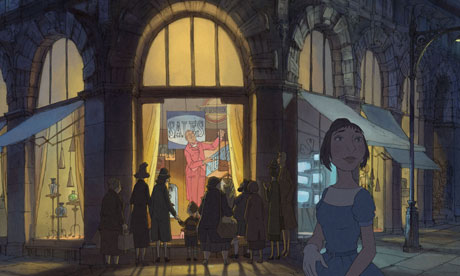
The Illusionist 2010


Mercy and I went out to see this tonight. You all probably know this, but it is based on an unfilmed script by Tati, the director of Mon Oncle and Play Time. I haven't seen any films by Tati, but I can see the influence of early film here. First of all, for all intents and purposes, it is a silent. And although it is about an older man caring for a younger as if she were his daughter, so without a romantic element, the main relationship has the flavor of Chaplain's Modern Times or City Lights.

I could see this being a classic silent film, and frankly, I think that animation is the perfect medium for this style of cinema. It is very reminiscent of the first half hour of Wall-E, and we can see Pixar using this same style of cinema, to even greater effect. But The Illusionist, instead of pressing for the quick plot or the quick laugh, is slower and yet still very entertaining, and thus it is utterly charming. This is a quiet film, and at first you wonder what it is about, then you wonder if it has a point, but it seduced me by the end. And it won me over with the ending. How wonderful and sad and touching. Passages of life and all that.

Nothing deep here, just a fine story well told. 4/5

Tuesday, November 16, 2010

Why I Love Movies

Posted by me on the Filmspotting Forum, where I dwell under the pseudonym, "Oldkid"

Film isn't just one thing. Painting is a visual art. Music is an audible art. Novels are a storytelling art. Film is all of this, or just one, or some combination of them. Film can have a black screen with no sound for thirty seconds and, depending on the context, it can have the deepest meaning or emotional impact. Film is the most complex art form we have, and perhaps only the Wii has the potential of giving us more. But for now, film is it.

Because of this, film has the greatest potential to be different things to different people. Everyone looking at "Starry Night" by Van Gogh sees something a little different. But that is nothing compared to a deeply rich film like Kieslowski's Blue or Coppola's Apocalypse Now. Some claim these to be among the greatest works of art of all time. Some won't appreciate them at all. But one thing is for certain, they speak to each of us differently, and for different reasons. That is what great art does. And the greatest of art sticks with us over time.

Given the complexity of film, it doesn't surprise me that our reactions to it is complex as well. I have my multiple rating system, and yet I find that even that system is inadequate to express my reaction to a film, as I gave Rachel Getting Married all top scores, but had more than twenty films I appreciated above it. What my marathon is helping me understand is that my appreciation for film is complicated enough that I can't dissect it precisely.

So I will have contradictions between my rating and my ranking. And you know why I don't mind that? Because it means that I am a human being-- complex and difficult to put in a box, like every other human being. And film is one of the few mediums that is rich enough to be able to compare to a complete human experience.

Our ratings of movies is funny, really. Do we rate our top 100 life events? How could we even judge such a thing? And, honestly, I see the best of films as being among my favorite life events. Yes, watching Spirited Away is as much a great event of my life as is watching my son be born or travelling to India. No, I won't rate these events, because they can't be measured like that. Nor can I say which event of my life I "enjoyed" the most, as if human experience can be judged on the level of "enjoyment". So, why should we judge film that way?

I really do like rating films. It's a pastime. But my determination of those which I put highest isn't limited to "enjoyment" nor to "greatness", however we might measure that. Rather, it is experience. Which film has become a part of my life more than others? Which film has become a memorable experience that I cherish? I have a hard time cherishing Rachel Getting Married as truly great I think that film is. But I can, and do, cherish the experience of Wendy and Lucy. And Nausicaa. And even Hunger and United 93-- although that may be hard to imagine.

I praise these filmmakers not just for technical ability or for the ability to take the most complex art form and create something truly wondrous with it. I praise them for enriching my life.

Wednesday, April 07, 2010

Why Spirited Away Is My Favorite Movie

Originally published in the Filmspotting Forum:

I really appreciate what a co-movie lover said recently, that as one gets to the top of one’s all time favorites list, that it becomes more personal.  I think that is really true.  My top ten is peppered with films that mean something important to me personally, but may not be as thrilling to others: Wendy and Lucy, The Mission, Being There.  They all carry double meaning for me: not only being well done films in their own right, but also expressing messages that are important to my life.  They not only speak to others in a general way, but they speak to my life directly in a way others might not understand.

So, with Spirited Away, I can give you the many reasons why this favorite film of my favorite director is generally excellent.  The animation is top notch, for one.  In re-watching Ponyo, I realized how much we are missing in focusing on computer animation instead of hand-drawn.  It has taken hand-drawn animation almost a hundred years to reach this place, while computer animation is still a teen.  Computer animation is wonderful, but it still has a long ways to go to establish a set of symbols we recognize as human emotion.  Miyazaki, however, has taken the step that Disney never did to make characters that are so real we feel that we know them.  This is certainly found in the writing and the voice acting (even the dubbed vocals!), but especially in the drawing.  It is not because they are more realistic looking, but because we grew up with this kind of animation, and Miyazaki, adding in expressions found in manga and older anime, has given us a visual language we can truly connect with.

Also, Spirited Away is one of the magnificent stories of imagination.  Setting aside the Japanese spiritism (which we will talk about in a moment), the amount of imagination that creates both the setting—a bath house for spirits—and specific unique characters such as No Face and the Radish Spirit, takes even the imaginative achievements of The Wizard of Oz, The Neverending Story and Labyrinth to new heights.  But more than that, this imaginary story is realized perfectly visually.  We can see this world existing.  This isn’t just an amusing tale with muppets or dressed up humans or poorly executed claymation.  This is another world that we have the opportunity to visit for a couple hours, and that experience gets added to our own.

I am just saying what could really be said of almost any of what I call “first tier” Miyazaki.  As well as this: Miyazaki’s characters are fully realized.  These are real people, even the spirits are of a type of character we recognize.  While there is sometimes comedy, it is the comedy of real life, not just pratfalls and one liners.  When there is achievement, it is rarely of the deeply heroic kind.  Rather, it is the daily success of those who act noble in small ways.  In this way, Miyazaki can connect to us in ways that blockbusters rarely do.  There are scenes in Miyazaki that, despite the outlandish settings, we can see as reflections of our lives.  Or our lives as we wish them to be.

There are two reasons, however, that Spirited Away especially speaks to me personally.  First of all is because we get to see Chihiro/Sen grow up.  I have three children of varying ages—17, 14 and 9—and they are all in different stages of development.  All of them are, in a sense, Chihiro.  At the beginning she is whiney and grumpy and self-centered.  The move is hard on her, her parents realize this, but it is necessary and they need her to stay strong through the difficulty.  But it is when her parents become self-centered that she is forced to grow up and become stronger than she—or her parents—ever thought she could be. 

Step by step we can see her shed her self-centeredness and fully take on the task of being responsible as the best of grown-ups are.  This is in contrast to Kiki of Kiki’s Delivery Service who begins the movie responsible and hard working.  Chihiro had to struggle through every step of the way.  First she expresses the moral outrage many young people express when they see grown ups acting irresponsibly.  Then she follows important instructions for how to live in the new world (something most fairy tale protagonists fail to do).  Then she learns boldness and tenacity in the face of threat.  Then she learns about hard work under someone else’s orders.  Then she learns about loving people even when they seem to not be lovable at times.  Then she learns about sacrifice for love.  And finally, she learns that intelligence balanced with care and wisdom is what truly saves the day. 

These are the life lessons I want all of my children to learn.  They are the lessons I see them learning, bit by bit.  The art of raising children is the art of seeing them become the Chihiro at the end of Spirited Away.  Every once in a while, as a parent, you can think to yourself, “I taught them that”, but most of the time you can’t.  These are lessons they have to learn themselves in the midst of the struggles they have to face in life.  But at the end of the movie, I am so proud of Chihiro, the buttons on my vest would burst, if I actually wore a vest.  She is my children.  My son becoming a responsible adult.  My oldest daughter being self-confident and self-reliant.  My youngest daughter learning to speak with respect and act in mercy.  This is all I hope for my children, in the strange worlds they will have to challenge.

My final reason is my strangest, and probably my most significant personal reason why I love this film.  I am only going to tell you guys, and I hope you won’t tell anyone else.  Not because I’d get in trouble, but because it’d be difficult to explain to my denomination and especially my congregation.  I could do it, but it wouldn’t do any good, so why bother?  Anyway, here it is:  the metaphysics of Spirited Away is pretty close to how I see the world functioning.

No, I don’t think that spirits have their own bath house and restaurants.  I don’t think that if humans eat spirit-food that they turn into pigs.  Nor do I think that young girls could be hired by someone to serve spirits.  I do, however, believe that there is an alternative universe, that runs on its own physics, that runs parallel to ours.  I do think that there are beings—and you could call them spirits—that live in that universe.  I also think that most of them are morally neutral, neither good nor bad, just trying to live their lives by their own values.  And I think that, at times, the two universes can converge, and allow communication between them.

This is not an unusual worldview, in the broader scheme of things.  Historically, before the Christian era, almost everyone in the world believed that summary of mine.  Certainly the ancient Jewish people did, as well as the first Jewish Christians.  It is Plato and his disciple Augustine that began to turn the world away from this notion.  They saw the spirit world as either the realm of ideas or as under the control of a single unified being.  Under their philosophy, the spirit world is neat and orderly, with everything politely lined up perfectly, within the mental grasp of humanity.

The ancient pagan world, the ancient first temple Judaism and the first century Christian church saw the spirit world as full of chaos as it was of spirits.  Each spirit had its own focus and desires and hopes.  They had their own realms of responsibility—jobs, if you will—of rivers and vegetation and winds and planetary beings.  Part of the spirit world is described as a sea, filled with dragons of chaos, battling against spirits who desired order and peace in both the spirit world and on earth.

Spirited Away, although a fantasy, is based on Japanese spiritism, a form of that ancient worldview.  In a twisted sense, the metaphysical basis of that movie is somewhat the same as the writers of the Bible.  This is how I see the world working.  I do not deny scientific reality—our world does operate on the laws of physics and development of life as discovered by scientists.  But looking at the physical realm is only a part of the story, like Chihiro’s parents seeing an abandoned amusement park. 

Some are content with this world and understanding its laws.  Others get to see the wonder and magic of the world below the surface, on a level not usually seen by eyes.  I wish to be one of the later.

Any who are concerned about my right to be a pastor, or my sanity, I would be glad to give the phone number of my denomination, and you can rat me out.  I understand.  Sometimes I don’t think I’m completely sane, either.  By the way, my wife already knows, so you don’t need to bother calling her.

Saturday, February 20, 2010

Hunger (2009, Steve McQueen director)

Hunger is the story of Bobby Sands, an Irish Republican put in prison for political violence against the British. While in prison, he leads protests, demanding to be treated as political prisoners—POWs— instead of just criminals. As the British refuse, he and his co-prisoners suffer the filthiest existence at their own hands. And then they endure forced bathings and the most inhumane searches. Finally, Bobby Sands decides on a hunger strike, for him and his comrades. And the horror of that fast is depicted gruesomely.

Obviously, this is not a movie for everyone. By the end of this film I began to wonder why I was putting myself through this torturous movie. Then I wondered why the director put in all of this amazing effort, with some of the greatest filmmaking talent ever, to put us through this experience with Bobby. It seems that Bobby is going through some of the most terrible self-torture, and for what? Political recognition? For the recognition of human rights, most of which were in their grasp at any point? To make some petty point?

But I realized that this was not a political film. The director depicts the suffering of the guards as well as the prisoners. The fact how everyone’s life involved was simply miserable because of this system, because of the determination of these men.

Finally, I realized what the movie is about. Endurance. It doesn’t matter what Bobby Sands was fighting for, or what methods he used. The point is simple—he was willing to go to whatever extent to obtain his goals. He had the steadfastness to put his body through any degradation, to suffer whatever the cost, to go through any pain or mutilation in order to achieve his goals. The ethic nature of the goals weren’t significant. But his determination was.

And, honestly, that’s what makes any cause great. Not the rightness of the cause, but the stark determination of the promoters of the cause. This is what made the civil rights movement great, as well as the Indian freedom protests—they were willing to suffer all, while not causing the suffering of anyone. This is what made the early Anabaptists great, the early Franciscans, the first century church. They all promoted their cause to the death, while never harming another.

I am ashamed of our modern day church. How little determination we have. How we speak so much about “balance” and “cycles”, as if the main text of Scripture we should be living out is not the Sermon on the Mount, but Ecclesiastes 3. We speak of the “discipline” of rest, but the fact is our lives are full of rest and we do little work for those who honestly need it. Pastors are the ultimate compromisers, seeking salaries and retirements and office hours, instead of trusting and giving.

I know true endurance. I once lived it. For fifteen years, I worked hard for the people on the street until my body, slowly but decidedly gave up on me—until my stress levels exploded. Surely, people would say, that is the need for balance. And I will say, no one’s body is meant to endure terrible stress for twelve or fifteen years. We just can’t keep doing it. Even Jesus only dealt with daily suffering for three years or so.

And this kind of endurance isn’t for everyone. It is a saintly life to support the spiritual athletes and soldiers—those who lay down their lives for the cause. But, honestly, we are in a time of the church where those who are willing to lay their lives down for the gospel are few. Very few.

What is the task? To love others, even if it means our own death.
What is the cost? Our lives, our sanity, our family, our “balance.
Who is willing to endure?

Who is willing to endure?

Tuesday, February 02, 2010

Culture of Oppression

I got this response to my post on the movie District 9 (edited):

Steve, this is very sad. the movie was very sad, inhumane, & cruel. I didn't like the movie, because it was inhumane & cruel & very brutal. I didn't like the guy who was in charge of trying to get the aliens out of their own homes & such. not until the very end, when he did what he did at the very end. i can't watch that movie again....I also saw Inglorious bastards, again, another movie that was way too brutal for my liking, and again, I saw that one because my friend had wanted to see it. I didn't care for it, nor was I interested in seeing that movie. I really don't like movies that are that kind of brutal. makes me sad & mad at the same time to see such cruelty at the hands of those humans that make me wish I wasn't part of their race. just like in Avatar. not all of the humans, but the majority of the humans, or the ones who worked for the RDA, made me sick....made me wish I wasn't part of their race. I actually found myself wishing I could be part of the Na'vi, the Omaticaya clanthat Truly sickens me to beyond words. to be part of the race that wants to wipe out what is pure & good, for the sake of greed....makes me sick to my stomache. why do those kind have to always try to destroy what is beautiful, pure, & natural? I just don't understand. there is No need to be cruel. I wish our world was like the Pandora world. minus the devastation & the greed of the real savages.

My response:
You make a good point about all three of the films mentioned. They all depict cruelty and insensitivity to a larger group of people. But in all of them, they are intended to display that cruelty so that we do not participate in it. In Avatar, it was clear that it is the U.S. cruelty against Native Americans, the Iraqis and others that are targeted. In District 9, it is apartheid that is targeted, but all kinds of racism is included-- any type of segregation, in fact. In Inglourious Basterds, the audience itself is shown as being cruel for wanting to see a gorefest of one particular group, even if they are Nazis. All three movies target us as the ones being cruel and unkind, as participants in our government, in purchasing the products of corporations that take advantage of indigenous peoples, as taking the fruits of years of racism and as moviegoers lusting after the death of our enemies. They all call us to repent of our own segregationism and racism and cruelty.

Sunday, January 24, 2010

The Spiritual Principles of Avatar

After two viewings of Avatar, I realized that there are some deep spiritual principles to be found in this film. If all you see is a tree-god and anti-American sentiment or a pretty weak statement about race, you're missing the deeper message. If you've seen the movie, read through these principles and see if they resonate with you, or your understanding of the film:

There is a empire, ruling the world, and its focus is to increase the wealth of a limited few, even if that hurts others. Everyone within the empire is a part of this system of greed, even if they superficially attempt to oppose it.

There is an alternative system which focuses on relationships, community and spiritual power.

The secret of the spiritual community is empathy. It is the sign that one is a part of the spiritual community, the unifying principle as well as the power. One has empathy with all life. Even if one must kill to survive, empathy requires that one feels the death of the other, and give it the respect that one would demand. The minimal amount of empathy is treating other’s life as one would be treated.

All empathy begins with understanding, with listening. Eventually, one can “see” another, deeply understanding the other, placing them as an equal in importance to oneself. Those who do not have the ability to understand, to empathize, are insane and cannot exist in the spiritual community.

But some relationships have deeper empathy, a full bond. In those relationships, two share their minds, their lives, their souls. And once bonded, the bond cannot be broken except through death. This is love.

The opposite to empathy, to bonding, is fear. To fear the other is to separate from the other. To listen to the other, one must receive the other; to accept the other, one must trust; to bond with the other one must unite.

Those of the empire cannot empathize. Yes, they can understand intellectually the other different from oneself, but they cannot truly see them as equals to themselves. They are so caught up in building their own empire for those like themselves, that they cannot see the other. So they outcast those who truly empathize, because the desires of empathy is opposite to the greed of the empire.

The evil empire wants the resources of the spiritual community and will ignore all the concerns of the spiritual community to get it. On the surface, the evil empire is more powerful than the spiritual community, and the spiritual community is in threat of extinction.

For the spiritual community to survive, there must be a mediator—one who knows what it is to be spiritual and one who has lived amidst the empire. He or she must be born of both worlds, but the Mediator does not straddle the fence. The Mediator must be on the side of the spiritual community, the weak, the oppressed, if they are to survive.

In the end, there will be conflict—disasterous conflict—between the empire and the spiritual community. And although the empire seems to have the greater power, the fact is that the spiritual community has a source that is at the core of all life. The only way to connect to that Source is through prayer. Thus, though the Mediator may use many different resources, the true power is found in prayer. Prayer is what changes the course for the spiritual community.

One must recognize, however, that the Source does not take sides between the empire and the spiritual community. The Source is on the side of all life, of order and balance. However, as long as the spiritual community is on the side of the Source, then the Source will act for them. And this action is more powerful than anything else they might conceive themselves.

Eventually, the spiritual community of empathy will rule the world and force the empire out. But this will only happen when the truly are united in Empathy. Only then will many in the Empire become united with the Source of all life, and seek balance.

Saturday, January 23, 2010

Why I Absolutely Despise Inglorious Basterds

I am a grudging fan of Quentin Tarantino.

His films are over-gory and glorify violence. They take the most dispicable characters and make you think about their motivations, which may not be the best kind of meditation. As a follower of Jesus, they made me uncomfortable, at best.

But after watching Pulp Fiction, I had to admit, he's amazing. The script is sparkling, brilliant, like a philosophy of religion class dressed as a 70s B movie. The characters revel in their hypocrisy, and allows us to look at our own, and as they explain their philosophy of life, they cause us to reflect on our own.

Kill Bill, especially Part 2, is the same. It was a Hollywood version of a Hong Kong violence fest, and then it becomes a reflection of life and motherhood and relationships and... wow. So much there to think about. And the possible connection to Buddhism is fantastic, even if Tarantino never meant to put that in.

Reservoir Dogs is intense, and the characters are perfect. And Deathproof? Well, it's a salute to 70's B movies and while revenge isn't my thing, it was cool to see women take charge in an action flick.

But after Inglorious Basterds I need to keep my distance away from Tarantino again.

Again, the script is brilliant, the dialog witty and sometimes deep and the film impossible to not look at in wonder. It begins with a teen fantasy premise, as Tarantino films often do-- a group of Jewish Americans in a created WWII scenario dropped in the middle of occupied France to do one thing-- kill as many Nazis as possible. And they do this task with glee.

However, compared to other Tarantino films, there is much less violence and gore. Most of the action takes place off the screen, which will disappoint some, I'm sure. But I was pleased, and was just waiting for the twist he often puts in his films, the moral glimpse at these violent purposes.

It never happened. (Here's the part where if you want to see the film, you stop reading, because I'm going to ruin it for you, if you continue) Sure, there was a twist. Unlike most WWII films, even the fantasy ones, they give a nod to reality, trying to fit their script to fit history as we know it. Not Tarantino. He shrugs off reality and gives us the end of the war as most Americans wished it would be like: A bloody, savage destruction of all the leaders of the Nazi party, including Hitler, with them all knowing that they are being killed by a Jew.

In the most amazing scene in the film, the climax, the beautiful face of Shoshanna is displayed on a screen of smoke, coming up from the fire that will burn down the theatre that all of the leaders of the Nazi party are locked in, and she is gleefully, almost Satanically, mocking them, "This is the face of Jewish vengeance!"

In this film, Tarantino goes back to an older form of the war epic-- there are good guys and there are bad guys. And the good guys, no matter how bloody they are or how many people they kill, they remain on the side of justice. And the bad guys are always bad and they always deserve to die. This fits a certain modern concept of war. Sure, the Nazis have been replaced with terrorists (read: Muslims) and the bad guys don't wear uniforms any more, but war is to create justice, and eventually to create peace because once you get rid of the bad guys then the world is free to do right again.

However, I've always been put off by that kind of movie, and Tarantino's is the most obvious example of it. This is because war doesn't just kill the bad guys-- some of them-- but a lot of misguided good people too. And both the "good" side and the "bad" side kill innocents-- on purpose at times. And what war really does is take the people interested in justice and peace and makes them the bad guys. People interested in doing evil to the other side, no matter what the cost, no matter what the personal moral sacrifice. They turn themselves into the very people they think they are destroying.

The best films on war recognize this. Both Full Metal Jacket and Apocalypse Now delve into the self-destruction of the one who participates in war, morally, spiritually and mentally. Saving Private Ryan and The Hurt Locker, while more subtle and realistic, clearly speak of a cost of war, of the personal sacrifice, and of a situation that any sane person would find impossible to live with.

Inglorious Basterds, however, is a full-on glorification of the worst of war. Although it is the company of Jews that are named the title, it is truly the Nazis themselves Tarantino sees as the inglorious bastards and they deserve to be killed in the most gruesome, bloody, horrific manner-- and Tarantino is going to give them violent justice in a way reality never did.

And he expects us to glory in it. To joyfully revel in shooting Hitler up to such a degree that his face couldn't even be pieced back together. I don't know how many people realize, however, that in sitting before this movie, reveling in all their deaths, that makes us just the same as those Nazis, reveling and chortling and shouting in glee over the hundreds of deaths of Americans.

Maybe I spoke too soon. Maybe Tarantino is more subtle than I realized. Maybe he truly is making that point. "If you enjoy this scene-- you are a Nazi too". It is true, really true. If we leave this movie happy to see this vengeance taken, then we are a Nazi, glorifying in the horrific destruction of our enemies. If, however, we are horrified, disgusted by the blood bath, then maybe there is some hope for us. Maybe it is simply a litmus test of our morality.

But somehow, I doubt it.

Wednesday, November 25, 2009

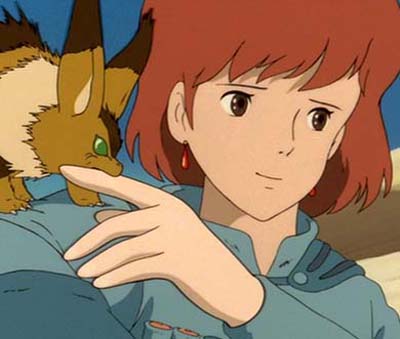
Nausicaa of the Valley of the Wind


This was first posted in the Filmspotting Forum, under my own thread, called "The Spirited Away Memorial Kimes Family Thanksgiving Miyazaki Marathon" (go ahead, say that three times fast!)

We kicked off the marathon tonight with Nausicaa of the Valley of the Wind.


Someone once mentioned that it is a pretty long title, but with Miyazaki one must expect that occasionally, such as Ponyo on the Cliffs By the Sea.

Nausicaa is Miyazaki's second feature film, and the first that begins using the themes that reflect his later films, among which are relationship between humanity and nature, flying machines, and war. It is based on a much longer, more complex manga written and drawn by Miyazaki.

Nausicaa takes place a thousand years after human war has poisoned the soil of earth to such a degree that poisoned jungles grew up, insects became gargantuan and huge protectors of nature were created-- Ohms. There are a number of human kingdoms, but the film deals with only three, Tolmekia-- a war-like kingdom that wants to rule the others; Pejite, the sworn enemies of Tolmekia; and the Valley of the Wind, a struggling utopia that gets caught up in the other kingdom's war.

Nausicaa herself is Miyazaki's saint-- the ultimate peacemaker. She is frankly an ideal Buddhist saint, who communes with all creatures, and seeks to make peace with all. She is especially focused on creating harmony between humanity and nature, trying to heal the 1000 year old rift. Throughout that thousand years, the poisoned jungles and humanity have been warring with each other, each attempting to overthrow the other's rule. Only Nausicaa realizes that humanity would perish without the jungle and that the jungle can flourish under humanity's enlightened guidance. Nausicaa is somehow able to understand the true nature of whatever she is facing. Instead of reacting to a threat, she responds to the fear behind the threat. Instead of seeing the death of the toxic jungle, she sees the beauty of it. She works with the nature of whatever is before her in order to create harmony with all creatures.

On the surface, this film seems weaker than other Miyazaki. Most Miyazaki are amazing in the detail of the world that was created for the film, and Nausicaa is no different in that. But the dialog is less rich and entertaining, the colors seem washed, and the style of animation is not as fluid as other Miyazaki films. Part of this, though not all, is due, I think because Miyazaki is trying to communicate the bleakness of the world in disharmony with nature. War-- both human and natural-- has taken its toll, draining life from everything. At the end of the film, [spoiler]after Nausicaa's messiahship is realized[/spoiler], the colors suddenly are brighter and everything changes.

Despite it's weaknesses (including a truly lame 80s score), this film is one of my favorites of all time. Despite it's bleakness, it is possibly the most joyful and optimistic of Miyazaki's films, and it plots out the general outline of hope for the future. Other Miyazaki films may communicate that war is bad and that bad guys aren't really all that bad, but this film actually lays out what would need to be done to end war, to change people's hearts. It isn't childish in any way, nor simplistic, if perhaps naive. It communicates that self sacrifice, listening to the another's heart, boldness for another's good and some basic reasoning can create a path out of the bleak world.

Perhaps I like this film because it is very much a religious philosophy I agree with. Perhaps it is because Nausicaa is such a strong character that to me she is the perfect moral hero. But with each time I watch it, the higher my estimation of it is.

5/5

Monday, November 16, 2009

Warning: This Post May Not Be Suitable for Children

This is a response to a discussion on Filmspotting Forum concerning the use of the term "bitch" in the movie Dear Zachary, which a nice, older man is using to describe the female killer of his son. The discussion begins with a woman who said she was sympathetic with the man until he said that and it made her question his gender politics. Others said that the use didn't have anything to do with gender politics, but with the emotional experience. I pipe in:

Everyone has gender politics, whether they admit it or not. Nevertheless, I don't know that him using that term reflects his gender politics.

His use of that term is certainly uncomfortable, even as his rare uses of CINECAST! are. From his internal perspective, I would hazard to guess that he is using strong language to express his strong emotion. I don't think he usually uses that language, especially in front of his wife, but the situation, he feels, merits it. And that, I think, we can all agree with.

And he is not using the term "bitch" to speak of any other woman than this woman who was so evil. If it were a man, he might use the term "bastard" or something else that was stronger. Would he ever use this term about his wife? We don't know. If he would, then perhaps we could say that he is expressing something about women in general. Instead, all we see is the use of the term against the most evil person he knew, and so he pulled out the strongest language. Could he have been gender neutral in the term he used? I don't know. Could we think of strong language about another evil person that was gender neutral? In the emotional situation? I doubt it.

I think that the instant reaction against the term "bitch" comes from having it used against women in a more casual way. When Kirk Russell uses it in Death Proof, he is clearly indicating his gender politics (as well as his actions). So we relate the use of the term with this kind of sexist pig, who uses the term casually, to indicate all women. But with this tragic figure of a grandfather, I don't think it reflects on him that same way.

Sunday, December 28, 2008

Merry Christmas!


Is Wall-E the best movie of 2008? Check out Steve's Interesting Stuff blog, here:
http://interestingbutpointlessstuff.blogspot.com/

Posted by Picasa